![PortStrategy[GreenPort]](https://www.portstrategy.com/wp-content/uploads/2026/09/PortStrategyGreenPort.svg)






DNV GL unveils new FLNG concept
DNV GL has developed a new unmanned floating LNG (FLNG) vessel concept, ‘Solitude’, said to improve maintenance, and safety and environmental compliance while at the same time saving on costs.
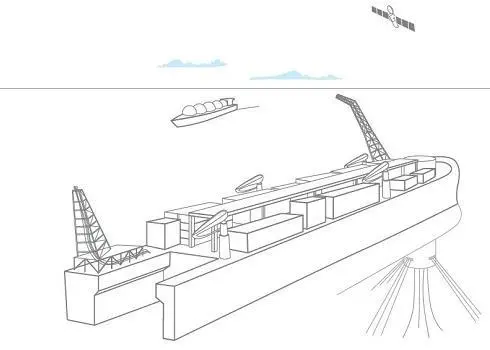
Solitude uses advanced technology to provide its power that would otherwise be generated by high-maintenance gas turbines. DNV GL says this technology is readily available and improves power generation reliability and reduces the unit’s environmental footprint.
“Solitude has been developed with maintainability foremost in mind,” said Elisabeth Tørstad, CEO, oil and gas, DNV GL. “By changing the focus from maximum efficiency to maximum reliability, and selecting robust processing options with built-in redundancy, we were able to develop a solution that ensures production levels and boosts the economic viability of FLNG projects.”
Equipment throughout the FLNG is modularised and monitored from shore with much of the routine maintenance and fault correction carried out by self-programming autonomous inspection and maintenance units. The topside has a system of rails that run along each process train, providing these robots with access to all the equipment.
Wireless sensor networks act as eyes, ears and noses, feeding information to a condition monitoring system that overseas fault detection, proactive maintenance and repair planning.
As there will be no one living on board or working on the topside during normal operation, DNV GL says the associated personal safety risks are eliminated.
“Operators are already controlling subsea installations and simple, fixed offshore installations from shore. Given the on-going advances in autonomous systems and remote operations, unmanned offshore installations are a natural development over the next few decades,” explained Ms Tørstad. “We see Solitude as a new opportunity for the future.”
DNV GL’s latest development is part of its ‘Extraordinary Innovation Projects’.
Related Articles
 ALTERNATIVE FUELS GREENPORT
 ALTERNATIVE FUELS GREENPORT
 ALTERNATIVE FUELS GREENPORT