![PortStrategy[GreenPort]](https://www.portstrategy.com/wp-content/uploads/2026/09/PortStrategyGreenPort.svg)




First ship-to-ship bunkering at German port
The first ship-to-ship LNG bunkering operation in a German port has taken place.
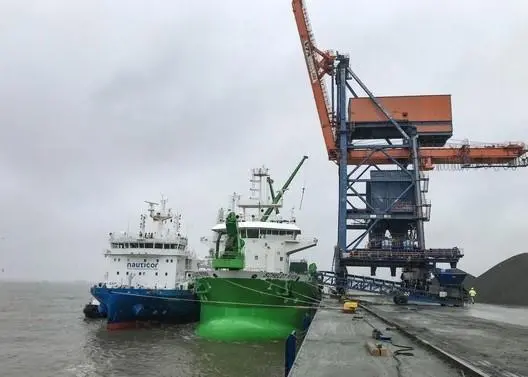
This operation at Elbehafen Brunsbüttel, part of Brunsbüttel Ports GmbH, involved trailing suction hopper dredger (TSHD) Scheldt River receiving LNG from Babcock Schulte Energy-owned bunker supply vessel (BSV) Kairos, operated on behalf of Nauticor.
Scheldt River, owned and operated by the DEME Group, received 300 cbm of LNG. At the beginning of October, the DEME Group and Nauticor signed a framework agreement for the supply of LNG with the BSV Kairos to DEME’s fleet of newbuild vessels with LNG propulsion. The first ship-to-ship LNG bunkering operation in a German port marks the start for an extended cooperation.
Mahinde Abeynaike, CEO of Nauticor, said: “Our team has been able to achieve another milestone in the development of a comprehensive LNG supply infrastructure with the successful execution of the first ship-to-ship LNG bunkering operation in Germany.
“The operations with the world’s largest LNG BSV Kairos allow for flexible, safe, and efficient supply of the environmentally friendly fuel to marine customers.
“A variety of marine customers are already utilizing this service, including product tankers, container vessels, ferries, and special purpose vessels, such as the trailing suction hopper dredger Scheldt River.“
Scheldt River is currently conducting maintenance dredging works on the Lower Elbe. In the past, the vessel has received LNG from Nauticor through truck-to-ship bunkering operations.
Important milestone
The possibility to supply LNG through a ship-to-ship bunkering operation marks an important milestone for the shipping sector in Germany in general.
By using larger BSVs, it becomes practical both economically and ecologically to supply larger vessels with significant amounts of LNG. Previous LNG bunkering operations in Germany were conducted solely through the truck-to-ship method.
Frank Schnabel, managing director at Brunsbüttel Ports GmbH/SCHRAMM group, said: “After having several truck-to-ship LNG bunkering operations on our premises, we have now been able to prove that ship-to-ship bunkering operations are possible in our port as well. All legal and operational prerequisities are in place as a result of the fruitful cooperation with the experts from Nauticor, Brunsbüttel Ports, and the Agency for Coastal Defense, National Parks and Marine Conservation for Schleswig-Holstein (LKN) as the responsible administrative authority.”
The German LNG Terminal GmbH continues to plan activities for a combined LNG import and distribution terminal in Brunsbüttel. In the future, the supply of LNG to marine customers would profit from the existence of such a terminal, since it is foreseen that LNG bunker supply vessels, such as Kairos, can load LNG as cargo directly at the terminal.

Related Articles
 ALTERNATIVE FUELS GREENPORT
 ALTERNATIVE FUELS GREENPORT
 ALTERNATIVE FUELS GREENPORT