![PortStrategy[GreenPort]](https://www.portstrategy.com/wp-content/uploads/2026/09/PortStrategyGreenPort.svg)


Eco train aids POLB clean air plan
Investment in an ultra-low emissions locomotive engine by a Port of Long Beach (POLB) operator will contribute towards the San Pedro Bay Ports Clean Air Action Plan.
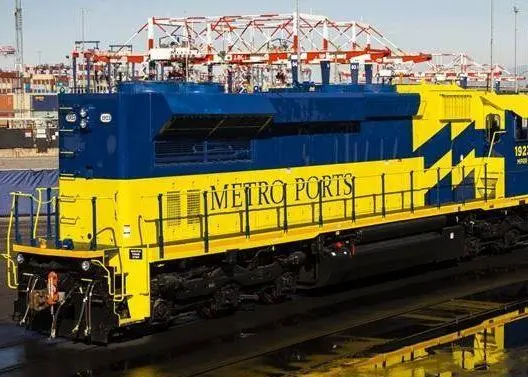
This is the second ultra-low emissions (Tier 4) engine that terminal operator and stevedoring company Metro Ports has brought for its Pier ‘G’ operations at the Port of Long Beach. The first unit was produced by National Railway Equipment Company.
“It’s our honour to be operating in lock-step with the Port of Long Beach and their award-winning Clean Air Action Plan. Metro Ports recognizes its position as an industry leader and seeks to inspire awareness with its early adoption of the newest technology in clean-air equipment,” said Robert Dickey, president of Metro Ports.
The ‘Tier’ number is a classification assigned to operating equipment by the U.S. Environmental Protection Agency (EPA), with a higher tier being assigned to cleaner-burning equipment with lower emissions. These improvements are not required by regulatory agencies but a voluntary, proactive step to lead the charge in environmental stewardship. Tier 4 represents a significant improvement in air quality emissions over the local industry standard of currently operating Tier 2 equipment.
Mario Cordero, executive director of POLB, said: “Through this acquisition, Metro continues to enhance its leadership position in the demonstration and deployment of clean technology equipment. Such efforts will help the Port, in partnership with operators like Metro, meet and exceed its CAAP goals.”
The new locomotive’s addition is a project four years in the making, involving Knoxville Locomotive Works and the South Coast Air Quality Management District, who coordinated to procure grant funds provided by the EPA earmarked for projects that achieve significant reductions in diesel emissions. These funds contributed to cover the total cost of the US$3.17m for the purchase.
Metro Ports, which operates at multiple locations across the US, expects to reduce air emissions such as nitrogen oxides (NOx), particulate matter (PM) and reactive organic gas (ROG) by over 4.5t over the next 15 years.
The San Pedro Bay Ports Clean Air Action Plan was enacted in 2006 by the ports of Los Angeles and Long Beach.
Related Articles
 ALTERNATIVE FUELS GREENPORT
 OPERATIONS
 ALTERNATIVE FUELS GREENPORT