![PortStrategy[GreenPort]](https://www.portstrategy.com/wp-content/uploads/2026/09/PortStrategyGreenPort.svg)






Electric exploration progresses in California
A major Port of Oakland freight hauler plans to add two new electric trucks to its operations by October to discover if zero-emission battery-powered tractors can haul cargo containers over highways.
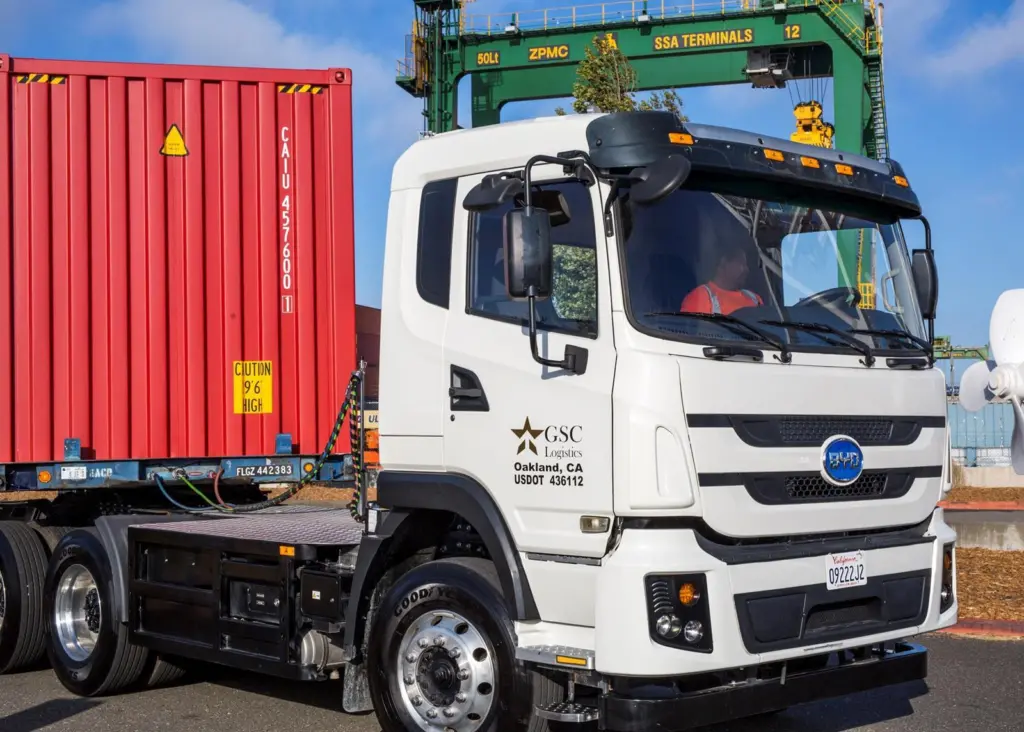
GSC Logistics will acquire two 13t electric trucks that will both have twin 241hp battery-driven motors. Based at the Californian port, each truck would be able to travel 125 miles on a battery charge.
“Our first tractor is fine moving containers around the Port…it does the job,” said Brandon Taylor director of transportation at GSC. “Now we want to test these new trucks on the road – the manufacturer says they can haul fully loaded containers 55 miles per hour up a steep grade.”
The trucks, that will be purchased with assistance from state grants, would be heavier than GSC’s first model due to battery weight.
Long haul investment
GSC, which hauls the equivalent of 120,000 20-foot-containers annually through Oakland, began electric truck testing 18 months ago. The company expects its second battery-powered rig this month, with a third to arrive in the autumn.
Port of Oakland environmental scientists are following the trial closely as battery-powered tractors are expected to factor in Oakland’s stated quest for zero-emission cargo handling. GSC, alongside Impact Transportation, Oakland Maritime Support Services and ConGlobal currently operate electric tractors near the port. The port projected that there could be as many as 20 battery-powered trucks hauling containers by year-end.
“We’re grateful to these firms for taking a chance on battery power,” said Richard Sinkoff, environmental programmes and planning director at Port of Oakland. “We can’t get to zero emissions without pioneers to lead the charge.”
It’s hoped that emission-free electric trucks can someday replace the 6,000 diesel tractors hauling containers in Oakland. However, the Port of Oakland stated that industry experts believe this won’t happen until costs are reduced, trucks can go further on a single charge and battery-charging infrastructure is developed.
“The technology and capability of electric tractors is moving fast,” said Mr Taylor. “But the ability of a truck owner-operator to buy an electric truck and have the electrical infrastructure to support it may be years away.”
Related Articles
 ALTERNATIVE FUELS GREENPORT
 OPERATIONS
 ALTERNATIVE FUELS GREENPORT