![PortStrategy[GreenPort]](https://www.portstrategy.com/wp-content/uploads/2026/09/PortStrategyGreenPort.svg)




Going hybrid?
. In a bid to develop clean terminal equipment, several US ports are now investigating alternative power systems, including hybrid technology.
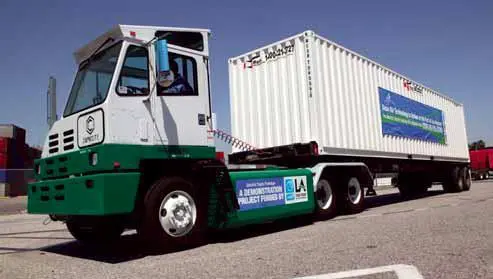
According to the US Environmental Protection Agency (EPA), hydraulic hybrid drive systems could reduce emissions by 40 percent, as well as improve fuel economy by 50-60 percent – and reduce greenhouse gases comparably. Speaking at the C40 Climate Change conference in Rotterdam in July, Richard Larrabee, the Director of the Commerce Department at the Port Authority of NY/ NJ, reported that hybrid systems, equipped with features such as regenerative braking and engine auto-stop, could dramatically improve air quality and fuel economy not only at NY/NJ’s marine terminals, but also at other transportation facilities, such as distribution centers and rail yard. “The Port Authority’s of New York and New Jersey (NY&NJ) marine terminal facilities are located within an area classified by the USEPA as a non-attainment area,” he explained, “which is defined as a locality where air pollution levels exceed national standards. Cargo handling equipment, together with the trucks that are coming to port to pick up or discharge cargo, is the second largest source of air pollution and greenhouse gas emissions in the ports.” Explaining the potential benefits of hybrid technology for port equipment, Joe Monaco, Manager, Environmental Projects, Port of NY/NJ, says: “The use of yard hostlers, which make frequent starts, stops and have a high percentage of idling time, are excellent operating conditions for this technology because the act of applying the vehicle’s brakes increases the storage of regenerative energy needed to propel the vehicle without utilizing the diesel engine.” Larrabee believes that hybrid technology holds great promise, but their use also raises several questions: can they meet operational requirements? Are they commercially viable? Can a business case be made for them?
Howland Hook and APM Terminals teams
Two teams within the Port of NY/NJ – at Howland Hook and APM Terminals – have been formed to research the opportunities and challenges associated with applying hybrid technology to cargo handling equipment, and the potential for its commercialization. The Howland Hook team, which includes The Port Authority of New York and New Jersey, the New York Power Authority, the New York City Department of Transportation, Kalmar Industries, CalStart and New York Container Terminal, will select a winning vendor’s proposal to configure and integrate a hybrid drive system into the Kalmar/Ottawa 4×2 terminal tractor. They are working jointly with a corresponding team based in the Port of Long Beach. “This is an exciting time to be looking into technology that will improve our air quality and reduce the company’s’ fuel costs,” notes Charlie Priscu NYCT Power Equipment Manager. The team at APM Terminal will focus on retrofitting the Kalmar/Ottowa 4×2 terminal tractor hydraulic hybrid technology. This particular technology, which has been spearheaded by the US EPA Ann Arbor technology laboratories, includes two power sources that propel a vehicle: a small fuel efficient diesel combustion engine and hydraulic components. In addition to APM Terminals and the PA of NY/NJ, team members include the US EPA, Kalmar, Parker Hannifin (a manufacturer of truck hydraulic components, systems and hybrid drives), and FEV Inc (an engineering contractor that designs and develops power train and vehicle technologies). Hydraulic hybrid technology replaces a conventional drive train with a hydraulic one, which eliminates the need for a mechanical transmission and driveline. Laboratory testing conducted by US EPA has demonstrated that a hydraulic hybrid technology applied to a United Parcel Service (UPS) delivery vehicle in Diamond Bar, California, has achieved a 60 to 70 percent improvement in fuel economy and a 40 percent reduction in emissions, compared to a conventional UPS vehicle. “We estimate similar results can be achieved for yard hostlers,” notes Monaco. The type of hybrid drive that should be used in the terminals will be determined through a solicitation process and may prove to be either electric, via a battery, or hydraulic.
US West Coast projects
Other systems for reducing pollution are being investigated by certain ports on the US West Coast. The Port of Long Beach (POLB) is implementing the LNG yard hostler demonstration and commercialization project, aimed at reducing emissions from diesel equipment that operates at the port. This project will retrofit three yard hostlers at the POLB with on-road certified liquefied natural gas (LNG) engines and will compare vehicle emissions and performance with diesel yard hostlers. Following the testing and evaluation phase, the project partners will assess a business case to expand the use of LNG yard hostlers at other marine terminals and similar applications. The ports of Seattle and Tacoma jointly purchased one electric yard hostler ($200,000), which will be used/studied at a Seattle marine terminal for six months, then at a Tacoma marine terminal for the next six months. As reported in the May/June 2008 issue of GreenPort journal, the Port of Los Angeles has approved a three year agreement with Balqon Corporation that will fund and implement Phase II and III of the Electric Truck Program. Phase I consisted of a joint project of the Air Quality Management District and the Port of Los Angeles to fabricate and test a single all-electric truck tractor. Phase II includes performance testing of the current test vehicle in the TraPac container terminal and the Port’s purchase of 20 electric yard hostlers, at a cost of $189,950 per vehicle, possessing specifications approved by the Port to be deployed in a “green terminal.” Phase III consists of the Port’s purchase of fi ve on-road electric trucks, at a cost of $208,500 per vehicle. The electric truck was developed by Santa Ana-based Balqon in a jointly funded effort led by the port and the South Coast Air Quality Management District. Balqon has agreed to establish an electric truck assembly plant near the port, where cargo container traffic is expected to double by 2020. The electric truck, which takes about three hours to charge, has a range of about 30 miles while pulling a 60,000-pound cargo container, and about 60 miles empty. It costs about 20 cents a mile to operate, or about four to nine times less than a diesel truck, depending on fluctuating fuel costs and operating conditions.
Related Articles
 ALTERNATIVE FUELS GREENPORT
 OPERATIONS
 ALTERNATIVE FUELS GREENPORT