![PortStrategy[GreenPort]](https://www.portstrategy.com/wp-content/uploads/2026/09/PortStrategyGreenPort.svg)



Ships slow down for cleaner California air
The Port of Long Beach has recognised more than 135 shipping lines for voluntarily participating in its programme offering financial incentives for cargo vessels to slow down near the port to reduce air pollution.
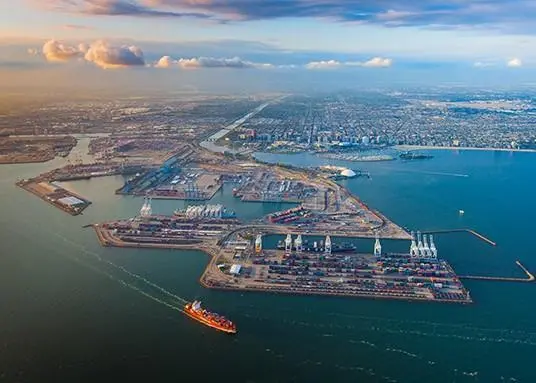
The Green Flag Incentive Program was initiated by the Port in 2005. Since then, the port has also started including vessel speed reduction for ships as a requirement of new leases with its terminal operator tenants. It’s estimated that the slowing of cargo ships at the Port of Long Beach prevents the emission of 45,000t of greenhouse gases and 1,000t of general air pollutants each year, contributing to the port’s Clean Air Action Plan.
“Our shipping line partners play an important role in our efforts to improve air quality at the Port and our surrounding communities,” said Tracy Egoscue, president of the Long Beach Board of Harbor Commissioners. “We’ve made dramatic reductions in air pollution emissions thanks to the industry and its enthusiastic cooperation.”
Green flag awards
Ocean carriers have been presented with green flags for opting into the incentive programme last year by slowing ships to 12 knots or less within 20 or 40 nautical miles of the port.
In 2018, 136 shipping lines met or exceeded the programme’s required 90% participation rate at either 20 or 40 nautical miles. Within 20 nautical miles, 95.8% of vessels slowed down, while 91.14% slowed down within 40 nautical miles.
Ocean carriers achieving a 90% or higher compliance rate are eligible for a 25% reduction in dockage rates at the 40 nautical mile mark, while those slowing down within 20 nautical miles receive a 15% break in fees.
Related Articles
 ALTERNATIVE FUELS GREENPORT
 OPERATIONS
 ALTERNATIVE FUELS GREENPORT