![PortStrategy[GreenPort]](https://www.portstrategy.com/wp-content/uploads/2026/09/PortStrategyGreenPort.svg)




The port of Arica: Working towards an environmentally efficient port
Last year, the port of Arica became the 4th Chilean port regarding the transfer of cargo volume. Due to its location, in the extreme north of Chile, Arica seaport is the port of exit of Bolivian cargo towards the Pacific, says Francisco Javier Gonzalez, Chairman of the Arica Port Company.
When looking in the past, the port of Arica hasn´t had a successful environmental management. This was due to the transfer of mineral concentrates by train or trucks, which, for a long time, caused environmental problems, especially in the railway factory of Arica-La Paz, which is located in the urban zone of Arica city where the minerals were stockpiled in the open air.
In that period, Regulations for handling minerals were not required, which means that various sectors with mineral stockpiles contained high contamination levels.
This is why in recent years, one of the main challenges of Arica port has been to create a sustainable environmental development policy that would make an end of that historic trace of contamination caused by the handling and storing of mineral concentrates, which was not consistent with current minimum standards.
Leader in environmental management
As from 2005, the work performed by the Board of Arica Port Company and the employees resulted in positive figures, projects and initiatives, which transformed the company into an undisputable leader in environmental management among other companies in the region and the country.
A few years later, the port received a “Green Company Award” in 2010, which was, so far, the biggest acknowledgment for the environmental management of the port and which confirmed its status of a Green Port, becoming the first one in Chile, in this category.
In order to fulfil the requirements, the port of Arica had invested more than 9 million USD during 8 years in the construction of hermetically sealed storages for mineral stockpiles. Furthermore, it invested in conveyor belt and pavement of more than 90% of the terminal, which makes it one of the few ports in Latin America under these conditions.
Following its work on environmental protection, the port of Arica obtained in 2012 the Certificate on carbon footprint measurement, the first one in Latin America. The certification allows the port to carry out necessary activities that mitigate the impact generated by its operations on employees and the environment.
Due to the investments of the Arica Port Company together with its concessionaires; the Arica Port Terminal and Somarco Company, the port is nowadays 100% sealed and the minerals are stockpiled in hermetical storage, which removes the mineral emissions. Through all these efforts to protect its employees and the community against the potential impact of polymetal, the Arica Port Company and its concessionaire the Arica Port Terminal committed themselves to implement measurements that lead to a sustainable port management.
Being defined as a Green Port, which cares for the environment and its community, the port of Arica has initially been in a position of developing environmental remediation initiatives, but which in time turned into a commitment to have the best port “environmental management”. In addition, the port has supported the implementation of normative standards that regulate and decrease the impact of port activities.
Carbon footprint
Climate change has been described as the greatest challenge that humanity has ever faced, representing the largest negative externality at global level. With reasonable certainty, many studies indicate that climate change is a natural processes that, over a period of 4.600 million years, has made the earth undergo a series of climatic fluctuations, being the last decade one of the warmest, as shown in the instrumental records of the global surface temperature (since 1850). Furthermore, due to human activities, the global emission of greenhouse gases has grown since pre-industrial times, with an increase of 70% between 1970 and 2004, primarily due to the industrial development and increasing use of fossil fuel.
In 2011, the port of Arica was certified in measuring carbon footprint, and elaborated an inventory that considered the totality of the emissions generated by maritime-port operations, within Scope 1*, 2* and 3*, thus complementing the measurements made in 2009 and 2010. This implied a reduction of carbon emissions up to 5,2% within the first year.
*Scope 1 corresponds to fossil fuels consumption and refrigerant gases. Most emissions are generated by 12 diesel consuming container cranes that operate within the port (33%), 3 Gottwald harbour cranes with 24% of the emissions, 14 truck-tractor (11%) and 4 frontal lifters (9%). The 28 forklifts that operate with LPG contribute to 8% of the Scope 1 emissions.
*Scope 2 refers to emissions from electricity consumption during the night, the lighting in operational area, the security, the staff offices and port agents that work 24 hours and the electricity supply of refrigerated containers.
*Scope 3 includes other emissions that are not under the direct control of the port company, but which are nevertheless part of the activities at the port, such as emissions from ships and trucks that arrive to the port for cargo loading and unloading
The GHG inventory was developed by using methodologies that are globally recognised, such as: Greenhouse Gas Protocol, Corporate Value Chain (Scope 3) Accounting and Reporting Standard (World Resources Institute/ World Business Council on Sustainable Development). Additionally, the Carbon Footprint Guide for Ports, elaborated by Carbon Footprint Working Group from the World Ports Climate Initiative (WPCI), was considered since some of its members are also concessionaires of port of Arica. In 2012, the port had a total CO2 equivalent emission of 20.681 tonnes, which were distributed as follows:
Scope2012 (tCO2e)% Scope 14.66023 Scope 21.0225 Scope 314.99972 TOTAL20.681100
If we compare closely the results with GHG reports from other ports, it can be concluded that the highest emission rate is registered in Scope 3, beyond the direct control of the port management. For that reason the approach concentrates on reducing emissions from Scope 1 and 2 by developing initiatives that seek to reduce the consumption of fossil fuels and electricity.
ISO 50001
The port’s energy department is constantly working on long term projects, with a focus on costs and investments return, thus forcing companies to plan their investments and anticipate the challenges.
In this context, the need arises for all port operations and productive tasks to be managed under the environmental and energy normative. Moreover, the port is ready to become certified by the international standard that is recognised and integrated by the Chilean law, NCh – ISO 50.001, and which consists of implementing the Energy Management System (hereinafter EMS) which controls, optimises and improves the energy use and consumption, thus contributes to the reduction of carbon footprint.
In October 2012, the Arica Port Company and its concessionaire; the Arica Port Terminal have signed a cooperation agreement with Chilean Energy Efficiency Agency (AChEE) in order to implement the ISO 50.001 standard. During the implementation process, a new organisational policy was elaborated, as well as objectives and energy targets, systemic and control procedures and instructions, while modifying the Integrated Management System Guideline, among other things.
An energy baseline was established, which was used as a basis for comparison in the following period. This document resumes overall information, which generates estimations of annual consumptions and evaluates the use and significant consumption of energy. All this is required by the ISO standard and Energy Performance Indicators (EPI).
Six EPIs were defined for the port of Arica in order to monitor the energy efficiency:
1. KWh Port / Mobilised tons
2. KWh Administration building / Cooling Degree Day
3. Diesel Port / Mobilised tonnes
4. Diesel Gottwald cranes/ Mobilised tonnes, except minerals
5. Diesel other machines / Mobilised tonnes, except minerals
6. LPG Forklifts / Consolidated + deconsolidated container tonnes
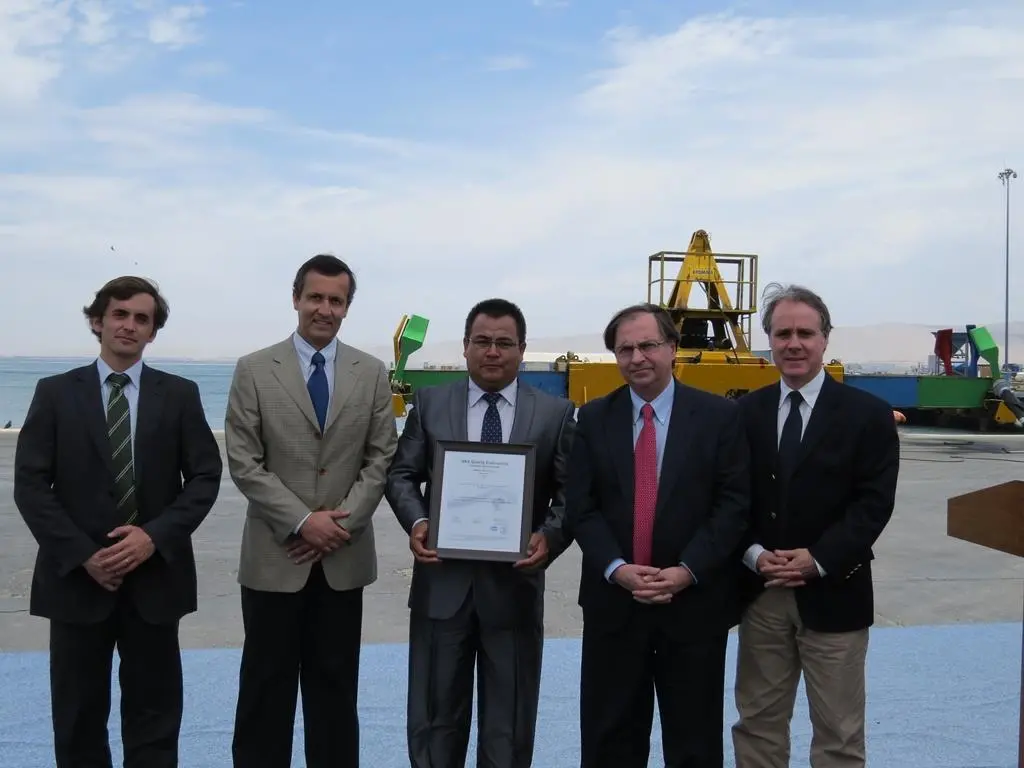
For the certification process, the external audit was conducted by ABS Quality Evaluations Company and consisted of two phases for the revision of the port’s Energy Management System. During phase 1, the level of compliance with the Regulations requirements was revised in general terms.
Subsequently, in phase 2, the certification audit made a full and detailed revision of the ISO 50.001 Regulation requirements, such as energy policy, objectives and targets, legal requirements, energy review, baseline, EPI, opportunities for improvement, project designs, energy criteria for goods and/or service acquisition, internal audit process, etc.
In November 2013, the port of Arica obtained the ISO 50.0001 certificate, and became the first port certified with an Energy Management System in Latin America and the world.
The port of Arica will continue to build its future on a solid foundation, while protecting the environment and the health of its workers, because its commitment is to remain the Green Port of Chile.
Related Articles
 ALTERNATIVE FUELS GREENPORT
 OPERATIONS
 ALTERNATIVE FUELS GREENPORT