![PortStrategy[GreenPort]](https://www.portstrategy.com/wp-content/uploads/2026/09/PortStrategyGreenPort.svg)





Alternative to Chinese medicine
It is easy to be lured by the headline figures emanating from China, but should investors be turning to Southeast Asia to reap rewards? Peter Trevalyn investigates
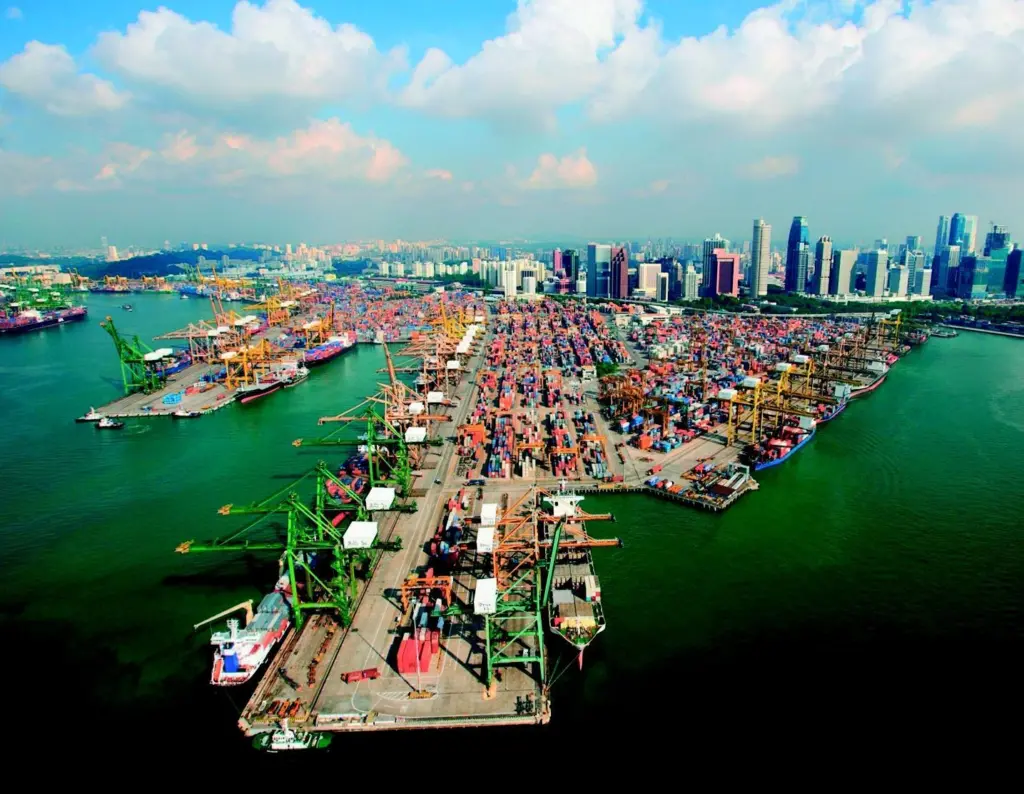
On the face of it, when looking at investment opportunities in China as compared with Southeast Asia, it should be a nobrainer. But have today’s investors missed the boat on China?
The most prominent stars in the China terminal constellation in recent months have been the trio of Tianjin, Dalian and Qingdao.
Just a few years ago, the northeast Chinese facilities were mere feeder ports. Now, as a result of the massive expansion of the Chinese economy and, more specifically, the central government’s five-yearplans that have targeted the region for development, they are all major container destinations in their own right.
What makes these ports interesting from the private investors’ point of view is how, under the 11th Five-Year-Plan, expansion is now being encouraged. In fact, all three ports have looked to the Hong Kong stock exchange in order to fund ambitious expansion plans. Although only two have gone through the process thus far.
And the punters lapped it up. When Tianjin Port Development Holdings, operator of China’s fifth largest port, listed on the Hong Kong Stock exchange in May this year, the institutional tranche alone was 40 times oversubscribed with orders worth $2.3bn.
But it was the fact that the retail tranche was 1,700 times oversubscribed that really shook the market. The 578m shares, which began trading on May 24, raised $125m. The share price subsequently soared 26% on the first day of trading.
Tianjin Port is already the 16th busiest container port after remarkable growth in 2005, when throughput grew 25.8% to 3.81m teu.
Official recognition always helps in China, and Tianjin got that in June 2005 when Prime Minister Wen Jiabao openly backed the port’s expansion.
Shortly after the commendation, Tianjin formally applied to Beijing for permission to develop a second free trade port covering up to 33 sq km, which it will develop with a $4.93bn investment to pay for 15 terminals. By 2007, throughput capacity will increase to 6.5m teu and 10m teu by 2010.
In terms of institutional investment, the usual suspects were of course in evidence. Hutchison Port Holdings, the world’s largest terminal operator took a 10% slice of the pie.
So good was the response that the company promptly put another 86.7m shares onto the market, raising another HK$159m.
Most importantly, Tianjin Port showed it was serious about doing something constructive with the money. It immediately announced a $73m investment in a 40% stake in the Beigangchi facility, raising the company’s total capacity to 4.5m teu.
Hutchison and Cosco are expected to take up the slack.
Tianjin Port Development also has a 30% stake in a three-berth terminal jointly invested with Cosco Pacific and APM terminals.
Dalian Port’s listing at the Hong Kong stock exchange preceded that of Tianjin by a month, generating a robust profit for its four strategic investors – NYK Line, China Shipping Terminal Development, PSA and Hutchison.
Again, the retail market was much enthused. Share prices soared 70% on the first day of trading after the IPO earned $303.8m.
Dalian was always going to be an interesting proposition for investors with an 11-berth container terminal and an oil terminal.
But Dalian intends to use the proceeds to finance the construction of four container berths at Dayao Bay and 12 crude oil storage tanks at Xingang In the short term, Dalian has been deemed a little overpriced.
With a 22.6% increase in container throughput, up to 6.30m teu in 2005, Qingdao is the leading port in the all important Bohai Basin.
As part of China’s 11th Five-Year Plan, the National development Reform Commission made recommendations that the port should be expanded.
In 2004, AP Moller, P&O Ports and Cosco Pacific signed a $1bn deal. Since the deal, DP World acquired P&O Ports share.
In fact DP World has had two bites of the cherry in recent months. In November last year the company signed up for a green field site to develop a new terminal with a 1,320m quay with four berths and a handling capacity of 2m teu. The new terminal is pegged to start operations in 2008.
Subsequently, DP World’s takeover of P&O Ports meant the Dubai-based state-owned operator inherited a share in the Qingdao Qianwan Terminal, where China Merchants also has a stake.
But where Qingdao has been really smart is in its move to form joint ventures with a sprinkling of other minor ports along the Shandong coast, thus containing the competition.
But what of the long-term future for these three stars in China’s port firmament?
The greatest risk is overinvestment and this is where investors might do well to set their sights elsewhere, for example Southeast Asia. To take Tianjin as an example, according to the authorities the port will have an 8m teu capacity by 2010. However, it is well known that existing ports manage to handle far more boxes than their nominal capacity would indicate.
In the case of Tianjin, local operators suggest that the actual capacity will be close to 15m teu by 2010, a figure greater than the UK, France and Spain put together.
Dalian is perhaps where the real threat of overcapacity exists, despite a great deal of investment in industries in the region by the Japanese.
While the headline figures have been attractive, the fear is that the real money has already been made in China. But with conservative estimates putting the Bohai region at close to 40m teu annually in five years time and the ongoing patronage of Chinese trade with its Southeast Asian neighbours, investment in Southeast Asia’s ports could now offer real alternative to China.
Related Articles
 CONCESSIONS & INVESTMENTS
 CONTAINER & CARGO HANDLING
 TERMINAL OPERATIONS