![PortStrategy[GreenPort]](https://www.portstrategy.com/wp-content/uploads/2026/09/PortStrategyGreenPort.svg)





Choosing sides
South Asian ports are getting, sometimes unwanted, helping hands, finds Stevie Knight
Port development in South Asia is steadily moving from terminal construction into an attempt to create complete, cohesive systems. But this can make the neighbours uneasy.
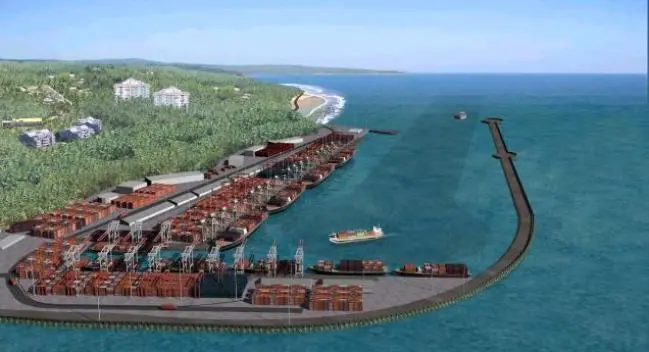
The go-ahead for the controversial Colombo Port City in Sri Lanka may not be so much about any natural warming of relations between Sri Lanka and China as the painful realisation that the former has few choices. Envisaged as part of the Chinese Maritime Silk Road, the 1,310 acre ‘Port City’ incorporates a financial hub, hotels, shopping centres and residential complexes alongside three, 1.2 km long terminals which will eventually raise capacity from 4.5m teu to 12m teu.
The plan, explains Mark Yong of BMT Asia Pacific, had been held off by Sri Lanka’s previous regime which was unwilling to carry the burden of more high-cost Chinese loans.
But spiralling debt – over 95% of its revenue is going toward paying back its borrowing – has resulted in virtually no wiggle room and a change of government has led to policy being reversed. As Dr Yong says, Sri Lankan infrastructure is desperate for a leg up “despite the controversy”, adding that the Chinese are “looking beyond port projects to new cities; they are now interested in creating entire ecosystems”.
Despite this, Sri Lanka is keen to put a good face on it and show that Colombo Port City is not just “a China-Sri Lanka venture” but has something in it for everybody says the island’s Prime Minister Ranil Wickremesinghe. He underlined that this includes disgruntled neighbour India which has been trying to wrest its cargo from Sri Lanka for years. Colombo handles around 70% of India’s transhipment cargo. So, the development, which will allow the business community entry via a 40% stock market floatation, is being pushed as a way to get India in on the deal.
However, the carrot might not be enough to change India’s mood, especially since Sri Lanka may also have to concede to China’s request for 15,000 acres of land surrounding the underutilised Hambantota port, another Chinese-funded project. The idea is to create a special economic zone that will bring in both industry – and a million workers – in order to kickstart Hambantota’s growth and competition with Colombo.
Further, the project lies on the Gulf-to-Malacca shipping lane that carries almost a third of the world sea freight. An enlarged presence in Hambantota gives China an important position against a fuel line on which India is heavily reliant.
China investment
And there’s more Chinese-backed transhipment development in Pakistan, probably adding to India’s suspicion that the Silk Road could tighten into a knot. The $46bn Gwadar port is the launch pad for the China-Pakistan Economic Corridor (CPEC) a 3,000 km road, rail and pipeline link that runs all the way to north-western China. However, Dr Yong explains the association is not just a matter of the money alone: “Pakistan probably feels it needs a political partner.”
The ports’ dual nature does give people pause: most will admit that an economic Chinese presence could be converted to a tactical one. As Suren Vakil of BMT Consultants India says: “While [Gwadar] port will be used for trade, the other strategic uses are not clear – and the same applies to other China-funded assets such as Hambantota.” However, the other side of the port-related coin is that the two powers enjoy a positive trading relationship. He goes on to say: “In the long run it is everyone’s hope that economics will trump politics.”
Still, for India these developments remain a sore point – especially as it doesn’t yet have a full, hub status transhipment facility of its own.
To counter this, India has set out its own ‘ecosystem’ approach. Mr Vakil explains the Sagarmala initiative aims to bind at least a dozen smart cities as well as economic regions to India’s revamped ports. More, it intends to use the subcontinent’s long, 7,500 km shoreline and waterways to tie the whole enterprise together, helping cut the logistics bill from 18% to 10% while projections suggest it will also boost India’s exports by $110m per annum.
But, “although the goals have been set out and we have a long list of projects put out by the government, it’s still not completely clear on finance”, says Mr Vakil. The challenge is that the initiative goes beyond an extensive infrastructure overhaul, it also relies on a new investment pattern – after all, to get the cargo volume up to 2.5bn tonnes the port programme will cost between $10bn and $11bn over five years.
There are some snags: “Private investors are often new to the ports and terminals business and they’ve not necessarily really understood what it’s about; it’s resulted in people being too ambitious about traffic volumes or asking for too high a revenue share…. we’ve seen a lack of realism.”
His colleague Darpan Jethi adds: “Loans are also getting more difficult – there have been write-downs and the insecure history of these investments is making it harder for others.” In fact, he adds: “Interest rates are much higher than in the past, project finance is running at about 11% at the moment.”
Further, the developments are in need of capacious hinterland links to back them up and tie them together. Mr Vakil says “connectivity” is at the heart of the concept and another $3bn-plus is to be focused on last-mile port-rail links. But this means land, and as Mr Jethi points out “land acquisition can be a very difficult subject. Unfortunately it often means taking it away from farmers, so it’s an emotive issue.” Consequently it’s also an expensive one.
Uncertainty lingering
Despite the big plans, India’s response to these transhipment projects on its doorstep is still a little unsteady.
Just a few months after its original announcement, Colachel in Tamil Nadu, one of the handful of large mega-port sites named as part of the Sagarmala initiative (along with Wadhwan in Gujarat, Tadadi in Karnataka and Sagar Island in West Bengal) was shifted 10 km away to Enayam. The stated reason is that Enayam has a lower population density that could more easily support expansion beyond Phase-III of the project. Needless to say conspiracy theories surrounding the sudden change of direction abound – and there may be trouble ahead from those angered by the turnaround.
On the other hand, the energetic Adani – APSEZ Group – now holds a 40 year concession on Vizhinjam, just a few nautical miles deviation from the main east-west shipping routes. With an 800m berth and capacity of 1.2m teu to be ready by 2018, (eventually 2.5 km and 4.3m teu) the idea is that it should provide India with a long awaited transhipment hub. In fact, both Kerala state and central government see it as such a necessity that they have split the $243.17m gap funding between them. However, Vizhinjam is an old game that’s been talked about for 25 years and as it didn’t get off the drawing board in all that time, some people are still nervous about treating it as a certainty.
But, despite both these ports’ positions close to the main routes, natural deep water – all the sites have the draft to be able to support the latest generation ships – and APSEZ’s association with lines such as MSC and CMA CGM, the lines might still not respond by jumping ship.
According to some analysts cargo won’t move over unless there’s a cash incentive. After all, Colombo is a low-cost, high productivity port and the lines are happy enough continuing to use feeders to tranship to India.
IRAN OFFERS CONVENIENT PAKISTAN BYPASS
China isn’t the only one playing with strategic investments in South Asia. Right next door to Gwadar – just across the Iranian border – is Chabahar Port.
Mr Vakil says Chabahar has been languishing for years under the burden of western sanctions, but this is now changing. He explains that its development is not only benefiting from the US-Iran deal, but also from the current Indian government’s turnaround. A newly assertive Indian foreign policy “is mending fences and improving relationships” which, he says, has put the Iranian port “on the ‘fast-track’.”
The idea is that neighbourly support will help Chabahar blossom into a regional trade, investment and transportation hub with a reconstructed container facility and refurbished berth.
The port’s position is an interesting one: this Indian-financed connection doesn’t just give Afghanistan an opening to the sea – it also gives Indian cargo a land and sea access far north, bypassing Pakistan which so far has kept a good grip the cargo routes in and out of Central Asia.
Related Articles
 CONCESSIONS & INVESTMENTS
 CONTAINER & CARGO HANDLING
 TERMINAL OPERATIONS