![PortStrategy[GreenPort]](https://www.portstrategy.com/wp-content/uploads/2026/09/PortStrategyGreenPort.svg)





Coal port logistics
Indonesias coal ports have forced a rethink on traditional handling options
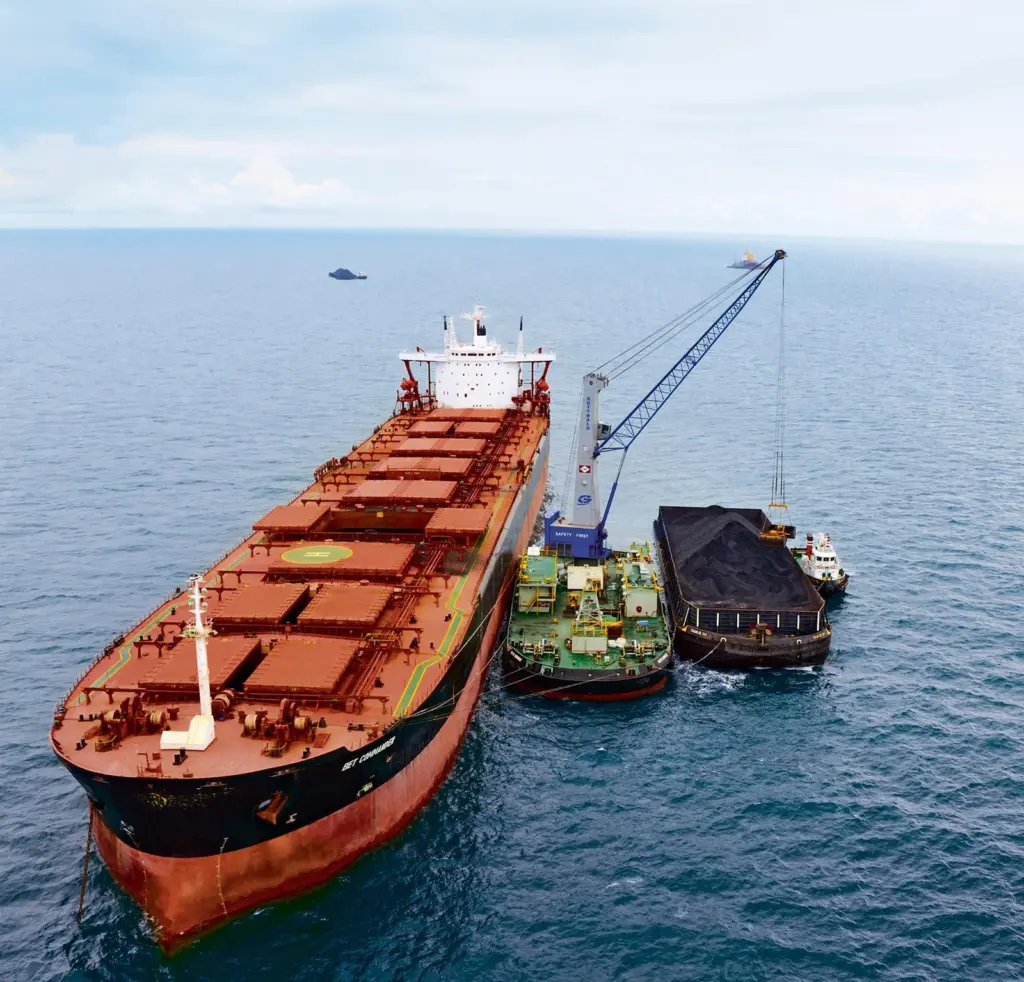
Indonesia’s main coal-producing islands of Kalimantan, Sulawesi and Sumatra suffer from a scarcity of suitable land-side infrastructure and deep harbours. For shipping logistics providers and miners this has presented unique terminal handling challenges, prompting many to outsource handling to overseas experts who have helped engineer new transhipment solutions.
Coeclerici Logistics, Canada Steamship Line, Gottwald, Liebherr, Logmarin Consultants and Swire CTM Bulk Logistics all have offshore handling systems deployed on Indonesia’s coal export supply chains.
Most recently Gottwald supplied a floating crane to PT Indo Straits at the end of last year. The G HPK 8200 B, classed with Lloyd’s Register for operation in open seas at wave heights up to 2.5 m, is now transhipping coal from river barges to ocean-going vessels 2.5 miles off the Indonesia coast at rates of up to 1,500 tonnes per hour. It boasts grab capacity of 63 tonnes up to a radius of 34 m and, at its maximum radius of 43 m, has a lifting capacity of 50 tonnes.
The order was the company’s second from Indonesia for its floating crane package. In 2006 Gottwald supplied a G HPK 8200 unit to PT Puteri Borneo Company. The unit is currently deployed 35 km off Kalimantan handling coal from barges to ocean-going vessels and is also classed with LR, this time to operate in winds up to force 6 and waves up to 1.5 metres high.
Despite the foreign presence, however, Indonesia-based companies are also active in the port logistics business. Jakarta’s PT Mitra Bahtera Segarasejati (MBSS), for example, operates a range of coal handling systems using floating cranes and transhipment stations supported by a fleet of 80+ barges of 4,000 dwt -11,000 dwt.
Last year the company took delivery of the 24,000 tonnes per day capacity FC Nicolas and the 18,000 tonnes per day capacity FC Princesse Abby – the latter jointly owned with Swire CTM Bulk Logistics – which have now been deployed at, respectively, the Taboneo anchorage in Kalimantan for Indonesia’s second largest miner PT Adaro, and off East Kalimantan at Muara Pantai anchorage in the Sulawesi Sea for PT Berau Coal.
The Princesse Abby is typical of the type of innovative design required in the harsh operating environment found at offshore coal export anchorages in Indonesia. The 3,500 dwt Rina-classed transhipment vessel was built to the technical specifications of Italian designers Logmarin and Interprogetti at Subic Shipyard and Engineering Inc in the Philippines at a cost of $10.5m.
At 60 m long, it crams in two 24.5 cu m coal grabs fitted to a Liebherr heavy duty crane able to handle 35 tonnes at 35 metres outreach in open water, offering rates up to 18,000 tonnes per day between barges and ocean-going vessels.
MBSS, which handled over 20m tonnes of coal last year, is also now developing a new river terminal at Muara Tuhup Port to take delivery of high grade coking coal from central Kalimantan which will be then shipped some 300 nautical miles to Taboneo.
“The facility will consist of a new berth capable of loading barges at 4,000 tonnes to be managed by a subsidiary, PT Inacia Perkasa, over a four year period with a one year option,” says Jon Vassella, vice president of MBSS. “The transhipment activities will be undertaken by MBSS’s newest floating crane which is rated at 18,000 tpd and is due for delivery in September 2009.”
The company also operates two floating cranes for Kaltim Prima Coal at Bengalon, where the FTS Bulk Pioneer offers loading capacity of 30,000 tonnes per day and the FC Ben Glory tranships at 22,000 tonnes per day. The former is operated in conjunction with Coeclerici.
Two more new floating transfer stations are due for delivery to MBSS this year – one will be wholly-owned by MBSS and one will be jointly owned in tandem with Swire CTM Bulk Logistics.
Related Articles
 CONCESSIONS & INVESTMENTS
 CONTAINER & CARGO HANDLING
 TERMINAL OPERATIONS