![PortStrategy[GreenPort]](https://www.portstrategy.com/wp-content/uploads/2026/09/PortStrategyGreenPort.svg)





Democracy in Action
Gavin van Marle spent several months roaming India recently. His report reveals how a stifling bureaucracy and genuine democracy form a two-edged sword in a country whose port sector is intent on progress.
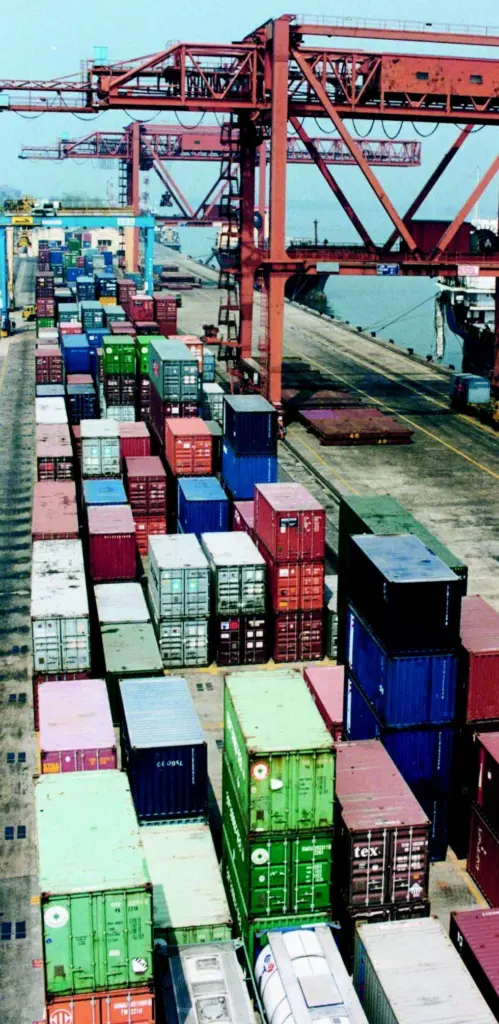
While the growth in Chinese port volumes seems to soar away into the ether at an unstoppable rate, it seems strange that India, the only country of comparable size, still boasts annual overall port volumes equivalent to a small developed country such as the Netherlands. Perhaps it is more than ironic then, that while the year-on-year 30+ percent increases in Chinese throughputs seem to either mask, or at least distract the eye from the fact that many of its ports are experiencing severe dockside congestion, and having a bottleneck effect throughout its entire supply chain. India’s growth in volumes – which has averaged 6-7% over the last few decades – only seems to highlight the problems it has with congestion.
But for India this is democracy in action. Or is it inaction? Ask observers, as well as many Indians themselves. When compared to the Chinese method of port development – enormous slates of state funding greenlighted with barely the blink of an eye – India seems to be befuddled with endless political debates and a cross-country assault course of bureaucracy.
How, for instance, would the Chinese have dealt with the proposed Sethusamudram Canal project? More commonly known simply as ‘Sethu’, the scheme will see a shipping channel blasted through the straits which lie between the southern Indian state of Tamil Nadu and Sri Lanka, and separate the Bay of Bengal from the Gulf of Mannar. A string of islands called Adam’s Bridge and low draughts elsewhere make this passage currently unnavigable, and ships heading for Chennai or other east coast ports have to circumvent Sri Lanka.
However, for over a decade Sethu has been discussed by shippers, lines, ports and government as a way of improving east India’s shipping links: it is commonly estimated that its creation would lead to a reduction in vessel sailing time from the east to west coasts of about 36 hours by reducing the distance by some 400 nautical miles.
ENVIRONMENTAL CONCERNS The project has been the source of much bitter dispute, with opponents ranging from environmentalists who argue that the area is unique and the project would lead to the extinction of several species, to Indian Civil Service bureaucrats who have seemed unable to agree on a way of funding the project.
But finally there is light – or darkness, depending on your point of view. Under the national government which won power mid-2004, a special purpose vehicle has been created to fund the project. Its members include the port authorities of Chennai, Tuticorin, Ennore, Visakhapatnam and Paradip, along with the state-owned Dredging Corporation of India and the Shipping Corporation of India.
Yet still no schedule has been set. Indeed within the shipping industry itself opinion remains divided. “Sethusamudram is the big hope for Chennai, ” says Chennai Port Trust deputy chairman K Elangovan. “We have been designated by central government as one of India’s three hub ports (along with Mumbai and Kolkata), but it won’t happen unless Sethusamudram goes ahead. We are predicating the development of a second container terminal in Chennai on the increased trade that Sethusamudram will bring.”
That may be the expected reaction from Chennai authorities, but inside the port others are not so sure. One liner agent told PS: “Adam’s Bridge is the place where the Bay of Bengal meets the Indian Ocean and the Arabian Sea. It’s an amazing place, the wildlife is utterly unique and will certainly be destroyed. I work in this industry, I can see the benefits that it will bring business here, but do we really want to destroy something so beautiful simply for the sake of a few rupees. My boss and I have arguments about this all the time, but I just can’t agree with it.”
At this point, a Chinese boss would have dismissed him. But in India everyone has a say, and to posit that this leads to a general indecisiveness would severely underestimate the challenges facing the Indian government. In other areas of the port business though, its reform policies appear to be winning friends. One of the clearest causes of both congestion and high transport costs has been the lack of competition in its intermodal sector, in which the state-owned Container Corporation of India (Concor), a subsidiary of Indian Railways, has a complete monopoly.
However, that is set to change after the government’s latest budget for 2005-6 ruled that private operators should also be allowed to run container block trains in and out of the ports.
This was greeted with enthusiasm by shippers and shipping lines, as well as container terminal operators, but it must be noted that this policy is still in its infancy. The budget was only delivered at the beginning of March and serious questions remain as to barriers of entry for private railfreight operators.
One local observer said: “Without major investments in Indian Railways’ infrastructure in the form of additional rolling stock and line capacity, it is impossible to run more trains, no matter whether by Concor or others. Several other questions arise in this regard: will the private sector firms invest substantially in rolling stock? After all, the domestic manufacture of wagons and locomotives will be hard put to cope with the increased demand. Will the government allow them to import? And will they be interested in investing in new lines and inland terminals when the cost of these is so high. Concor’s monopoly is not yet broken and the congestion will only get worse in the short-term.”
The capacity constraints of the supply chain – by far the majority of containers coming into and exiting Indian ports go on rail – are also periodically highlighted during dock labour disputes. Last year the P&O Ports-operated Chennai Container Terminal was shut down for two weeks by a crane drivers strike that led to a backlog of containers throughout inland depots in South India. Rathish Nair, senior logistics analyst at APL Logistics’ Bangalore office, recalls the chaos that a strike some 500 miles away caused: “Firstly we couldn’t get the containers out of Bangalore, as the dockers had caused the port gates to close, then we couldn’t get the containers from the customers’ warehouses to the Concor ICDs here because they were full. It was a nightmare. We tried buying space on vessels leaving Cochin and Tuticorin but they were all full, and the Mumbai ports of Jawaharlal Nehru Port Trust (JNPT) and Nhava Sheva were experiencing even more congestion than usual as shippers tried to get their stuff out of there. Even once the strike was over, it still took about three weeks to fully clear the backlog.”
While India’s unions are strong, they are no more so than some of their highly-vocal European counterparts. What presented more of a problem to operators once the strike was over was the obtuseness of Indian Customs, who still have a propensity to inspect a high proportion of containers coming and going, despite the existence of a fledgling ‘known shipper’ programme which gives a green channel to containers whose contents have been pre-registered via EDI.
GM Govind, chairman of the Bangalore branch of the Indian Institute of Materials Management (IIMM), an association of major shippers, told PS: “Currently this system is only for certain niche companies which have demonstrated transparency. It needs to be expanded to include the majority of exporters, but industry can only follow the diktat of Customs. The reform needs to come from them.” He adds a damning indictment of other Customs practices: “Anyway, none of it will be much use unless Customs moves from an eight-hour working day to a 24-hour operation. What is currently considered overtime here should be regular working time, just as it is in the West.”
VESTED INTERESTS PREFER STATUS QUO While there seems to be some sort of will in various sectors to resolve these administrative headaches, most predict that the obvious solutions will be some time in coming because there are vested interests that prefer to see the status quo remain. And this is a problem that affects the whole sub-continent, not just India. In the meantime, however governments across the region are tackling one of the other fundamental issues: the insufficiency of port infrastructure.
Elsewhere, the Indian state of West Bengal is keen to launch a new deepwater port to supplement the lower draught facilities at Haldia Dock Complex and Kokata Port Trust, which are both located upriver.
A few months ago the obvious choice would have been at Kulpi, where P&O Ports signed an agreement to develop a bulk facility.
However, sources in India say that the project has yet to get off the ground, for whatever reason, and it appears that the West Bengal authorities have become less enamored with the project as Kulpi is also located on the Hooghly River and thus subject to the same problems of poor navigability as Haldia and Kolkata. Instead, it is now looking at the development of facilities at Sagar Island, which currently has a 10.5 metre draught, and would need a 10-mile approach channel dredged to the depth of 12.5 metres.
Any decision on the final location of the state’s deepwater port will have to wait until Japan’s International Cooperation Agency has also had its say, as it has made a commitment to fund the necessary feasibility study. Increasingly in India, foreign concerns are having a say as well.
And well they might, for there is no doubt that India’s ports are increasingly being seen as a worthwhile investment. For a long time the only major international operator with any presence has been P&O Ports, which under the management of Jimmy Sarbh has considerable local knowledge. But in an attempt to limit the British firm’s control on the country, India has been welcoming other big names. APM Terminals in conjunction with Concor, was last year awarded the concession to build and operate JNPT’s third container terminal, with 1.3mTEU capacity that is scheduled to open in August 2006.
Meanwhile Dubai Ports International (DPI) has finally been given the full go-ahead to operate the forthcoming transhipment terminal on Vallarpadam island, by the port of Cochin. With these interests comes substantial investment funds which are desperately needed to maintain India’s development. The challenge for India is to create the right administrative and legislative climate to allow these investments to flourish.
Related Articles
 CONCESSIONS & INVESTMENTS
 CONTAINER & CARGO HANDLING
 TERMINAL OPERATIONS