![PortStrategy[GreenPort]](https://www.portstrategy.com/wp-content/uploads/2026/09/PortStrategyGreenPort.svg)






Drewry: get used to congestion in China
Fast growing inbound trade is just one of the many factors causing port congestion at China’s major ports. Other factors include bad weather, the restructuring of alliance networks, ever-bigger ships and shippers’ eagerness to move cargo ahead of planned rate increases.
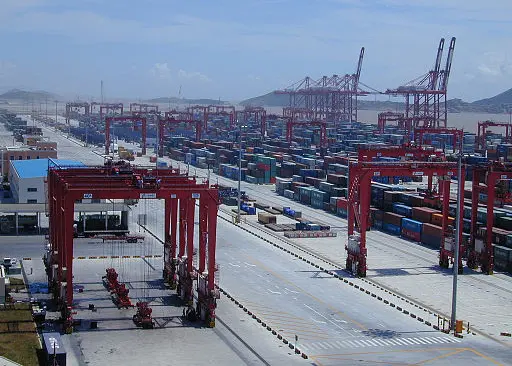
Another reason for why ships are being kept waiting outside ports and for slower than usual turnarounds is that they are simply struggling under the weight of extra business.
According to Drewry’s Container Intelligence Weekly, China’s top 10 ports collectively experienced a 6% year-on-year jump in throughput in the first quarter of 2017. It is unlikely to be a coincidence that the ports facing the worst of the congestion registered the biggest gains: Qingdao (12%); Shanghai (10%) and Ningbo (9%).
Although some of these issues will pass over soon enough, whether it will reduce the probability of future congestion in some of the world’s busiest container ports remains unclear.
In general, the deployment of bigger ships results in lower frequency services and greater volume peaks that stretch the manpower and yard capacities of ports and terminals, said Drewry.
This is a universal trend and not specific to Shanghai, but it will not get any easier as the size of ships continues to grow. As fewer terminals are able to accommodate the bigger ships, the operational difficulties faced by ports and terminals gets progressively more localised as more traffic heads to facilities that can do the job.
What’s more, information provided by Shanghai International Port Group (SIPG) for the upcoming 2017 version of Drewry’s Global Container Terminal Operators Annual Review and Forecast indicates that average terminal utilisation levels at Shanghai were very high in 2016, it said, adding that it therefore takes very little to push over the dominoes into full blown congestion.
Meanwhile, the long-discussed efforts of China’s government to rebalance the nation towards a more consumer-driven import economy have not, until very recently, borne much fruit when examining container flows with some of its biggest trading partners, added Drewry.
As per data from Container Trade Statistics, Drewry revealed that Greater China’s container imports from Europe, the US, Middle East and South Asia, grew by a barely visible 0.1% per annum between 2012 and 2016. Over the same period, exports to the same markets registered CAGR of 3.8%. Instead of rebalancing, the opposite was happening and container exports to these markets outnumbered imports by 3-to-1 in 2015, it said.
However, Drewry noted that it is finally starting to see a shift as for the first time in its data series, imports to Greater China outpaced exports in 2016; the inbound trade from its sample of trades growing by 2.3% year-on-year versus 0.5% for the outbound market, in the process lowering the export-to-import ratio.
Related Articles
 CONCESSIONS & INVESTMENTS
 CONTAINER & CARGO HANDLING
 TERMINAL OPERATIONS