![PortStrategy[GreenPort]](https://www.portstrategy.com/wp-content/uploads/2026/09/PortStrategyGreenPort.svg)





Fatal attraction
East Asia might dominates the top ten box port lists, but its not all plain sailing, says Stevie Knight
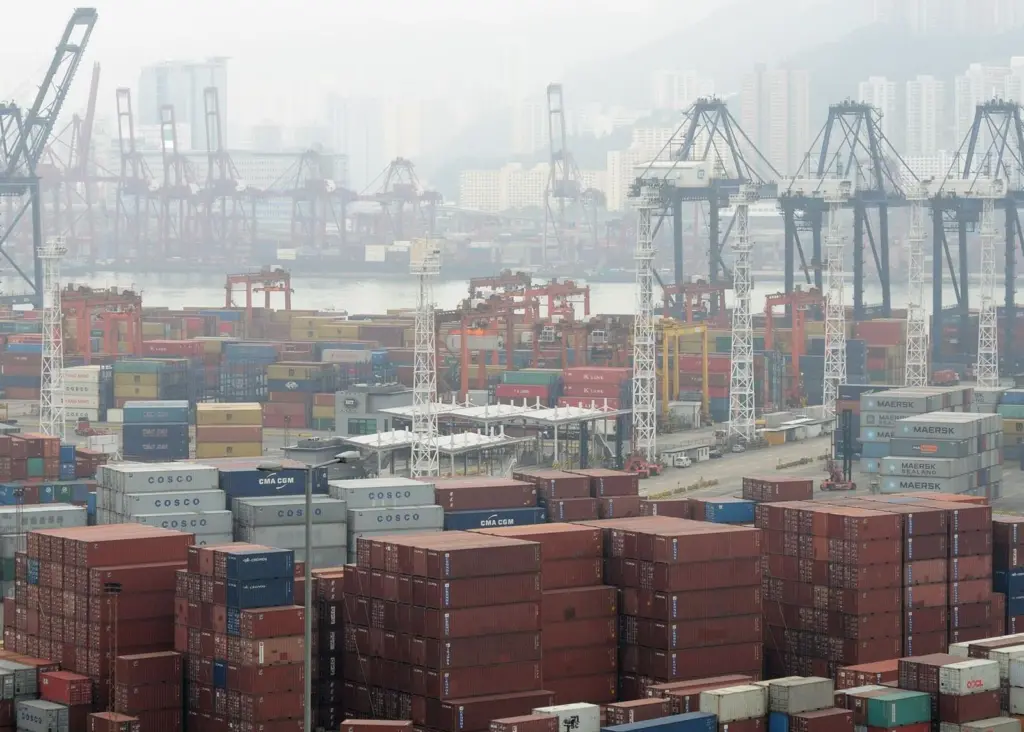
Hong Kong, the world’s fourth busiest port, is already falling foul of what Tina Liu of Drewry calls “lumpy volumes”. But it’s not alone.
It’s a dynamic that’s becoming more common in the big ports that the region is famed for, “particularly those that deal with Asia-Europe routes”, says Ms Liu. While alliances and ship sharing remain the best way for cash strapped lines to gain coverage without increasing costs, it means everything arrives in one go.
“For example, before the 2M Alliance, it would be usual for Maersk and MSC to be running from two different terminals on two different ships: given these changes, containers could be arriving once instead of twice a week, on one big vessel. Further, as the G6 alliance has six member lines this makes the intra-port logistics even harder to deal with – a container could arrive at any one of several terminals.” Obviously it’s not easy for an older, less spacious port like Hong Kong to accommodate the handling equipment and trucks that have to whizz round to get the boxes into the right place.
Hong Kong is really being hurt by this right now and this same dynamic is expected to catch up with most big ports in the region – even nearby Busan has seen bottlenecks last year. As one ship can generate hundreds of feeder moves and a thousand trucks, these ports are facing a situation where almost all of their energy is going to be used up dealing with the impact of bigger ships and alliances.
An Asia specialist comments: “Not many ports have the luxury of Singapore, which is looking at dismantling the facilities in order to reconfigure them.” Certainly not Hong Kong, which is only now looking at a precious few hectares at its backdoor in order to gain breathing space – but it won’t be enough to halt its fall from grace.
Cooling off
However, despite holding several of the world’s top ten ports, China “is simply not as hot as it was”, says Ms Liu. “Though there are lots of enquiries as to performance levels, there’s no big port infrastructure changes on the horizon that we can see… which given present market conditions is definitely a good thing.”
Its earlier announcement of a 7% ‘official’ GDP growth rate is telling. “In China, an 8% GDP growth was the accepted mental benchmark of an economy buoyant enough to ward off issues,” says Ms Liu. Others say even the 7% figure is inflated, which is problematic since the government has a lot resting on a continuous boom to keep a growing, educated middle class satisfied.
However, there are big differences in the way each of the three port clusters (the Bohai Rim ports, the Shanghai-Yangtze region and the Hong Kong Pearl River Delta area) cope.
While on one hand the northerly Bohai Rim ports are generally less exposed to foreign trade, this hasn’t insulated them completely and according to Ms Liu, the big facilities at Tianjin, Dalian, Qinhuandao, Yantai and half a dozen smaller ports are feeling the effect of the slowing.
“Although the supply-demand balance may look alright for the time being, capacity could be added into the market in a short period of time”, adding that despite part listing on the stock exchange, the “watchful eye from Beijing” is definitely a good thing given present market conditions.
Shanghai’s strength
Positioned in the middle of China’s pot belly coast and at the mouth of the Yangtze, Shanghai, the world’s busiest port, remains hard to dent. Last year it handled over 35m teu and despite the general slowing earlier this year it still saw 11.7m teu in the first four months (far outrunning Shenzen, its closest Chinese competitor, which handled 7.6m boxes in the same period).
It’s partly because it has a more or less captive market and it holds a full set of cards along the Yangtze. The river leads all the way into China’s interior and Shanghai International Port Group (SIPG) has both a feeder fleet and interests in most of the dozen or so terminals that pepper the Yangtze right up to Chongqing – a facility worth noting in its own right.
Despite its inland position, Chongqing has sprung into life through a mixture of government support and private enterprise, becoming a major rail and river hub. While initiatives to disperse queues downstream at the Three Gorges Shiplock have come to nothing, it doesn’t seem to have held Chongqing’s development back: rail takes higher value goods while the river tends to take the lower value, less time constrained cargo. So, the pragmatic reaction to the bottleneck has been simply to step around it using trucks, then rejoin the river”.
However, it’s the southern Pearl River Ports which are suffering most. Ms Liu explains: “The further you get from Beijing, the looser the controls on development.” There’s certainly a lot of ‘top ten’ ports in the same neighbourhood and they are fighting for position: Hong Kong has just lost out to nearby (and cheaper) Shenzhen which has overtaken it in the box ranking with 23m teu to Hong Kong’s 22m. Another nearby port, Guangzhou, is only 5m teu behind which adds to the pressure.
Meanwhile, China’s been aggressively marketing its Silk Road trade corridor which reaches all the way into Europe and there are still big infrastructure initiatives underway that aim to establish China as everyone’s favourite banker while providing new markets for its surplus construction materials and labour pool.
Interestingly, the ‘iron’ Silk Road railway initiatives are already boosting volumes at a handful of ports. Shenzhen is benefitting from new rail connections, but unexpected winners among the small fry include the northwestern port of Yingkou. Originally it was being eclipsed by Dalian, but now it’s taken advantage of its position and is offering a sea-rail link from nearby Japan and Korea to central Asia and onto Duisberg in Europe.
Another port beneficiary from China-European rail is Lianyungang, just north of Shanghai, which now holds one end of an uninterrupted link to Kazakhstan – an energy rich country that’s long lacked an opening into global waters itself.
Busan leads by example
The South Korean hub of Busan with its 18.86m teu throughput “is a very good story” in a challenging market says Drewry’s Ms Liu. Although other ports in the area might try hard to catch up, she says: “Busan is the one everybody is chasing for the transhipment hub position, but realistically, it’s too established for any other port to get ahead”, adding that Chinese ports in the area “would do better to concentrate on developing their gateway traffic”.
It’s definitely on a roll: Busan New Port recently announced it will gain another 15 berths to add to the 30 currently in use or under construction. Though it will be looking at feeder and multipurpose terminals it will also be increasing its container capacity by 15.8m teu and seems to be intent on dredging to 17m to make sure the ultralarge box ships can get in. Neck and neck with Ningbo as far as present volumes are concerned, half Busan’s throughput is gateway traffic but it’s playing hard with cut-price incentives for boxes destined for northern China and Japan, much to the Japanese authorities’ chagrin.
“Japan is trying very hard to revitalise the ports in order to get hold of more direct calls, but it’s down to the lines, and they tend to go for the economies of scale that Busan provides,” says Ms Liu. It doesn’t help that the major ports like Tokyo and Nagoya are on the eastern, not western, Chinese side of the islands.
It’s interesting that in a time when most ports are looking to build relationships, Japan’s success in doing just that has created a double-edged sword: “As a result of a long tradition of keeping close, the main facilities are tied to the lines which are the de facto operators, so foreign investment that’s not a direct customer simply can’t get a foot in the door.” The result is that while Japanese ports are fairly efficient, in general they have not spent as much on infrastructure development as neighbouring Busan, Shanghai and Shenzhen.
Related Articles
 CONCESSIONS & INVESTMENTS
 CONTAINER & CARGO HANDLING
 TERMINAL OPERATIONS