![PortStrategy[GreenPort]](https://www.portstrategy.com/wp-content/uploads/2026/09/PortStrategyGreenPort.svg)





Lifting eastern fog
Theres more to eastern Chinas ports scene than the massive Yangshan, with Taicang,Nantong and Nanjing leading the container pack
In eastern China, every port has to grapple with the rapacious spread of Shanghai and its powerful operating body, the Shanghai International Port Group. Last year, Shanghai leapfrogged both Rotterdam and Singapore to become the world’s largest port overall and on the container front it is not far behind, likely to become top of the league by next year as Yangshan Deepwater Port continues to develop.
Yangshan, a pair of islands 32km from shore linked by a world record-beating bridge,opened last year with the second phase coming onstream this year. When fully operational,Yangshan will boast 52 berths.Though not yet announced, Port Strategy has exclusively learnt
of the split for the keenly fought over third phase of development at Yangshan. PSA, which was the main loser in the previous round of bidding, has a 30% stake as does China Shipping, with SIPG taking 20%, Cosco Pacific 10% and the remaining 10% still undecided between carriers CMA-CGM or Lloyd Triestino of the Evergreen clan.
Seemingly unfazed by the mega plans at Shanghai, Ningbo to the south across Hangzhou Bay has set out its own stall for serious growth by merging with the various ports of the neighbouring Zhoushan archipelago. Widely acclaimed as the finest natural deepwater harbour in China, Ningbo is cheaper to call at than Shanghai. Ningbo has gone after shipping lines for investment while the port operators have had to spend big to take part in Yangshan, which ironically, though out at sea, is actually in Zhejiang province, the same as Ningbo. The merger of the ports is aimed at making Ningbo-Zhoushan Port the world’s third largest port by 2010.
Further south, the port of Xiamen has eyes on overtaking Kaohsiung across the Taiwan Strait. Xiamen has set a goal of handling 16m teu by 2020 something that has spurred the government in Taiwan to overhaul its port policy to ensure Kaohsiung remains competitive.
However, despite the growth seen on the eastern coast it is inland that sees some of the greatest opportunities for container terminal investment now that a major dredging programme is into its third phase along the Yangtze which will take the river’s depth to 12.5m all the way up to Nanjing by 2008.At the mouth, there were two notorious shoals that historically prevented 25,000 dwt ocean-going vessels from entering Shanghai port until high tide. The on-going three-phase dredging project at the mouth has successfully removed the sandbars.
Nearly 80% of shipping activities on the Yangtze are concentrated in the 250 km section between Shanghai and Nanjing. According to the recently published Yangtze River Ports 2006 handbook, seven of the Yangtze top ten container ports are along this bustling stretch of river. “All told, cargo traffic levels along this riverine artery are growing at a rate of more than 25% a year,” says author Matthew Flynn,
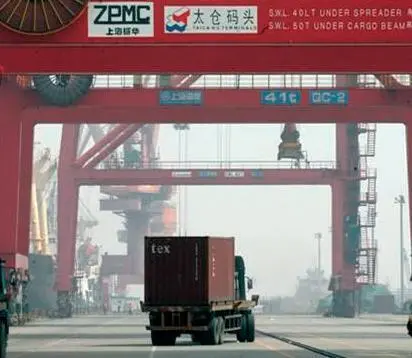
managing director of eponymous Flynn Consulting. Cargo volumes more than doubled between 2001 and 2005, from 310m tons to 795m tons. In 2005, the Yangtze’s 24 leading ports, excluding Shanghai, recorded a throughput of 2.6m teu, 3.8 times more than in 2000. This trend is set to continue in the future.According to official forecasts, throughput will reach 6.5m teu by 2010 and will exceed 10m teu by 2020. Leading the pack on the container front will be Taicang, Nantong and Nanjing.
Beyond Nanjing, navigation has changed dramatically thanks to the engineering feat that is the Three Gorges Dam. Obviously the dam and the lake that it has created has deepened shipping channels but other previously unthought of hurdles have emerged.Opened to much fanfare last year,the locks of the Three Gorges Dam have proven to be a major bottleneck. The dam itself is creating new and uncharted patterns of silting further downstream.
Further upstream beyond the Three Gorges Dam, the port of Chongqing is set for dramatic growth as the world’s most populous municipality ramps up capacity to move car parts here, the city widely acknowledged as the Detroit of China.Throughput surpassed 100,000 teu last year and may well double this year. The local government has set aside $2bn in the coming 10 years to ensure the city becomes a prime port.
Related Articles
 CONCESSIONS & INVESTMENTS
 CONTAINER & CARGO HANDLING
 TERMINAL OPERATIONS