![PortStrategy[GreenPort]](https://www.portstrategy.com/wp-content/uploads/2026/09/PortStrategyGreenPort.svg)





Personal banking
India needs to capture private sector investment if it is to realise its full future potential. Gordon Feller reports
With 12 major ports, 187 non-major ports and 7,517 km long coastline, India’s government says the port system is poised for a big leap in throughput – and that the success of that leap depends upon private sector investment.
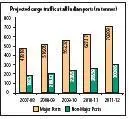
The government estimates that the total cargo traffic at all Indian ports will grow from 2007-08 to 2011-12 at a compound annual growth rate (CAGR) of 10.96%,with non-major ports seeing a CAGR of 12.58%. About 95% of India’s foreign trade by volume and about 70% by value are seaborne.
Investors interested in the development of Indian ports have seen good news: 100% foreign ownership is now permitted. Furthermore, 100% income tax exemption can be granted for a period of ten years.
Tariff Authority for major ports regulates the ceiling for tariffs charged by major ports/port operators, a rule which is not applied at non-major ports and the government has formulated a comprehensive National Maritime Policy with a new strategy for the sector’s development through 2025. Private sector investment is being pushed rather hard; consider just two of the more than forty big commitments already in process:
● Navayuga Engineering Company (Hyderabad) will construct a port at Astaranga with a commitment of $1.43bn.The company wants to develop this port, at the mouth of the Devi River, in three phases on a build-own-operate-share-transfer basis. The investment total is estimated at $357m for phase one. The second and third phases will require an investment of $476m and $595m, respectively.
● Chennai Port Trust will invest $357m during the next two to three years on various infrastructure projects. A total of $179m will ease traffic flows by elevating the expressway from that port to Maduraivoyal (up to Highway 4). It will modernise the port at a cost of $48m.Of this total, $9.5m will be spent on realigning rail and road networks inside the port for quicker movement of cargo.
However, the problems are large-scale: just to keep pace with growing traffic, cargo-handling capacity at major ports must be expanded from about 600m tonnes in 2005-06 to about 1,300m tonnes by 2011-12. And the government says it is doing just that.
In 2006- 07 the total cargo handled was 630.30m tonnes, an increase of 9.92% over the previous year. By 2011-12 it estimates that about 1,011m tonnes of cargo will be handled at these same ports. New facilities will clearly be needed to cater to rising cargo demand. Cargoes handled include petroleum-oil-lubricants at 33.38% of the total cargo traffic during April 2006- March 2007; iron ore 17.37%, coal 12.98%; containers 15.84%; fertiliser 3.04%; others 17.49%.
Owing to India’s pace of containerisation, container traffic at all the major ports grew by 18% over the same period in 2006. The rising volume of container traffic was followed by fertilisers, with 15.75% growth from April 05-March 06. Container traffic grew at a CAGR of 14.73% from 2000-01 to 2006-07; non-container traffic grew at a CAGR of 8.7%.
According to World Bank estimates, India’s port inefficiencies have led to huge losses for the national economy. Container handling delays cost India at least $70m/annum.
The government’s new port development programme focuses on improving port productivity by increasing major port capacities. The aggregate capacity at major ports, as of March 31, 2006,was 600m tonnes/annum.
The government has identified a total of 387 specific projects under its National Maritime Development Programme (NMDP), requiring investments totaling Rs1,003bn ($24.5bn). Of these, 276 projects focus on major port development or restructuring – with an investment of Rs558bn ($13.5bn). The balance is for inland water transportation development.
NMDP dictates a significant role to private sector investors and operators. Of the Rs558bn total, about Rs345bn ($8.4bn) is expected to come from the private sector, with a focus on the most commercially-viable projects – such as the development and operation of berths and terminals at major ports. During 2006-7 numerous projects have already been undertaken as public-private-partnerships with a total value of Rs110bn ($2.7bn) at several ports.
Related Articles
 CONCESSIONS & INVESTMENTS
 CONTAINER & CARGO HANDLING
 TERMINAL OPERATIONS