![PortStrategy[GreenPort]](https://www.portstrategy.com/wp-content/uploads/2026/09/PortStrategyGreenPort.svg)





THAT CHINA FACTOR AGAIN
With its sterling economic performance, China has overshadowed the region. But while China is a formidable rival in the battle for foreign investment, forcing several of its neighbours to make painful readjustments, it is also an ally. Its expansion has created fresh opportunities for Southeast Asian companies and countries, reports June Lim
Thailand’s long-held dream of building an energy landbridge across the Kra Isthmus as part of its larger plan to jumpstart development in its impoverished south, is closer to realisation, thanks to the interest of China’s leading oil and petrochemical trader Sinochem. Critics questioned the economics and logistics of the scheme as transit through the Malacca Straits is anyway short. But for Sinochem the issue is security of supply: an accident involving an oil tanker in the narrow straits through which almost 70% of East Asia’s oil trade flows, could disrupt supplies to fuel China’s burgeoning expansion.
Under the $700m plan envisaged by Thailand, 230km oil pipelines would link oil terminals on either side of the isthmus connecting Thailand to the Malaysian peninsula. Crude or product from the Middle East and West Africa would be piped through a 106 cm pipeline at the rate of 3 million barrels a day. On opposite ends of the landbridge, storage facilities would be built to accommodate 50-100 million barrels of oil products.
China’s closer ties with its southern neighbours in the 10-member Association of South East Asian Nation (ASEAN) are being tightened in the China-ASEAN Free Trade Agreement, expected to be finalised in 2010. But the liberalisation process has already kicked in. Under an early harvest programme, China would steadily lower tariffs on 600 items, mainly agricultural, to zero for the six more-developed ASEAN nations between January this year and 2006. China’s annual trade with ASEAN is estimated at about $55 billion, or about half the value of China’s trade with the US.
Meanwhile, fears that China may have political designs on Southeast Asia have galvanised Japan and the US to act. ASEAN is working on a Comprehensive Economic Partnership arrangement with Japan while the US has announced the Enterprise ASEAN Initiative, under which it will pursue agreements with individual ASEAN countries, taking into account their respective progress in economic liberalisation.
HALF THE WORLD’S MANUFACTURED GOODS Tighter integration amongst East Asian nations – nearly half the world’s manufactured goods now originate from the region – will generate possibilities for business. As Ernest Bower, president of the US-ASEAN Business Council, noted companies like General Electric can have an engine plant in southern China and a parts plant in Malaysia. If no duty has to be paid, the final product can be very competitive.
Small wonder then there is general optimism across Southeast Asia. To handle the anticipated trade growth terminal operators are boosting their capacity. With increasing exports in manufactured goods the bulk of the investment is in containers. Existing terminals are being beefed up and new terminals developed. Plans that have been put on the backburner have been revitalised and revised with more realistic projections than the pre-Asian Crisis years where 10% growth was the norm for Singapore, Malaysia, Thailand and Indonesia.
On Indonesia’s Batam Island, the Batam Industrial Authority has invited tenders for a 2mTEU terminal, whilst Vietnam, which has the second highest economic growth rate in East Asia after China, is considering a 2.4mTEU deep-sea transhipment port at the environmentally sensitive Van Phong Bay.
Non-container projects are also being considered, including the expansion of Thailand’s Si Chang Thong Terminal and the construction of a car terminal at Malaysia’s Port of Tanjong Pelepas (PTP), though nothing has been finalised. With the benefit of recent hindsight, Southeast Asian governments and companies have reasons to be cautious lest they be caught on the wrong foot again.
Singapore’s PSA Corp is expanding its physical infrastructure and enhancing its capability to handle more, as well as larger ships with their more exacting requirements. Another five berths will be built at its Pasir Panjang Terminal, raising its total throughput by 4m to 24mTEU. The expansion – the first since 1997 – follows a robust increase in throughput after the setback in 2001 after the loss of its biggest client Maersk Sealand. PSA enjoyed 9% growth rate in 2002 followed 7.8% in 2003. For the current year, the forecast is for an 8% increase, though this seems a tad conservative based on the 12% improvement in January and February. This will bring PSA to the limit of its present capacity. The 37 berths it currently operates have a combined capacity of 20mTEUs a year, though it can handle more through improved utilisation.
PSA DETERMINED TO CONSOLIDATE HUB STATUS More expansion is in store should PSA continue to expand at the current pace of around 8% annually. CEO of PSA’s Singapore Terminal Grace Fu, said with an 8% increase PSA would require two extra container berths each year. The government is committed to providing PSA with the space it needs, as Singapore’s deputy prime minister and finance minister Lee Hsien Loong, told Parliament recently:
“Transhipment is an international business. Within our neighborhood alone, Tanjong Pelapas, Port Klang and Laem Chabang, are all vying to replace PSA as the hub port for Southeast Asia?The government is determined to consolidate Singapore’s status as a hub port.”
But the ambitions of PSA’s smaller rival, Jurong Port, have been crimped. Lee said Jurong Port would not expand to Pasir Panjang, where the government has earlier reclaimed large tracts of land for container terminal operatio just a one million TEU capacity.
As ultra large container ships, 8,000 TEUs and above, may one day be the workhorses for the main arterial routes, PSA has begun to mobilise its resources to meet physical and operational demands. The new berths will be longer at 450 metres of 16-metre draft, with a deeper approach channel of 18-19 metres and a bigger back-up area for containers.
The mega ships also impose stiff operational demands. As Fu noted: “How do we increase the velocity of movements so that port stay is as short as possible? The terminal has to move faster, the velocity higher. How do we fine-tune our plans if there are exemptions?
There must be a way of feeding back to our system.” The deployment of these mega ships also has implications for port resource maximisation since they may cause sharp spikes in demand when such a ship is in port followed by a trough after she leaves. And as mega vessels are more expensive, their requirements are more exacting.
Tolerance for delays will be lower as the cost of delay is higher. By being able to handle the mega ships more efficiently PSA hopes to differentiate itself from regional competition.
PTP CONTINUES SURGE Port of Tanjung Pelepas (PTP) has caught the imagination of the shipping fraternity with its ability to snare two major customers – Maersk Sealand and Evergreen – from Singapore. The success which catapulted the port to the top container slot in Malaysia over more recognised terminals Northport and Westport in Port Klang, is an inspiration for other greenfield sites.
Last year PTP surged 31% to 3.5m TEU, of which 3.33m TEU were transhipment containers and the rest local. Based on the performance of the first two months, the port is heading for another year of robust growth. In January it enjoyed year-on-year gains of 31% followed by 21% in February.
However, efforts to entice other major carriers away from Singapore have proven difficult as PSA has learnt to guard its turf more carefully. PTP instead has turned its attention to cargo generation by developing the PTP Free Trade Zone (FTZ) and encouraging the automotive sector. The 405ha FTZ comprises a 162ha Free Commercial Zone reserved for warehousing, distribution and logistics activities, and a 243ha Free Industrial Zone for companies manufacturing or assembling mainly for export. Zone tenants are exempted duties on raw materials, component parts or machinery and equipment imported for the manufacturing process.
The Customs Department has also implemented its Sistem Maklumat Kastam (SMK) to facilitate on-line declaration for imports and exports.
“There are currently over 50 tenants operating within the PTP Free Zone, many of which have indicated their intention to expand their current operations here, ” says PTP CEO, Datuk Mohd Sidik Shaik Osman.
Among the tenants is German car manufacturer BMW which is relocating its regional parts distribution centre from Singapore to the PTP FTZ and its regional IT centre to Malaysia’s multimedia hub Cyberjaya. Scheduled to be completed in August, the Eurocentre will serve BMW’s 19 markets in the Asia Pacific region. BMW is something of a coup for PTP, which it hopes will fast track its plan to be an automotive and spare parts distribution centre. A dedicated car carrier/ro-ro terminal is being considered but no time frame has been established.
Meanwhile PTP is pressing ahead with its container development believing in building ahead of demand. Two new berths, measuring 360 metres each, are being added to the present six berths to boost capacity from 4.5m to 6mTEUs. The longer term goal is to have 14 berths with a combined capacity of 10m TEUs.
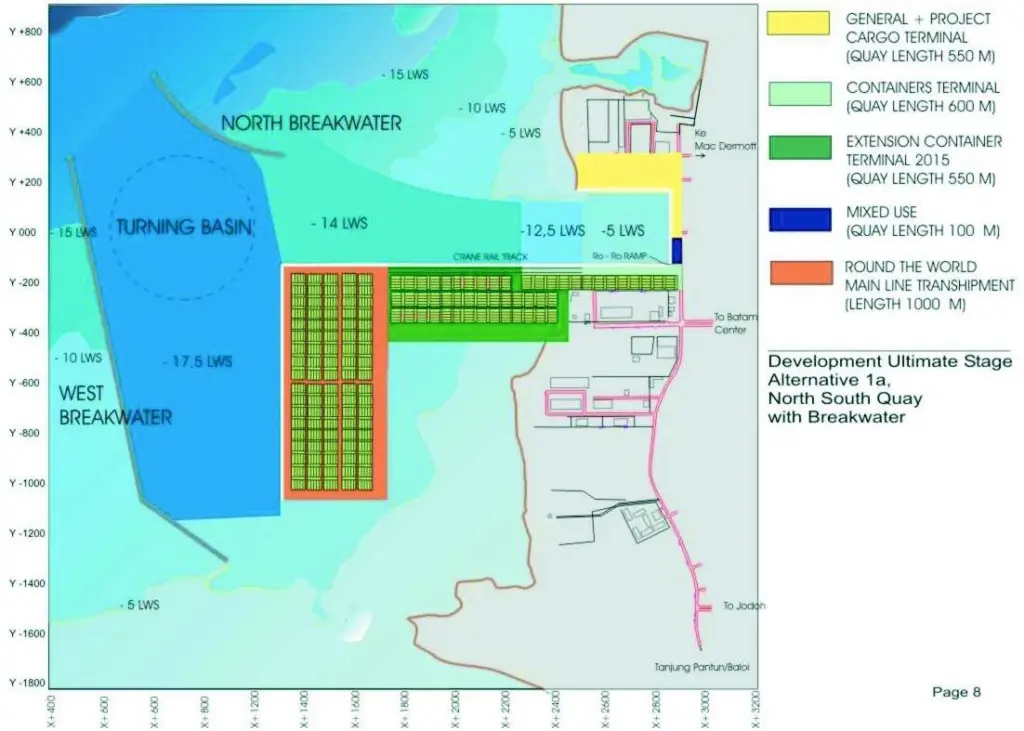
TENDERS INVITED FOR BATAM If everything goes according to plan, Batam, an Indonesian island 20kms south of Singapore, will have a dedicated container terminal in 2007. “Under the current plan we are more realistic, focusing on domestic containers. If we are lucky, we’ll get transhipment, ” says Donald Pandjaitan, business development director for Batam Industrial Development Authority (Bida).
Bida has invited tenders to build and operate the Batu Ampar Container Terminal on a 25-year concession. It will be developed under a two-phase programme: the $105m phase one will push handling capacity to 900,000 TEUs, and at $278m, phase two will increase throughput to 2mTEUs.
As a free trade zone, Pandjaitan says Batam now generates about 250,000TEUs a year, with about 170,000TEUs shipped through Batu Ampar and the rest via Kabil and Sekupang. By 2007 the number could increase to 450,000-500,000 TEUs with expanded economic activities. If the successful contender could generate a comparable amount through feedering or regional traffic, the port will be able to handle 900,000 TEUs annually. This is a far cry from more grandiose proposals made 10 years ago for a 10mTEU transhipment port costing $1 billion. Pandjaitan says past proposals were made by private investors based on their own study and projections. This time round Bida commissioned Dutch consultancy Witteveen+Bo Container Port to undertake a detailed study before inviting bids.
Interest is strong. In the list are about 20 shipping lines and terminal operators including ICTSI, P&O Ports, Port Klang’s Northport, HIT and Hanjin. Says Pandjaitan: “Its success is very important for us because Bida’s aim is to build the island as an industrial area and the port is one of the important facilities to help increase foreign investment.”
Batam whose fortunes are inextricably linked with Singapore has seen a steady increase in investment from companies who want to enjoy the benefits Singapore can offer without the steep cost structures. Land and labour are a fraction of Singapore’s and the island is accessible by ferries, which connect the two islands almost hourly.
FEEDERING FIRST AT BANTEN With natural deep water, Banten in West Java, next to the Sunda Straits, will be able to handle some of the largest containers ships when current expansion is completed in 2005. But PT Portindo Dinamika (Portindo), which holds the concession until 2022, has less ambitious plans, at least for now. “It will take quite sometime before we get main liners in there, ” says Peter Darley, technical director of Portek, the majority shareholder of Portindo. ” We have to build it up with feedering via Singapore initially. For a greenfield project, the trick is to get it started.”
Under its agreement signed with Pelabuhan Indonesia III, one of the four Indonesian state-owned port management enterprises, Portindo is building a second berth by doubling the existing 200 metre long quay to 400 metres by end 2005. Equipped with two container quay cranes and a back-up container yard of 8ha, Banten will be able to handle 400,000 TEUs. It can scale up when the need arises as there is sufficient land area to build up to a million TEU terminal.
Darley says its immediate market is the industrial hinterland in Banten province which relies on Tanjong Priok in Jakarta some 100kms away. Banten currently receives only ad-hoc calls from Maersk Sealand/K Line’s joint venture service.
Better known for handling equipment than port operation, Portek has teamed up with John Ong, former head of PSA Corporation marketing, to beef up its marketing efforts. Ong led a group of investors including shipping lines to take up 25% stake in Portindo for $5.9m last August. As Portek’s chairman Larry Lam told reporters then: “We know the port authorities in Southeast Asia and we have the capability to deliver equipment and run the operation, but the missing piece is that we are not so well introduced to the shipping circles.”
OILTRADING FOR SI CHANG THONG Si Chang Thong Terminal has been given a new lease of life. The once disused terminal and tank farm at Si Racha District in Thailand’s southern Chon Buri province is now a hub of activity. This follows the Thai government’s decision to establish its first petroleum trading centre in Si Racha and to designate the Si Chang Thong Terminal as the first customs-free port for oil imports, exports and refining. The government’s ambition is to build Thailand into a regional oil trading hub in five years to rival Singapore.
Over a dozen oil traders have been attracted by low corporate tax rates of 10% to set up at the centre. On the opening day, they traded almost $1 billion in contracts for 30.5m barrels of crude and refined products.
China’s Sinochem Corporation is believed to have accounted for the lion’s share of transactions.
Si Chang Thong, which has been leased to government linked petrochemical conglomerate PTT, has enjoyed 100% utilisation.
The terminal has four jetties, one capable of handling 100,000 dwt vessels, and 14 storage tanks.
Si Chang Thong was conceptualised in the heady early 1990s when Thailand was still riding high with growth rates of 10% per annum. Completed by Thai Public Port Co in January 1996 at a cost of $101m, it was fully utilised.
However, Thailand’s decade-long high growth rates masked fiscal deficiencies which came to a head in July 1997, following the devaluation of the Thai baht against the US dollar, triggering the now infamous Asian crisis.
The worst is now behind them and Thailand is once again one of the most dynamic countries in Asia.
Related Articles
 CONCESSIONS & INVESTMENTS
 CONTAINER & CARGO HANDLING
 TERMINAL OPERATIONS