


THERE MAY BE TROUBLE AHEAD
Container throughput at many of China’s major ports was up in 2020, but is the increasemasking underlying problems? AJ Keyes investigates.
China is the only major economy to record economic expansion in 2020 – with a strong recovery set to gather pace in 2021. Yet the country’s ports work on the export demand model, making them heavily dependent upon demand recovery in North America and Europe, with the latter far from certain.
It is, therefore, questionable how sustainable continued port growth will be? And all the more so when it is recognised that China remains dependent upon raw material imports and has been adopting a confrontational trade policy that risks dislocating the supply chains that have driven previous growth. The latter subject comes under scrutiny in the article ‘K2 for Bulk Port Planners?’.
POSITIVE CONTAINER PORT GROWTH
Last year proved a positive one for many of the larger container ports in China. According to China’s Ministry of Transport, total container port throughout for the 24 largest mainland ports registered an increase of 1.5 per cent for 2020 over 2019. A total of 234.3 million TEU passed through these container facilities. Interestingly, this increase is reported despite the negative impact of the COVID-19 pandemic and an array of trade tensions, notably with the USA.
Looking at the data that has been made available in more detail, it is reported that the largest volume port, Shanghai, saw throughput in 2020 stay largely flat with a minimal 0.4 per cent rise. The other largest volume container facilities, however, all recorded stronger growth, ranging from a 6.1 per cent rise to 18.4 million TEU at Tianjin (which is the main port for the greater Beijing region) to a lower, but still positive 1.5 per cent increase for the Pearl River Delta port of Guangzhou, (which includes Nansha) with 23.2 million TEU in 2020.
The Shenzen facilities of (Yantian, Shekou, Chiwan and Dachan Bay) also saw a 3.0 per cent rise to 26.6 million TEU, with Qingdao being the other major facility generating growth, with the 22.0 million TEU handled in 2020 representing a 4.7 per cent increase over 2019. Table 1 details the total container volumes handled for the biggest volume ports in 2020, with confirmation of the percentage increase over the full-year 2019 also shown.
DALIAN BUCKS THE TREND – MAJOR LOSS
The other notable factor in the data is the severe loss of container cargo through the Port of Dalian, which saw a substantial drop of 41.7 per cent to finish 2020 on 5.11 million TEU – down from the 8.81 million TEU handled in 2019. Localised reports reference weakening GDP, a drop in reefer shipments and traffic shifting to nearby Yingkou as all influencing factors.
There are clearly ongoing issues impacting this port because it has recently confirmed a change in name to Liaoning Port Company, as part of a restructuring process. China Merchants Group assumed control of Liaoning Port Group during 2019 and there have been a number of different consolidation activities since, which included Dalian Port absorbing listed port operator, Yingkou Port.
At the same time, the previously private port company, Dandong Port, was also taken over by Liaoning Port Group after it went into bankruptcy. This reflects the relatively high reliance of the regional economy on the heavy industry sector and could be a bellwether for broader problems in the short term.
Based on Ministry of Transportation data, the fastest-growing port in the country is currently Beibuwan. Located in Guangxi province, this facility reportedly handled 5.05 million TEU in 2020, an increase of 32.2 per cent over container activity seen in 2019.
So, how much have China’s ports been impacted by the COVID-19 pandemic? It is difficult to be precise. As Figure 2 shows, generally, growth in 2020 was lower than in 2019 for most of the ports, although Ningbo-Zhousan saw a small improvement from 4.2 per cent in 2019 to 4.4 per cent for 2020, while Shenzen turned a 6.9 per cent drop in 2019 to a 3.0 per cent increase for 2020.
Yet the overriding conclusion is that while some ports have seen slightly more positive growth, overall the trend for 2020 for container ports was an increase of just 1.5 per cent overall – which is a very poor performance for China.
STRUCTURAL CHANGE IN CHINA
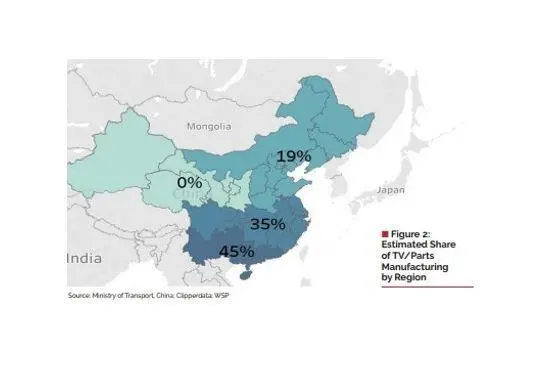
It is important to understand the industrial structure in China. Traditionally, heavy industries are located in the north and produce bulk products and intermediate goods that feed the consumer production and goods focused in the south.
The share of production/manufacturing of steel in the northern regions and for televisions/parts in the central and southern area can be seen in Figures 1 and 2. This make-up of the market has enabled central ports to grow strongly, resulting in the higher volumes moving through the likes of Shanghai and Ningbo.
Northern ports have seen lower growth, especially Dalian. Qingdao is less impacted because it is the most southern of the Northern ports and can still access some central areas. According to one liner shipping executive, who did not wish to be named, the real impact is being seen with the northern regions losing around one million TEU of cargo year-on-year up to 2020, but the south and central areas each generating increases by two million TEU per annum.
This suggests that while the north may have largely maintained its export production, it has seen output of the intermediate goods that are supplying the consumer good manufacturing hubs of the south and centre being replaced by ports in these latter two areas. The key conclusion from the combination of port volumes and manufacturing activities is the structural shift towards the south with the reduction in “dirty” production activities in the north.
MOUNTING PROBLEMS
So a process of structural change in the country and potentially challenging trade activities are two key issues faced by China and its ports. There are also other issues emerging at home, with China facing emerging economic challenges. While the current port model is appropriate, structural issues that are already starting to bite have the potential to negatively impact port growth and investment going forward.
According to the Chinese Academy of Social Sciences, Beijing’s plan for domestic consumption to drive economic growth could “fall short” and there is a growing pressure on local government finances that is expected to see the levels of infrastructure investment slow – which would directly impact port projects.
The current model adopted by the Chinese government for its ports can continue to be followed, but it does not seem like a workable longer-term strategy. Rising debt in the country, structural changes to industry and issues concerning the sourcing of imported raw materials are all new problems that the country has to face.
The position is complicated and may be further challenged as near-shoring increases in China’s key exports markets such as the USA as a result of the COVID-19 pandemic. Equally, the shift of manufacturing to other Asian and subcontinent manufacturing locations is another worrying trend. There may indeed be trouble ahead.
Related Articles
 CONCESSIONS & INVESTMENTS
 CONTAINER & CARGO HANDLING
 TERMINAL OPERATIONS