![PortStrategy[GreenPort]](https://www.portstrategy.com/wp-content/uploads/2026/09/PortStrategyGreenPort.svg)





Cost effects
Is it really possible to come up with meaningful life cycle costs for port equipment? Opinions vary, as Felicity Landon reports
Who is best positioned to calculate the likely life cycle costs of portside equipment – manufacturer or user? The answer seems to be that with better communication, they might both be.
Manufacturers of equipment often don’t know what the life cycle costs of their equipment are – because they don’t get feedback from the people who buy, use and maintain the equipment, says Ben Stafford, the Port of Liverpool’s engineering services manager.
And Rob van Hove, vice president service at Kalmar Services, agrees that more communication would be helpful: “This closed loop is often not there. But because we are increasingly not only selling but also maintaining our equipment in a growing number of outsourcing agreements, we are gaining more knowledge all the time. And because we are working with Kalmar and non-Kalmar equipment, so we also learn the costs of our competitors’ machines.
“By organising this knowledge internally, that is our big advantage. As global players, we can see the data not only from one terminal but from a lot of terminals, countries and time zones – so we can look and see the difference in how they operate and in their cost structure.”
Ben Stafford says that equipment tender documents from the Port of Liverpool always ask for life cycle costings, “but that can be problematic for manufacturers.
“You have the purchase price of the crane. You have the parts you are going to use for the life of the crane. And you have the cost of actually changing the parts, and then the routine maintenance costs – wire ropes, etc.
“Some of that information the manufacturer will have. But if you ask the manufacturers for life cycle costs, you will get their predicted life expectancy of their components. They don’t know what our maintenance costs actually are, because probably companies don’t feed it back to them. And there are commercial issues as well, because you don’t necessarily want to disclose what your maintenance costs are.”
Manufacturers generally base their life cycle costings on the life expectancy of the main components and what those components would cost if they were bought from the manufacturer, says Mr Stafford. “But there are quite a few flaws in this. First of all, they probably won’t last for the length of time predicted – either it will be longer or shorter, but they won’t know for sure. The equipment won’t fail on one particular day in five years’ time.
“Then you may not buy the components from the manufacturer. You might be able to buy them from someone else, or you might be able to get them refurbished. Life cycle costs depend on many factors.”
The equipment at the Port of Liverpool is maintained under a total care maintenance contract with local firm Carrylift.
As part of its contract commitment, Carrylift operates a computer maintenance management system, which delivers a high level of transparency of costs, says Mr Stafford.
“Every job we do is logged on that system. Every consumable we buy and any components or special orders or labour is put against the individual plant item so we can look backwards and say that is what this cost. But that doesn’t tell us what it will cost in the future, or what another crane will cost – because it will be a different crane, and technology will have moved on.”
What is clear is that buying the cheapest crane or piece of equipment isn’t necessarily going to offer the best life cycle costs if you are going to spend several times the value of the crane on its maintenance. “You might be spending 5%-10% less on the crane but that saving could pale into insignificance if there are higher maintenance costs,” says Mr Stafford.
And labour costs can be a big part of that. He says that Liverpool’s formula – retaining control but using contract labour available 24 hours a day – means that he knows what basic maintenance costs will be.
As part of its maintenance strategy, Liverpool operates a continuous improvement programme, using the information provided by the computerised maintenance system. “Additionally, through the system, we can monitor the number of breakdowns and parts usage, and what actually has failed,” says Mr Stafford.
“We can see what fails most and try to modify that part or piece of equipment to avoid the problem. For example, if a limit switch was particularly prone to failure, we would look at changing it to a different component, or we might be able to do a simple modification.”
Broadly, he says, predicting life cycle costs is more difficult in the ports sector than in many other more “predictable” industries. “In ports you are operating in such a dynamic situation in a difficult environment involving very short cycle times between starting and stopping and lifting up a load, so there is a lot more stress on equipment.”
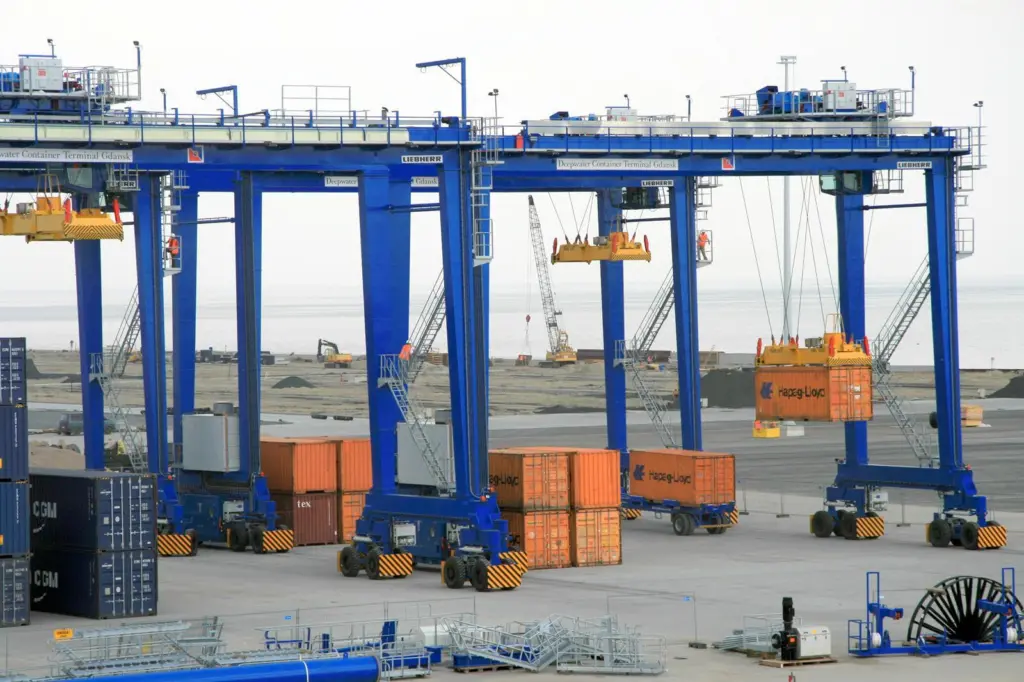
Robin McLeod, technical director at DCT Gdansk, says calculating life cycle cost (LCC) is “a black art as far as I am concerned, and dependent on a number of quite subjective assessments” – but that it is essential to track costs.
“LCC is usually trotted out to prove that it is cheaper to buy a Mercedes than a Ford and the only true calculation takes place post-event when the one completes 200,000 miles and you needed two of the other to achieve the same performance.
“You should always track your costs, attributing them to the individual assets so that you can weed out the ones which are costing too much to keep running.”
Depreciation is another issue: “Depreciation is a notional accounting concept to spread the capital cost of an asset over an acceptable period which may or may not represent the actual life of the asset,” says Mr McLeod. “If you get economic use of an asset beyond its deprecation period, you are a hero; if you have to replace an asset before it has been fully depreciated, you are a knave.”
Related Articles
 BULK HANDLING
 BULK HANDLING
 BULK HANDLING