![PortStrategy[GreenPort]](https://www.portstrategy.com/wp-content/uploads/2026/09/PortStrategyGreenPort.svg)





The Art of the Impossible
Containerisation has fundamentally changed the way cargo handling services are paid for. Gustaaf de Monie explores an intricate subject.
Containerisation’s introduction has made it possible to change all-in flat rates with modulation according to size and the status of the boxes (FCL imports, transhipment, transit, reefers and so on). Consequently, container terminal tariffs became much more transparent than those for general cargoes. This simplification was, however, only short-lived. Their complexity started to increase in line with the ever-growing importance of container shipping. Moreover, in the past decade, the major restructuring both in container shipping and port handling, has lead to a situation in which established pricing principles have been seriously challenged.
To better understand the intricacies of container terminal pricing, it is essential to consider its scope, underlying principles and basic concepts. The scope as illustrated in Figure 1, covers all cargohandling activities on the terminal, as well as storage of containers.
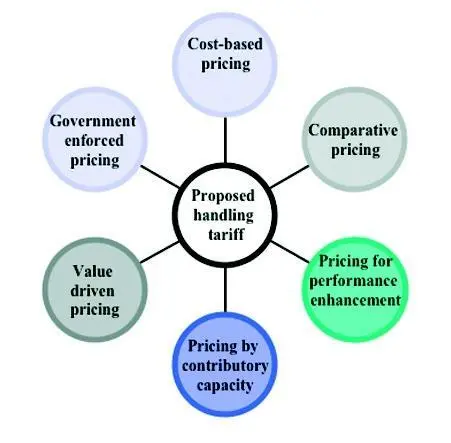
The main clients are the shipping lines, but some handling may specifically be requested by truckers, railways, barge companies or cargo interests. The core tariffs cover the discharge, subsequent handling and delivery of the box on another transport mode, or the loading of a container starting with the receipt for loading, successive handling and stowage on board. To charge for these moves, a terminal operator has a choice between the five major approaches shown in Figure 2. His tariffs mostly incorporate a mix of these.
To achieve his priority objectives and above all financial viability, the terminal operator will adopt what he considers the appropriate approach and strategy. Because of the predominance of fixed costs in terminal operations, handling costs are to a large extent a function of the achieved throughput, as illustrated in Figure 3. As for the objectives, the terminal operator can choose from many, including cost recovery, minimum return on capital investment, throughput maximization, increased market share or optimum use of assets. All these are worth pursuing but clearly priorities have to be set and these are greatly influenced by the relative balance of power between the operator and his shipping line customers.
Negotiated tariffs are the standard procedure where terminal operators enjoy the freedom to autonomously negotiate tariffs with their clients. This approach allows both parties to take into account the most significant parameters that define service quality, productivity and handling capacity such as:
Required berthing window Required number of berths to serve mainline and feeder vessels Guaranteed minimum throughput Minimum sustainable output rates Number of gantry cranes per vessel In many countries however, governments seem unable to refrain from interfering with container tariffs, either because of a genuine concern to avoid monopolistic pricing, or because they don’t want to relinquish their powers. This then results in the imposition of a published tariff which is either used as the sole charging base, or becomes the ceiling rate. Where published tariffs are the rule, terminal performance tends to be abysmal. This is logical because what is paid by terminal users carries no relationship with the actual cost of handling or the demanded performance. Moreover, price discrimination is rife because, although in principle every user pays the same rates, their demand for service will be very different.
Finally, a more sophisticated way for government to continue influencing handling tariffs consists in setting up a tariff authority.
Not only does such an authority take no notice of the requirements of each user, or the specific circumstances prevailing on a terminal, but as for example the Indian Tariff Authority candidly admits, it has no clue as regards the income projections of individual terminal operators and faces great difficulty to assess expenses such as cost of manpower, equipment, maintenance and repairs, and the effects of foreign exchange and index fluctuations.
MORE AMBIGUOUS RULES Container terminal pricing has traditionally been a complex game with high stakes (in 2005 the global annual container handling bill can be conservatively estimated at US$50bn). Recent developments in container shipping and terminal handling, in particular acquisitions, mergers and joint ventures, have however created a new situation with regard to terminal pricing. The rules of the game have become far more ambiguous. A major shift of power is underway, with container shipping lines taking a prominent and sometimes controlling interest in container terminal operations. The strength of the major container lines (in terms of global network, total number of containers moved and intermodal capacity) has grown to such an extent that they increasingly demand special dedicated terminals, invest in joint ventures with terminal operators or set up their own terminal operating companies.
Apart from the fear that a lack of terminal handling capacity is becoming a serious impediment, they see the development of their interests in terminal handling as a way to participate in a business that is perceived as highly profitable. Because of the confidential nature of negotiated contracts and the sluggishness of published tariffs, the impact of this on terminal pricing is only now beginning to be noticed. In terms of impact on tariffs three cases can be distinguished:
1. the shipping line and the terminal operator have signed a dedicated terminal agreement 2. the shipping line operates its own terminal and is sole user or the shipping line is in a joint venture with one or more other shipping lines for the operation of a terminal only serving vessels of the shareholding lines 3. the shipping line is in a joint venture with a terminal operating company for the operation of a multi-user terminal.
In the first case the agreement will, by definition, be of a mediumterm nature and is usually based on guaranteed throughput volumes.
For both parties, the agreed rates will be value driven. Therefore they may be marginally more favourable to the line that signed the dedicated agreement than for the ones that are being served at the non-dedicated facilities of the same terminal operator. The latter, next to acknowledging the contributory capacity of the line, also aims to achieve his cost-based pricing objectives. Performance enhancement plays a minor part in price setting, because it forms an integral part of the contract agreement.
In the second case the shipping lines have a choice. They can consider their shipping business as their prime concern and the terminal operation as a supporting activity that doesn’t need to recover full cost. Overall value for the transport chain is then the first priority. Consequently, the terminal operation may subsidise the shipping lines’ activities. Or, both businesses are strictly ring-fenced in which case the rates paid by the line(s) will come close to prices based on cost. Neither comparative or value driven pricing then applies.
The third case is the more complex as the terminal operator and the shipping line are partners in a commercial business venture. To understand the potential impact on the tariffs paid by the line, one needs to know the precise objectives of both partners. What takes priority for the shipping line: the return generated by the terminal operating company or the possibility to push rates down and get better value and performance from the operating company?
What is the main objective of the terminal operator shareholder: to ensure loyalty of the shipping line or create common value? It is a case in which rate discrimination becomes almost unavoidable.
Over the next months the relationship between shipping lines and terminal operating companies is bound to shift even more. New information will become available about the shareholdings of the lines in such companies, the ultimate goals of their involvement and the impact this has on themselves and on competitors. This will put the involvement of shipping lines in terminal operations fully in the spotlight. Consequently much pricing instability in terminal operations will occur. Watch this space! It promises to get interesting.
Related Articles
 BULK HANDLING
 BULK HANDLING
 BULK HANDLING