![PortStrategy[GreenPort]](https://www.portstrategy.com/wp-content/uploads/2026/09/PortStrategyGreenPort.svg)





Claims camouflage
As trade volumes have fallen and times have become less frenetic, port insurance claims have slowed, reports Felicity Landon
If there is one positive to come out of the recession, it is that ports are under far less pressure than two or three years ago. That has almost certainly resulted in a reduction in claims for certain types of incidents, says Peregrine Storrs-Fox, risk management director at the TT Club.
However, he is careful not to suggest that we can all relax. “Obviously, we keep banging the safety drum, as do a number of organisations internationally and nationally. I think safety is definitely a strong focus in the ports industry, and that is something we certainly find very welcome – and we are not going to let up, because there is still room for improvement.”
Mr Storrs-Fox says the TT Club has seen a reduction in claims from the ports sector in the past 12 months or so, but says that while this is almost certainly partially due to the fall in trade volumes, there are other factors – for example, parties might have increased deductibles.
What remains true is that “behaviour” is the single most significant factor in all of the claims it handles, whether these are asset or bodily injury related.
The TT Club, which insures more than 400 ports and terminals globally, recently published an analysis of insurance claims which showed that while 29% of claims incidents were caused by weather, 26% were related to maintenance and 45% were caused by operational issues. As Mr Storrs-Fox points out, the latter two can be added together under the “behaviour” bracket.
“Operational issues obviously cover behaviour – but so does maintenance, because this is something that hasn’t been done.”
Throughout the boom times, the club frequently issued warnings that the claims environment was getting worse – and it continued to warn members, giving them advice on specific issues to which they should pay attention. Now there is more time to carry out maintenance and operate safety, but the question remains whether cash-strapped ports will cut back in these areas.
“Undoubtedly there will be a certain amount of cost-cutting or reduced maintenance, although we haven’t seen anything coming through that would suggest that has been an operational or, indeed, insurance risk,” says Mr Storrs-Fox.
Among the issues the TT Club continues to highlight is the risk of ships hitting cranes, or cranes hitting ships: “We have spoken repeatedly about what you can do to stop this – for example, using anti-collision sensors,” he says.
However, such collisions and other incidents caused by the weather can be a different matter.
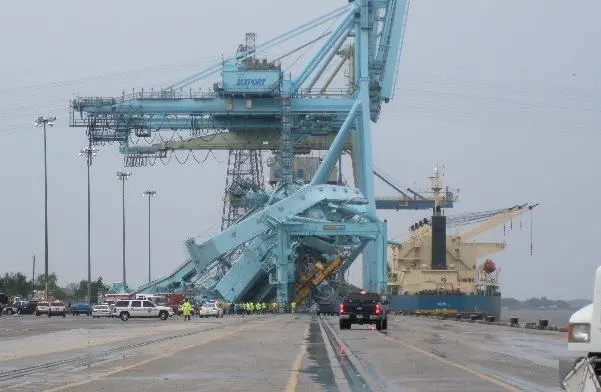
There have recently been some significant wind storms in areas where they might not necessarily be expected, he says. At the end of last year, a crane was unusually blown over backwards on the Aleutian Islands off Alaska. A storm in Malta toppled containers in January.
Industry-wide figures indicate that weather-related claims such as high wind damage to equipment are increasing, and many of these could easily be prevented by better tie-down procedures, says Robert Barnett, of Marsh’s marine practice.
“Some significant claims have been experienced due to a vessel impacting either the berth or crane as a result of high winds or large swells. It is acknowledged within the industry that some emphasis and consideration needs to be placed on ship movements and berthing procedures in order to mitigate claims,” he says. “This places an increased focus on improved risk management procedures.”
The combination of wind storms and recession interestingly create a new risk. Gielijn Arends, manager claims marine at Rotterdam-based Amlin Corporate Insurance, says: “Empty containers might pose a problem. Because there is less demand and a lot of shipping and leasing companies are not recovering their containers because they don’t need them, we are seeing quite high stacking of containers in ports.”
He warns: “Usually insurers might provide cover for stacking boxes up to a certain level only; when that level is exceeded, insurance coverage might be an issue. When a wind storm comes, hundreds of containers can be blown down. I think that is a major risk to port operations at the moment and is a direct result of the economic situation. Ports and terminals should bring their risk management in line with their insurance cover.”
He adds that a big fear for ports and terminals is the danger of a vessel parting from its moorings in a major wind storm – and this as ships continue to get bigger, so that the implications of such an incident are more serious.
“The giant containerships now operating offer a very, very large surface to the wind. So if a vessel like that parted from its moorings and was blown around the harbour, causing pollution and damage, the vessel might face some very heavy liabilities. Which in turn might be brought up against the port or terminal the vessel parted from.”
Another major issues in ports and terminals is bodily injury – and in recent times, many of these incidents have involved temporary personnel, who are not experienced enough or don’t know how to handle the equipment.
In the recession, many ports have shed their temporary workforce, so that the resource that remains working at the terminal tends to be a more dedicated and experienced workforce. “That can have a positive influence. Bodily injury leads to very high claims,” says Mr Arends.
Related Articles
 CONCESSIONS & INVESTMENTS
 CONCESSIONS & INVESTMENTS
 CONCESSIONS & INVESTMENTS