![PortStrategy[GreenPort]](https://www.portstrategy.com/wp-content/uploads/2026/09/PortStrategyGreenPort.svg)





Crane simulator article
Learning institutions give the usual simulator suspects a run for their money. Alex Hughes reports
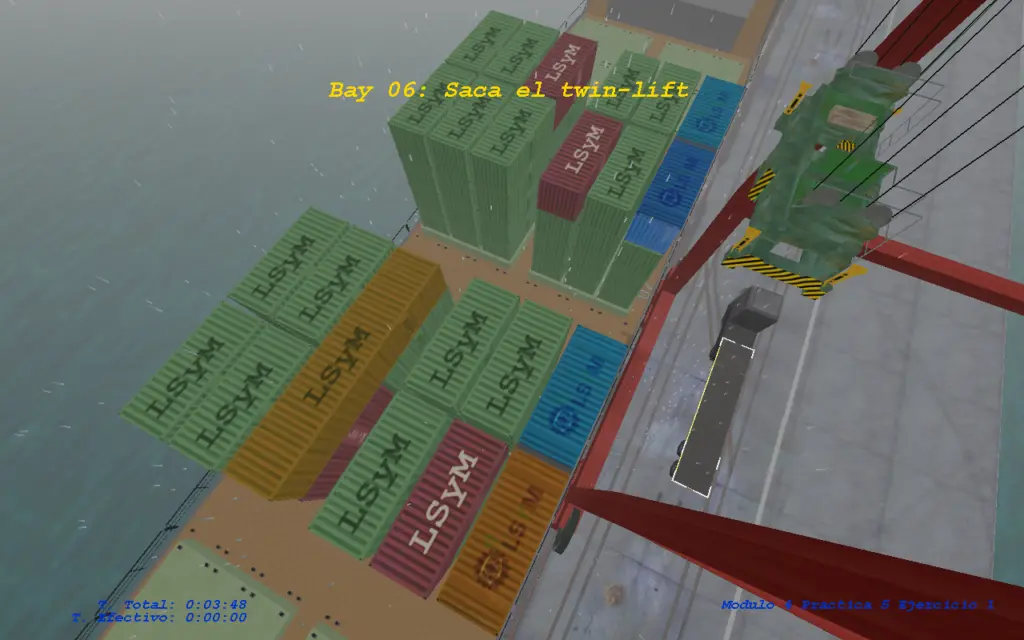
In the competitive crane simulator market, a new breed of supplier is causing waves among the traditionals – universities.
These educational institutions are increasingly using their skills to offer alternatives to an audience hungry for fresh thinking.
Rio de Janeiro-based Virtualy, for example, is associated with Rio de Janeiro’s Univeridade Federal (UFRJ), while the University of Valencia’s Robotics Institute (LISITT) acts as a player in its own right in this expanding market.
Virtualy has already sold two crane simulators to Italy, one of which was acquired by Genova Port Authority. Initially, it built simulators for quayside gantry and yard crane operation, although its range now extends to encompass reachstackers and terminal tractors.
LISITT, for its part, provided the state-owned port stevedoring company, Sevasa, at the Spanish Port of Valencia, with a gantry crane simulator in 1997, incorporating 3D real-time graphics. This was followed in 1999 by a second phase development, which added new features, such as lateral vision for rubber-tyred gantry, conventional, mobile harbour and quayside gantry cranes, as well as providing simulation of Mafi tractor operation.
Sevasa’s experience with simulators is now being used to benefit the EU’s OPTIMUS project.
“In the past, port workers in Valencia were trained on real cranes. However, it was not productive to take these out of normal service just for training purposes. The introduction of simulators helped reduce the number of crane breakdowns and also significantly reduced occupational health and safety risks during training,” explains a Sevasa spokesperson, adding that fewer hours now need to be spent on using real cranes for training purposes.
The Valencia simulator enables manoeuvres and exercises to be repeated, while training can be carried out in a wide variety of simulated conditions. These include bad weather, such as wind and rain; working with broken down equipment; or at night. According to Sevasa, it would not be viable to gain this experience using real cranes.
Virtualy company director, Marcus Gandier, believes that the good experience obtained by terminal operators and port authorities around the world could prompt modernising Brazilian ports to acquire simulators, too.
“We know that the closer we can get to the real training environment, the greater the immersion and therefore the more realistic the training. So we have developed an environment based as closely as possible on real cabins, duplicating everything that an operator would find,” Mr Gandier says.
In this respect, the motion system in his company’s simulators is very important, as is the concept of motion cue. Virtualy therefore aims to recreate as close an environment as possible to the real thing, with the company having developed its own 3DOF or 6DOFmotion systems, including washout algorithms.
“We believe that crane simulators are an essential part of training, because they keep down overall training costs, whilst enhancing safety once the operator starts working on the quay,” he says. The instructor can determine the degree of training difficulty, thereby providing a more didactic and methodological experience.”
Indeed, he points out that there are certain procedures that can only be performed in a simulator. Deliberately making mistakes during on-the-job training, for example, would be unacceptable. However, simulator instructors can put trainees in highly dangerous situation, where they might be confronted by a combination of the worst possible weather conditions and the lowest imaginable visibility, and then see how they deal with emergencies.
The Valencia simulator has also been built to be as realistic as possible. The cabin and controls are identical to those of a real crane, and the shadows created at particular times of day and during particular weather conditions are also highly realistic.
In fact, the simulator was built to recreate many different variables encountered during a typical working day. These include rain, wind and fog, as well as different light and sound conditions, which are identical to those experienced by operators using real cranes. Among operations, trainees learn about starting and stopping a real crane; loading and unloading a lorry; undertaking on-board vessel moves; trimming; control of twist locks; working with 20 and 40 foot containers; manual and automatic operational modes; and how to turn wheels on an RTG in order to change lanes.
However, the Sevasa spokesperson acknowledges that a simulator is never going to be exactly the same as the real thing, but it is sufficiently real to ensure that trainees acquire the necessary knowledge and skills in all the operations they will have to carry out once this stage of their training is complete.
Significantly, Virtualy simulators can be configured to combine the use of different pieces of equipment into a single work station. So, multiple configurations of quayside gantry crane can be offered, along with virtual training using ships gear, mobile harbour cranes and other forms of lifting equipment.
While this doubtless helps in making an investment case, a study undertaken by the Port of Genova also showed training port workers without simulators cut annual profits by around ¢2m ($2.9m), because novice operators were slower, resulting in longer vessel turnaround times, as well as being more prone to accidents.
“New recruits trained in simulators gain experience without prejudicing operations on the quayside. At the same time, you can train workers to be much more flexible and therefore help them to operate various types of equipment. In the end, by investing in simulators, ports and terminals should be able to cut their overall training budget,” says Mr Gandier.
Sevasa calculates the return on investment by looking at the number of hours that can be saved prior to the operator being ready to work on a real crane and in the reduced number of breakdowns and occupational health and safety risks.
Related Articles
 CONCESSIONS & INVESTMENTS
 CONCESSIONS & INVESTMENTS
 CONCESSIONS & INVESTMENTS