![PortStrategy[GreenPort]](https://www.portstrategy.com/wp-content/uploads/2026/09/PortStrategyGreenPort.svg)






Crane simulators
MerseyMaritime, Drake Port Distribution Services and technology supplier AIMSSolutions (Liverpool) Ltd are collaborating on a radical new trainingprogramme for port operators under the Quay Skills banner.
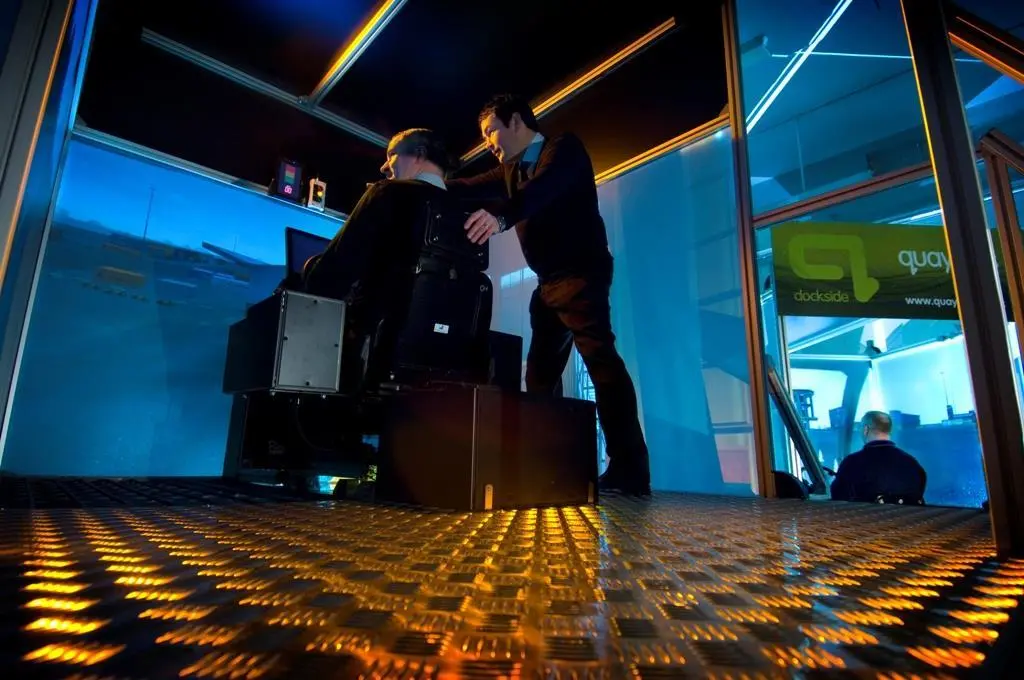
This involves the provision of three simulators, one of which will simulate operations on a straddle carrier, a second offering both quay and gantry crane simulation and a third combining fork-lift truck and terminal trailer activities.
Unlike previous simulators, those being developed by AIMS will retail at between £60,000 and £120,000, radically cheaper than anything similar currently available in the market. This is due to dramatic changes in available technology.
In the four years it took AIMS to win grant funding for the eventual contract with Mersey Maritime, equipment got better and cheaper. Projectors, for example, can nowadays be acquired for £1,500, whereas four years ago they cost in the region of £10,000. Such savings have allowed AIMS to be able to deliver a very good product at a hugely accessible price.
However, despite the highly accessible price, AIMS managing director Bryan Denby stresses that the equipment will still offer port operators all the functionality they need.
“There is always a balance to be struck between quality and price, but you don’t need to spend a fortune to get good quality; quality, after all, is about value, as much as anything,” he says.
“Our simulators won’t be incorporating top end extras such as motion platforms. But the extra price you would have to pay for these isn’t really necessary. Indeed, you have to view simulators in the same way that you look at word processing programmes: they offer immense functionality – but how much of that do you really need?”
The simulators under development for Mersey Maritime are essentially two metre square cubes, incorporating three to four screens mounted on three walls and a driving position with appropriate hand controls. The most complicated of the five simulator applications under production is that for the straddle carrier, which requires a full complement of four screens, including projections of what is happening beneath the machine. In the terminal tractor/FLT simulator just three screens are necessary, with switch over from mode to the other being achieved in under 10 minutes.
“Trainees will undertake training in the simulator immersed in images from the Port of Liverpool, which is where they will be working. However, if other ports wish to either acquire their own simulators or buy time on those supplied to Liverpool, appropriate images from their terminals could also be captured and projected onto the screens,” says Mr Denby.
He adds that AIMS had approached the project from a health and safety angle, with the simulators aiming to reduce the number of accidents registered by newly qualified equipment operators by letting them get a feel for their equipment in the simulator.
“We can highlight the dangers, let them experience hazardous situations and see whether they can spot those situations developing before letting them loose in the terminal itself,” says Mr Denby.
In addition to health and safety, he believes that there will be extra benefits from being able to measure cycle times and see whether employees are operating controls in the most efficient way. However, that is not the main aim of the collaboration with Mersey Maritime, he adds.
The simulators will become part of an integrated training approach, which also includes initial classroom theory sessions and on-line assessment systems which have also been developed as part of the project. However, Denby is very clear that the simulators won’t replace the need for on-the-job training. Instead, he believes they will accelerate people up the learning curve, although this won’t necessarily mean new employees will get through the training any faster.
“It is also possible to use simulators for aptitude testing: assessing whether people have got the ability to operate port equipment. By early identification of those that haven’t, a port operator can cut down on wasted training.”
For those not contemplating purchasing a simulator, Mersey Maritime will be offering short courses to interested parties, which Denby says will help them receive good quality training, without having to stump up capital costs of acquiring the equipment.
Related Articles
 CONCESSIONS & INVESTMENTS
 CONCESSIONS & INVESTMENTS
 CONCESSIONS & INVESTMENTS