![PortStrategy[GreenPort]](https://www.portstrategy.com/wp-content/uploads/2026/09/PortStrategyGreenPort.svg)





Credit in the crunch
Getting credit for cargo handling equipment in the current financial climate need not be too much of a problem with manufacturers offering a number of finance deals, reports Patrik Wheater
The advent of 2007’s sub-prime mortgage crisis in the US has led to a liquidity squeeze that has already impacted on the shipping sector’s ability to raise capital, though not to the extent that was initially envisioned. Ports too are affected as banks and finance houses remain reluctant to invest, making it increasingly difficult to get finance for port development projects or even credit for equipment purchases.
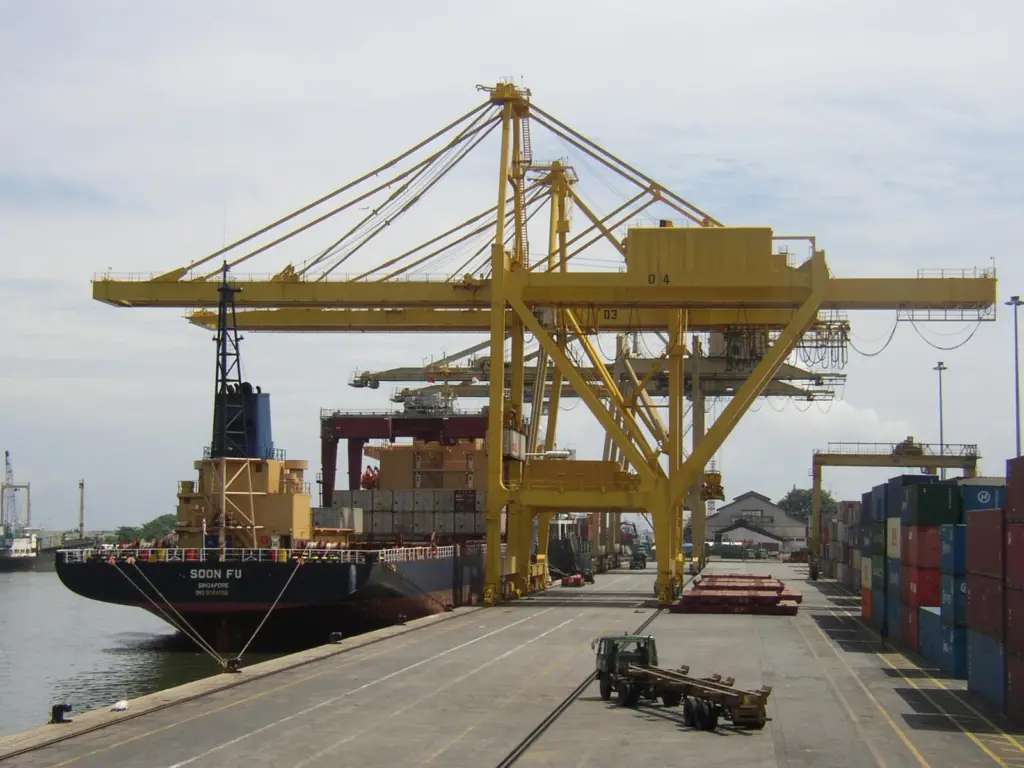
For operators entering the market, especially those looking to establish smaller 200,000 teu capacity terminals, credit is sacrosanct, but the inability to secure a loan can make the difference between success and failure since the initial outlay for say two brand new panamax-size cranes and four rubber-tyred gantry cranes could set you back between $15m and $20m – a substantial amount for even the established port operator in an industry that traditionally fails to yield significant profit.
However, most manufacturers these days make equipment available through various schemes of one another, such as operating leases, finance leases, export finance deals and contract renting.
Where ownership of equipment is unimportant the operating lease allows port operators to use the gamut of equipment required to successfully run a port over a determined period against payment of a lease fee, usually based on capital and interest.
Unless the lease period is renewed the equipment is returned to the manufacturer.
Jason Smith, Kalmar’s sales and marketing manager, Contract, says that according to International Financial Reporting Standards this type of arrangement, common for equipment with a functional second-hand market, “is advantageous because in most countries it is classified as an off-balance sheet” transaction so you don’t need to activate the equipment as an asset. Capital allowances are claimed by the leasing company and therefore the port operator can gain the benefit of reduced lease payments, which for accountancy purposes are a tax deductible expense.
Port operators can also negotiate contract rental deals. Kalmar’s three- to seven-year arrangement for instance is ostensibly the same as an operating lease but with a maintenance package add-on that helps control operational budgets. Based on a fixed monthly price Kalmar’s service scheme includes the servicing and repair of its and other manufacturers’ equipment over the given lease period.
Finance leasing on the other hand can eventually transfer ownership of the equipment to the port operator. For this type of arrangement, once the lease period ends and all capital and interest payments are complete, the port operator automatically becomes the owner of the equipment or, depending on the nature of the agreement, can buy the equipment at a pre-determined price, often lower than the anticipated future market value. Where the equipment has a long useful working life, the lease period can be extended into a secondary period at a nominal cost.
While port operators can utilise the equipment for a minimal capital outlay, the nature of the arrangement means that those who acquire equipment in this way have to account for it on the balance sheet, as if they had paid for the equipment with cash. Mr Smith acknowledges, though, that in many countries local accounting principles allow the lessee to treat the finance lease as an operating lease and payments can usually be treated as a tax deductible expense. Value Added Tax, which is only payable on the lease payment and not in full at the start of an agreement, as in a Hire Purchase arrangement (see below), can be spread over the lease period.
According to Kalmar, leasing equipment in either way frees up capital for use elsewhere, helps maintain liquidity and credit lines, and can improve the return on assets, solvency and gearing ratios.
Hire Purchase, regarded by the tax man as an interest bearing debt, is another option of course, but here you record the equipment in your fixed assets, and claim capital allowances on the equipment as if you had purchased it for cash. Kalmar can also arrange normal debt financing under an Export Finance agreement guaranteed by an Export Credit Agency (ECA), but this is usually only offered to emerging markets where access to medium/long term financing with reasonable terms is often limited. ECA’s involvement adds value to Kalmar customers via longer repayment periods and attractive rates, although to benefit from this support a down payment if 15% of the contract value is requires so only 85% can be financed. The repayment period is typically from three to seven years depending on the contract value.
Port operators, especially those running smaller feeder ports that may not have the means of fronting up the cash or finding sources of credit for new equipment, can also pick up good finance deals for second-hand, refurbished equipment, and Singapore’s Portek International has delivered an array of refurbished, customised equipment as part of finance and operator lease packages.
“We have arranged finance leases for cranes and RTGS for ports in Vietnam. We have done finance leases for straddle carriers and operating leases for bulk un-loaders in the Philippines, and a whole host of operating leases for equipment in Jakarta, Indonesia.
” We work out the port’s exact requirements and because we are not a manufacturer, but an operator that also specialises in customising and refurbishing surplus cranes from one port to another we can guarantee the availability of cranes, and therefore don’t have to tender and wait for new cranes to be manufactured. It’s usually a much cheaper way than getting a crane, maybe up to two thirds the cost of a new crane, so you immediately save on the costs, that’s the number one benefit. Number two is, depending on how the lease is structured, we can maintain the cranes for the user as well,” says Portek’s executive director Boon Hoe Ooi.
He says this way there is no financial risk for the operator and because Portek itself is an operator, it has all it takes to start up a small terminal: the engineering, the management expertise, the intellectual property required in terms of software and so on. So the best solution for a small port authority, suggests Mr Ooi, “is to ask someone like us to come in and start the terminal up and just sit there and collect royalties”.
One major operator believes, however, that agreements with equipment manufacturers to buy equipment over a certain period of time are more applicable to those operators running a number of ports. Wishing not to be named, Port Strategy’s contact at the port said the gist is to lock in on the best price and get a discount based on the potential large quantity of equipment to be purchased. Generally, it applies well to equipment (or components of equipment) that are homogenous across the operator’s ports. This framework approach also fares better for port operators which have the ability to coordinate the equipment purchase across the ports they have control over.
In today’s inflationary climate, many equipment manufacturers may not be prepared to hold prices beyond a short period; alternatively, they would want to build in escalation which is pegged onto, say, price of a certain material, like steel, says the PS source.
Most of the equipment in place at International Container Terminal Services’ (ICTSI) facilities spanning 11 countries in four continents is purchased through general liability, which means the company borrows against its balance sheet to purchase equipment. The Philippines-headquartered operator has been recently offered terms by an equipment supplier, but despite lengthier repayment terms ICTSI treasurer Rafael J Consing’s calculates it is still more economical for the group to borrow the funds directly and purchase the equipment for cash.
Only last month, the ICTSI-operated Batumi International Container Terminal (BICT) acquired two new Gottwald mobile harbour cranes. The new cranes, acquired to increase Batumi’s container handling capability in the Black Sea, have already attracted the interest of several shipping lines who are now showing interest in calling at BICT.
Related Articles
 CONCESSIONS & INVESTMENTS
 CONCESSIONS & INVESTMENTS
 CONCESSIONS & INVESTMENTS