![PortStrategy[GreenPort]](https://www.portstrategy.com/wp-content/uploads/2026/09/PortStrategyGreenPort.svg)





Do simulators provide Effective Training?
Simulare Port Technology puts the case for the benefits of simulator training.
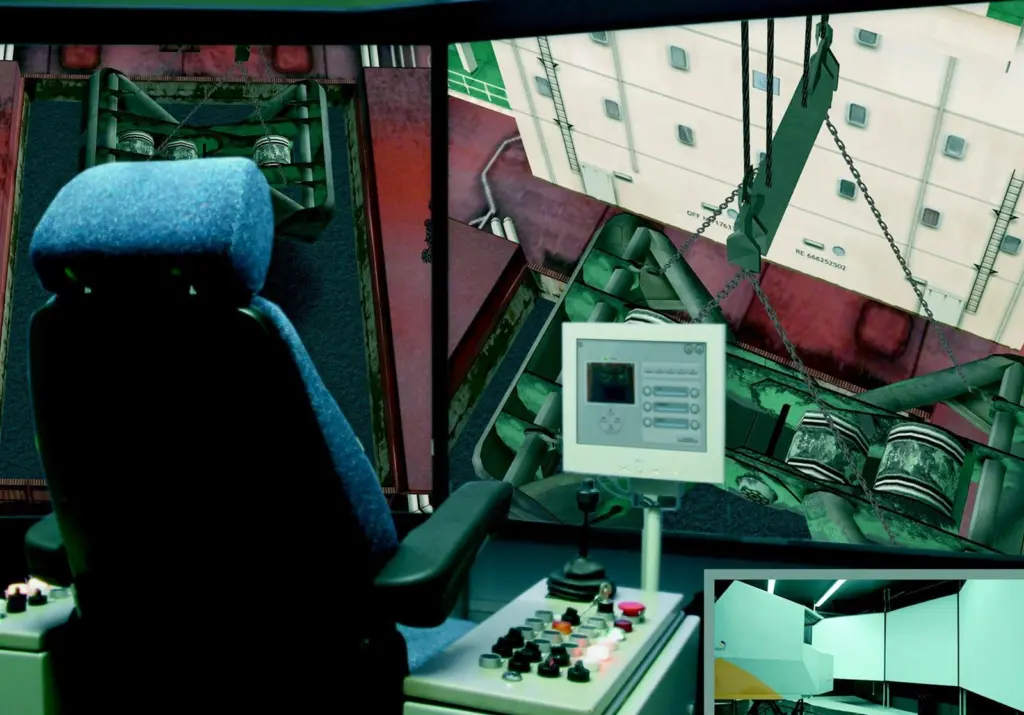
Training simulators are an increasingly common sight at our sector’s worldwide trade fairs. But do they provide effective training? Simulators have been used in the aeronautical and military sectors for many decades. Taking flight simulators as an example, pilot responsibility is greater than in most roles that terminal operators have to deal with. If simulators deliver effective training in such critical situations, it simply doesn’t make sense to think that simulators can’t provide effective training to crane drivers and other machine operators where the cost of a mistake is gladly, often only economic.
The effectiveness of the training that simulators can provide can be broken down into the following areas: as a selection tool; to provide basic training; and to provide advanced training. As a selection tool, or for basic and advanced training, simulator training is better and safer than training in real machinery. In a shorter space of time, and without risk, container and dry bulk terminals can determine whether a trainee has the set of skills required to enter a training programme.
Simulators can then provide the variety of working conditions, as well as both standard and less frequent manoeuvres to deliver comprehensive training. This allows trainees to obtain a wide set of skills and have the confidence to operate real machinery.
Studies have shown that for new trainees, 20 hours spent in a high quality dry bulk crane simulator, virtually eliminates the risk of costly grab to ship and grab to hopper collisions. Afterwards, trainees have the skills and confidence to begin mixing their training with real machine time. When it comes to increasing productivity and learning complex manoeuvres such as swings in dry bulk unloading, once again, simulators give trainees the skills and confidence to be able to take on such manoeuvres in the real crane.
Quality in a simulator is the key to providing effective training and obtaining a return on investment. The reason that simulators have had limited use in industrial fields until now has been due to the elevated cost that this quality required. Companies such as Simulare Port Technology now offer high quality simulators at costs that are accessible to all terminals around the world.
WHAT MAKES A SIMULATOR AN EFFECTIVE TRAINING PLATFORM?
Quality in a simulator is key. Quality can be broken down into the following areas: mathematical modelling, graphics, level of immersion, and instructor port support systems.
Mathematical models should be tailored to each port’s machinery so that the simulator reflects the sensitivity of the crane controls and the corresponding crane behaviour and speed of movement. There is little point in getting used to a set of controls and a speed of movement that does not reflect a terminal’s real installations.
Graphics should be custom developed for each terminal’s facilities and installations. Everything in the operator’s field of view should be customised – the quay, vessels, grabs, spreaders, cranes, the stockyard, materials, etc. – to reflect each terminal’s facilities. This provides familiarity between the training environment and the real terminal environment making the transition to the real machine far more effective. Furthermore, a simulator should recreate all manner of weather conditions, including wind speed and direction, as well as offering day and night training scenarios. Finally, dry bulk simulators should offer training in various material densities and corresponding types of grab.
Immersion means that the trainee is made to believe that the simulator is as real as the machine itself. Simulators will never be 100% identical to real machinery. However, simulators should offer an extremely high level of realism thanks to the immersion that should be built into the design. Motion platforms deliver the same vibrations and movements as in a real crane, to the simulator cabin; audio systems deliver machine noise and background noise to the trainee.
Finally, the projection system and cabin design itself, ensures that the view the trainee receives is a 100% simulated view. Immersion delivers concentration, which in turn results in effective training.
Instructor Post support systems are important to make the most of every hour a trainee spends in a simulator. Simulators should offer full training session recording, briefing/debriefing tools, statistical analysis as well as a tutor to allow trainees to follow a training programme.
Simulare Port Technology, with its modular and customised Terminal Training System (TTS) delivers this functionality, offering quality simulators that are developed for each individual terminal. Our simulators provide effective training systems generating the intended return on investment that terminals are looking for.
Related Articles
 CONCESSIONS & INVESTMENTS
 CONCESSIONS & INVESTMENTS
 CONCESSIONS & INVESTMENTS