![PortStrategy[GreenPort]](https://www.portstrategy.com/wp-content/uploads/2026/09/PortStrategyGreenPort.svg)






Odds stacked against high Oz handling
Carriers treat Australia as “the end of the bus line, says Searoad Holdings John Hunter, “with the result that we often don’t get the best ships.” This, he says, is one of the reasons for productivity and efficiency being lower than it should.
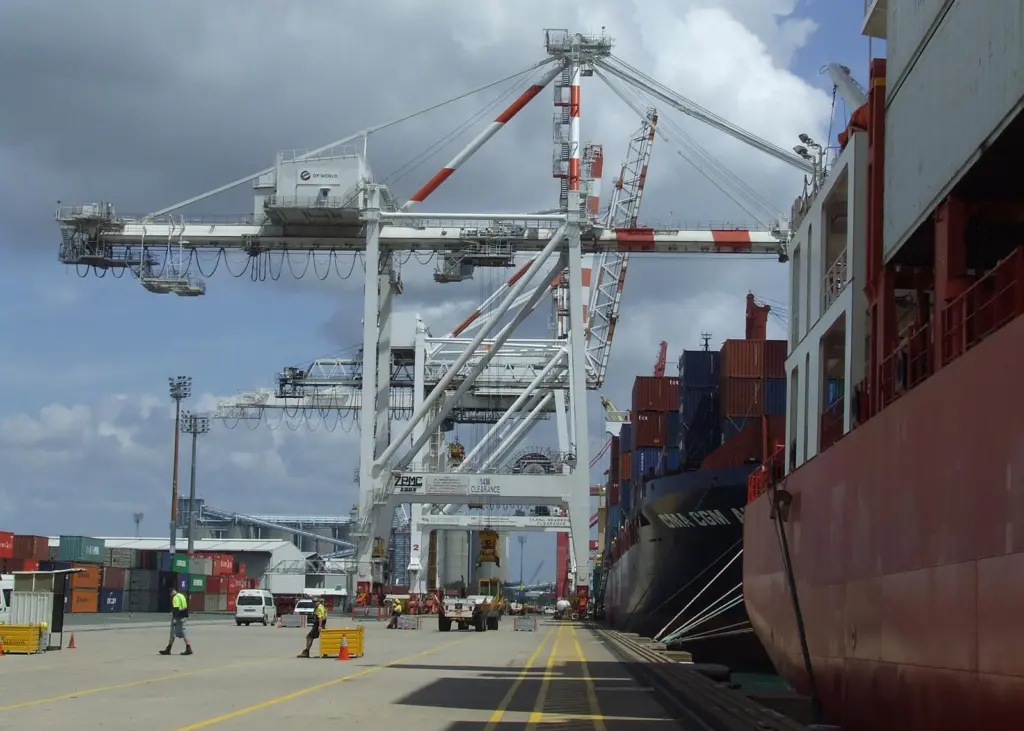
Central government policy also has a bearing. “The government reckons that there must be competition at every port, but the amount of business is too small to justify more than one operator – so you have two stevedore companies supposedly competing – with the result that there is over capacity.
“Australia has a small population for its size but due to demands for competition (not least from the government competition watchdog, the Competition and Consumer Commission), there is considerable over-capacity at all ports. All major ports have two stevedores (DP World and Patrick) and the east coast state governments (Queensland, New South Wales and Victoria) have bought the commission’s line that a third stevedore is required for true competition. Hutchison Ports Holdings is in the process of developing Brisbane and Sydney facilities (after billions of dollars of taxpayers’ money to reclaim land) and a new facility is on offer in Melbourne.
“This obviously results in all stevedores suffering from periods when they are either extremely busy of completely idle,” says Mr Hunter. “The introduction of berthing windows agreed with shipping lines has assisted in levelling out ship arrivals, and hence demands for labour. However, all stevedores have the problem of how to cope with peaks while avoiding surplus labour at other times.
“In general, all stevedores employ sufficient permanent stevedores to cope with, say, 75% of the peak workload and use a mixture of part-time permanent employee and supplementaries to provide sufficient labour for the remainder.”
Mr Hunter is not keen on incentives for reaching certain productivity rates, “as they simply encourage employees to either work faster (i.e. take risks) or take short-cuts (e.g. divide the gang into two to do twice as much work). Either way, I believe incentives lead to risks to occupational health and safety. In any event, in the event of an industrial dispute with the union, the union is likely to tell its members to go slow, even if this means the employees not earning a productivity bonus i.e. any productivity gains are at the whim of the workforce and not sustainable or reliable.”
Related Articles
 CONCESSIONS & INVESTMENTS
 CONCESSIONS & INVESTMENTS
 CONCESSIONS & INVESTMENTS