![PortStrategy[GreenPort]](https://www.portstrategy.com/wp-content/uploads/2026/09/PortStrategyGreenPort.svg)






Port Tariffs and THCS The Perpetual Controversy
Gustaaf de Monie considers the eternal argument over port tariffs and THCs and concludes it is an inevitable result of a timeless principle.
Few issues seem capable of angering shippers more than that of Terminal Handling Charges. The argument whether the underlying principle for THCs and the levels of the charges are justified, didn’t start in 1966 when containerisation was introduced on the international trade routes, but only from the mid 70’s onwards. Only then did the European shipping conferences realise that because of containerisation a fundamental change had occurred in the pricing of cargo-handling in ports As Figure 1 shows, for break-bulk handling under liner terms, the shipowners pay the stevedoring (the cargo-handling on board) directly to stevedores appointed by them. Handling on the landside is carried out by cargo-handlers, appointed by the shipping line’s local agents.
Their charges are based on a tariff set by the local association of shipping lines. Agents pay them and pass them onto the cargo receivers. Hence, the split of the total handling cost between the ship (responsible for the stevedoring costs included in the freight rate) and the handling costs on the landside (borne by the cargo interests) is automatic.
The handling of containers on specialised terminals started a sea change in the manner cargo handling costs are charged. On request of the lines, terminal operators introduced all-in pricing, covering the cost of handling from ship’s hold to delivered onto truck or rail wagon.
Consequently, the separation between the charges for stevedoring and landside cargo-handling disappeared. Container lines didn’t immediately realize the implications of lump sum pricing or react to recover from the cargo owners the charges they paid for but which according to the B/L the latter should have paid. When that realisation dawned the container lines, they (and not the terminal operators) introduced a recovery charge or THC.
Strong opposition against this charge from both shippers and receivers followed. Over time, however, the nature of that opposition has considerably changed. Initially, the cargo interests questioned the legitimacy of THCs. Today, the number of those that continue to oppose THCs from a contractual and legal point of view, is fast declining. The present criticism rather focuses on the perceived lack of transparency; the actual levels of THC; the great variation between THC levels on different routes; and the belief that THCs are an exponent of monopolistic pricing. In order to assess the correctness of these allegations it is first necessary to consider the relationship between the different port charges and verify who should pay for them under liner terms.
WHO SHOULD PAY As shown in Figure 2 and notwithstanding a great diversity in terminology, the overall structure of port charges for liner shipping can be broken down in two major groups. Besides the charges paid for by the shipping lines and recovered through the freight rates such as pilotage, towage or stevedoring 2, there are charges for services that are excluded from the freight rate coverage and have to be paid for separately (cargo-handling on the landside, storage after free time, etc. ). If there is usually no discussion about the first group of charges, the second group often gives rise to disagreement or even conflict, as it isn’t clear who should pay for them (this may depend on contractual clauses between seller and buyer or on the custom of the port) and how much. Moreover, the party that gives the order for carrying out an activity is not necessarily the one paying. The latter is specifically the case for the cargo handling on the landside where the shipping line issues orders and cargo interests pay. Although this may seem odd to outsiders, it is a regular arrangement based on the principle of ‘common interest’. Otherwise every cargo owner could decide who should handle his cargo on the landside, resulting in the loss of unity of control and operational chaos 3. Port charges can also be classified by underlying pricing principles, notably:
cost (average, direct, short or long run marginal costs, full costs) the ‘contributing’ capacity of the vessel or cargo benchmarking based on the tariffs of leading ports government directed pricing Although all port-related entities claim to set their prices exclusively on a cost basis a review of port tariffs shows that the above mentioned principles are often simultaneously applied, because even freely negotiated prices constitute a compromise between pure cost arguments and commercial considerations. Moreover, the purist economist may well insist on an exclusive cost basis, but in a real world this doesn’t work out. In setting port dues on ships and cargo, port authorities are forced to resort to a great deal of arbitrary decisionmaking in order to set rates for different vessel types, services, etc.
This is highlighted by the rebate systems that apply (e. g. rebates based on vessel type and dimensions, number of vessel calls in a given period, type of service). On the other hand, cargo-handling tariffs between shipping lines and terminal operators can be agreed to a large extent on cost basis, as long as average annual cost for handling a specific service are negotiable. Trying to assess the cost of handling an individual box is, however, unfeasible and unrealistic.
ARE THE GRIEVANCES JUSTIFIED?
The above reminder of some simple facts on port pricing is a good starting base when deciding whether the grievances of shippers concerning THCs are justified.
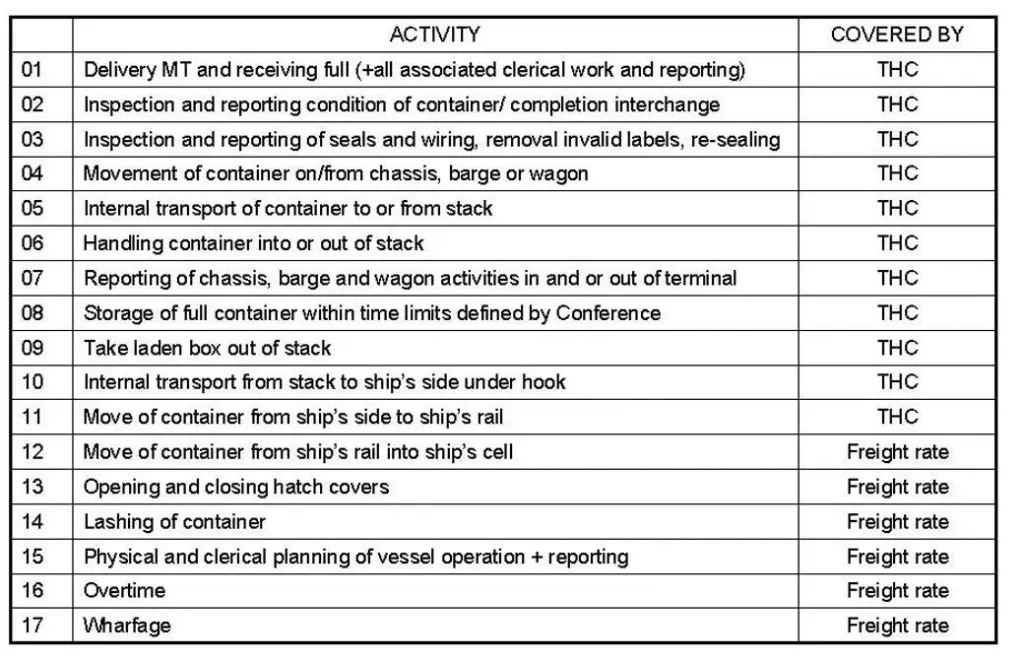
First and foremost, it should be clear that THCs are not a surcharge as is still claimed by some cargo interests. Since 1989 there exists a common understanding between shipping lines and shippers’ organisations that the cost of handling containers on a terminal4 represents some 80% of the handling cost that is initially paid by the shipping line to the terminal operator. Unfortunately, the handling tariff agreed between shipping line and terminal operator is part of confidential contract negotiations. Consequently, the actual price paid by the lines is not known to shippers. The suspicion therefore arises that the Conferences impose a THC which is well above the 80% level of the all-in terminal charge the lines pay. This would mean that they not only aim for cost recovery but use THCs to generate supplementary revenues.
The THCs applied by different conferences show significant variations in level. Assuming that the all-in handling rates are cost-based, then cargo owners should not be surprised by these differences, because the productivity parameters5 that determine costs can significantly differ from route to route. Nevertheless, some differences in THCs can be noted, that are difficult to explain away by merely pointing at the observed variation in productivity. Hence, the suspicion is further fuelled that some conferences use the THCs to make up for a shortfall in freight rates.
PERCEIVED LACK OF TRANSPARENCY When the conferences include in the THC other charges then shippers organisations may have a point when claiming that THCs are insufficiently transparent. Regrettably, shippers use the argument mainly to demand specific cost data for each activity covered by the THC. Such a demand is unreasonable because segregation of cost per activity and for individual shippers is an unworkable proposition. The nature of terminal handling will always impose a certain level of cross-subsidisation between the various parties depending on their commercial bargaining power and political weight. If THCs would be decided in the same manner as freight rates, or incorporated into them (as some shippers are demanding), there would be no transparency at all. Large contract buyers of shipping space would then clearly pay much lower THCs than the majority of the shippers. The favourable freight conditions that big buyers agree on FOB basis are the real problem, because they leave the exporters to pay for the THC charges.
JETTISON WASTEFUL STRATEGIES The continuing debate about the relevance and validity of THCs finds its origin in the timeless principle, that to be commercially successful a company has to maximise revenues and minimise costs. That is exactly what both the shipping lines and the cargo interests try to achieve, the former by defending THCs and the way their levels are decided, the latter by questioning the THC rationale. Quite naturally, the lines are tempted to set THCs at levels that generate more revenue than pure cost recovery would warrant. And of course cargo interests do either push the charges onto other parties or demand their abolition. Maybe all interests would be better served by coming back to first principles and agree on what the port industry knows as being a reasonable level for a simplified THC based on audited cost figures from the shipping lines. More time would then be available to consider operational arrangements that could help to reduce the overall cost of maritime transport through closer interaction and the jettisoning of wasteful self-centred strategies.
1Most Conferences serving Asia only followed suit in the early 90’s.
2Thus the unfortunate use by some authors of the term ‘stevedoring’ to mean all cargohandling activities carried out by a terminal operator, only adds to the confusion regarding the justification of THC charges, as it seems to confirm the contention of some shippers that also cargo-handling on the terminal would be covered by the freight rate.
3Moreover on a container terminal the principle of ‘unity of control’ is now fully endorsed. This leaves no room for any other operator but the terminal operator to handle containers on the landside.
4See box 1 for the detail of the activities on the landside.
5Such as type and size of ship, number of exchanges per vessel call, stowage patterns, etc.
Related Articles
 CONCESSIONS & INVESTMENTS
 CONCESSIONS & INVESTMENTS
 CONCESSIONS & INVESTMENTS