![PortStrategy[GreenPort]](https://www.portstrategy.com/wp-content/uploads/2026/09/PortStrategyGreenPort.svg)






Right to work
Swings and roundabouts predominate as the industry tries to find a perfect labour solution. Martin Rushmere reports
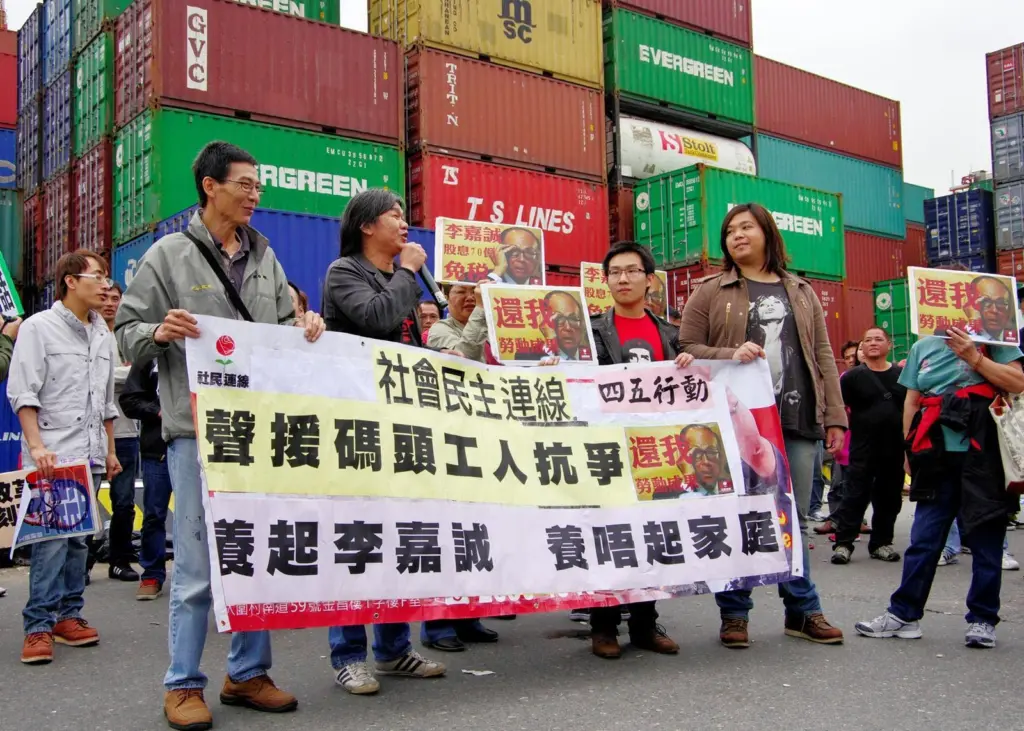
Hong Kong is probably the least likely location for a port strike, and yet the success and determination of the recent stevedore walk-outs have shaken the very roots of the industry.
At first dismissed as a small group of malcontents, the protestors wrung out a 9.8% pay rise even though they are in twilight world of being neither fully union nor contract/salaried workers but something resembling indentured apprentices – although the Confederation of Trade Unions gave its full backing and resources once the strikes began.
Their status and unexpected forcefulness shows there is no perfect answer for dockside labour organisation and that all arrangements have weaknesses. In developed countries the most common employers’ strategy is to accept history, continue with the established system (largely based on a union structure) and concentrate on damping down cost-of-living increases.
From labour’s point of view, the hard truth is that automation and more IT is an unstoppable process and that the smartest approach is to get the best combination of wages and benefits.
Terminal operators often want to change the system but know they are unable to on their own and instead have set up associations staffed by non-partisan professionals to handle disputes and deal with routine waterfront operations.
Upside down
In Australia however, the system works the other way around and provides an intriguing lesson for other countries. Employers negotiate individually, while dockworkers are grouped under the Maritime Union of Australia.
John Hunter, national stevedoring manager for Searoad Holdings, says: “This caused the pendulum of bargaining power to swing completely the opposite way. The MUA now has knowledge of every agreement being negotiated by every stevedore nationally, whereas the individual employer can only know about its own operations.
“There are three outcomes of this. Firstly, there can never be an agreement strongly in favour of one company because the MUA knows that every other stevedore will demand the same conditions (which it will know about by viewing FWA’s website). Secondly, the MUA therefore submits excessive claims in the expectation that it will be beaten down, but the claim(s) are so high it can afford to compromise and still win a good outcome for its members. And thridly, every MUA member will obviously want the same good conditions won with the previous stevedore – after all, they pay the same union dues.”
One way
In many other countries, national regulations mandate the use of unionised labour and any attempt to employ private contractors is illegal. And the emphasis is on tamping or even capping pension and cost-of-living increases. Canada is governed by the national Labour Code, with employers working through regional Maritime Employers’ Associations. The Montreal association has just completed a six-year contract, lasting through to 2018.
“This is a ground breaking agreement for us,” says Jean Bedard, president and chief executive. “The contract was signed before the old agreement ended, highly significant in itself, and provides for major reductions – up to 30% this year – in job security benefits (roughly equivalent to the royalty agreements on the US East Coast).
“The initial Job Security Program saving in 2013 is approximately C$2.5m for 2013,” says Mr Bedard. “The cost of the programme in 2012 was C$9m. Everyone here knows that we have to be flexible to be extremely efficient so as to compete with other ports. But, being a destination port we don’t have the complexity of matching inward and outward cargo. Vessels coming here are mostly unloaded completely.”
The gang system of staffing has long been done away with and dockers are called on as needed. Two operators per eight-hour shift are assigned for each crane.
Automation is becoming more prevalent (the dispatch system is fully computerised), but Mr Bedard reckons that Montreal will always need a considerable degree of manual work. “Being on the St Lawrence means that the layout is irregular, while automated ports are almost all symmetrical and square.”
He is one of an increasing number of industry executives who shy away from comparing port success and achievements in terms of crane movements per hour and similar measurements. “We have been arguing about this for years with Vancouver and others. The ports are all so different and the factors so varying that it can give a distorted picture of what is happening.”
Union growth
In the US the urge for salaried workers has long been dominant, but unionised labour roots are deep and the rise of the east and west coast unions has been relatively unhindered. Most ports have embraced the unions – Seattle deals with at least a dozen.
“Policy on this is decided by the board of harbour commissioners,” says labour relations director Gary Schmitt, “but this pattern is likely to continue. The secret is for both sides to be open and honest with each other, which is difficult at times. But we face tougher times and stronger competition and have to realise that we need to face that challenge.
“Over the next five years there will be more conservative contract agreements with the unions – they will last a shorter time and increases related to health care will be lower.”
A couple of hundred miles south of Seattle there has been severe turmoil, with lockouts, strikes and police action. The reason? An analyst notes that the upheavals have all been at bulk and breakbulk ports, whereas Seattle is largely containers. Labour is fragmented – the ILWU has to work with other unions because of the different nature of the commodities and there is disagreement between the various groups.
Employers have outflanked the ILWU by dealing with individual unions, guaranteeing a good hourly wage but being absolutely merciless on the fringe benefits. And it has worked.
Coupled with this has been the determination by both sides to avoid the possibility of the federal government getting involved plus increasing public anger at what are seen as unwarranted wage levels. In 2011 royalty payments (compensation for lost jobs because of containerisation, insisted on by the unions 40 years ago) on the East Coast were about $15,500 per worker, on top of the normal wages.
Related Articles
 CONCESSIONS & INVESTMENTS
 CONCESSIONS & INVESTMENTS
 CONCESSIONS & INVESTMENTS