![PortStrategy[GreenPort]](https://www.portstrategy.com/wp-content/uploads/2026/09/PortStrategyGreenPort.svg)






Simulators: use this one, not the previous!!!
With training simulators now more affordable than ever, should ports still be risking on-the-job training? Alex Hughes investigates
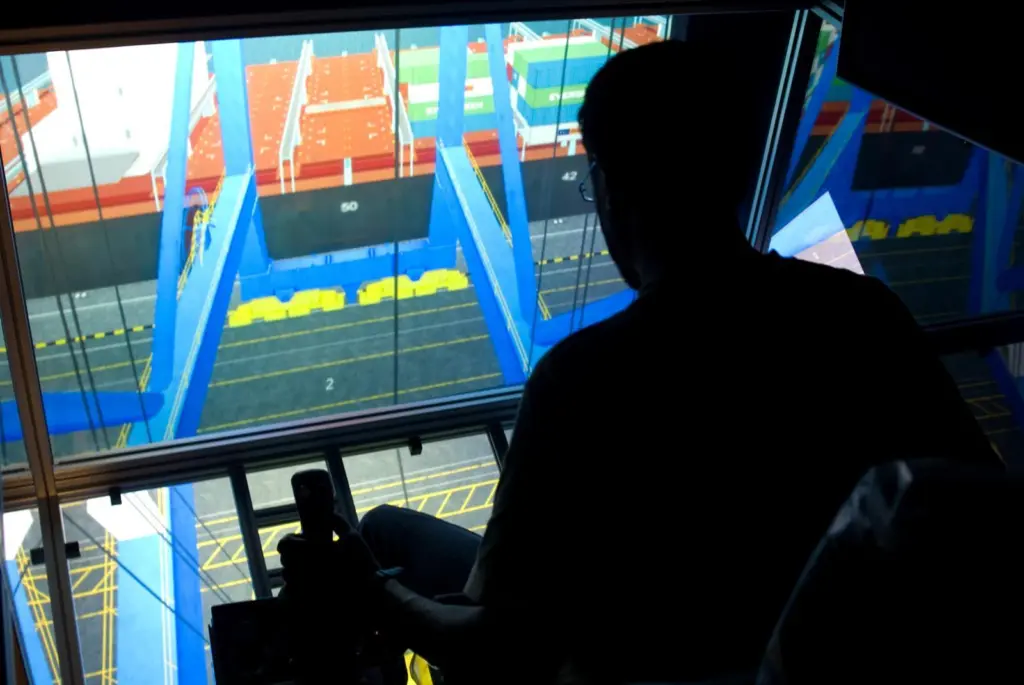
Once viewed as expensive toys, manufacturers of crane simulators now claim they not only help operators save money, but investment payback could be in as little as 12 months. New Delhi-based Applied Research International (ARI) offers a wide range of advanced virtual crane simulator solutions, from desk top, kit-based and multi-purpose trainers up to multi-model, multi-visual, instructor-controlled, motion-based full crane simulators. Depending on specifications and client configurations, prices can range from a few thousand US dollars to over $1m. Typical customers include terminal operators, port authorities, ship managers, trade unions and original equipment manufacturers.
“We have crane simulator installations across North America, the Indian sub-continent and South East Asia. So, for those terminals not wishing to purchase a simulator of their own, they could approach some of the training establishments that offer simulation training to third parties. Alternately, ARI could work on client specific requirements,” company spokesperson Raksesh Yadav tells Port Strategy.
Similarly, simulators produced by the MPRI Simulations Group are purchased by port training entities and academic institutions on the one hand and by port authorities or terminal operators on the other, remarks Dan Lamothe, the director of crane products. Cost, he says, is dependant on configuration, modules and application, so can vary between $470,000 and $2.4m.
“If a port operator doesn’t have investment available for a simulator of their own, there are various colleges around the world that offer training to third parties. For example, the Shipping & Transport College in Rotterdam offers a training programme catering to the needs of the maritime port industry,” he says.
Mr Lamothe adds that potential customers are particularly interested in the advantages that a simulator will ultimately bring them, both in terms of saving money and improving operator efficiency. Unfortunately, he says, there is little hard data available to substantiate many of the claims that MPRI makes for its products.
“We calculate that a training course can be completed in less time by using a simulator; students take between 60% and 75% of the time than they would using other training methods. Clearly, compared to conventional training, a simulator is significantly cheaper,” he says.
“Both efficiency and productivity are improved after going through a training programme on the simulator, thus one could argue that it is an effective training device designed to train new operators, whilst also having a role in enhancing skills or refreshing skills of experienced operators.”
But how can simulators help owners save money? ARI’s Mr Yadav points to gains in terms of shorter training periods, better trained operators and also by building up a well documented record of how both novices and experienced operators are ultimately trained.
“There are clearly savings in the cost of training, a reduction of personnel accident risk and of damage to both the environment and also to the equipment itself. Training can take place at any time and in all weather conditions, whilst allowing operators to practice hazardous and life threatening scenarios and at the same time learning to increase their operational efficiency.”
Asked about return on investment, he notes that payback could be within a year on just the cost of training and improvements in operational ability. However, when peripheral and notional benefits are included, simulators pay for themselves even faster.
MPRI, which produces much more expensive simulators, takes a somewhat different view. Mr Lamothe says that, while it is difficult to generalise, MPRI believes it will take two to six years to recoup the cost of the initial purchase. However, he adds that the payback period isn’t dependent on the piece of equipment the simulator has been designed to mimic.
And clearly, if the owner of the simulator then uses it to generate revenue from outside interests, return on investment can be achieved that much faster.
Asked whether there are any situations in which an operator would not financially benefit from using a simulator, Lamothe says that, from his experience as a master trainer with direct hands on training responsibilities, virtually everybody put through a programme before real life operations will benefit.
Related Articles
 CONCESSIONS & INVESTMENTS
 CONCESSIONS & INVESTMENTS
 CONCESSIONS & INVESTMENTS