![PortStrategy[GreenPort]](https://www.portstrategy.com/wp-content/uploads/2026/09/PortStrategyGreenPort.svg)






Turning of the tide
As the economic tide ebbs, terminal operators continue to invest for the future, writes Patrik Wheater
The first quarter of 2010 saw a definite ebb of the recessional tide for terminal operators, with a number of big players reporting increases in throughput and more favourable financial results than the same period last year.
International Container Terminal Services (ICTSI) posted first quarter revenue from port operations of $120.7m, an increase of 30% over the $92.8m reported last year. APM Terminals’ Q1 results evinced an 8% rise in the number of teu handled to 7.6m and the same period saw Dubai-headquartered DP World attest a 15% growth in volume to 11.2m teu, largely driven by strong growth in Asia Pacific and Australia.
Similar upward mobility was registered by Gulftainer. This UAE-based operator, whose operations include the container terminals at Sharjah and Khorfakkan, had an impressive 2009 with container volumes nudging towards a 10% increase over the previous year. Even with the global downturn, Gulftainer forecasts a positive 2010 with financial results showing some degree of growth.
Due to the big economies of Saudi Arabia and Iran, the Middle East has been relatively unscathed by the crisis that has hit terminal operators elsewhere, although the decisions by a number of major liner operators to reshuffle their services in order to utilise their larger ships more effectively has also helped the region.
Gulftainer has certainly noted an increase in the number and size of vessels that is using its terminal at Khorfakkan, and this trend, according to the group’s commercial manager Keith Nuttall, is expected to continue. “The surrounding region is still reasonably buoyant… Overall there are some signs that the worst of the crisis may soon be over, but the specific Dubai economy will take time to recover,” he says.
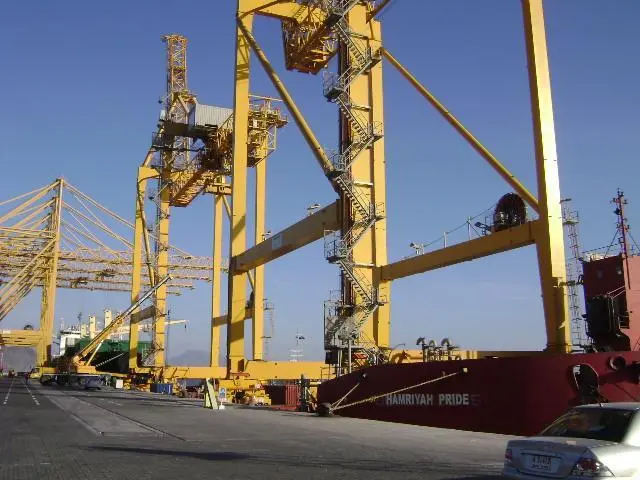
Indeed, to meet anticipated demand, Gulftainer has expanded its facilities at Khorfakkan with the completion of the multi-million dollar Phase Two development which has increased its 1,460m quay by 440m and added four new Liebherr super post-panamax gantries with tandem lift facility. This brings the total number of gantries at the terminal to twenty.
Equally, the pace of traffic at Gulftainer’s terminal at Sharjah is such that both operator and Port Authority have accepted that more investment is needed to keep up with demand and the terminal is being expanded to cater for future growth. An additional berth, situated at 90 degrees to the current terminal, is to on the cards and the terminal’s overall draught is to be dredged to 12.5m. An additional container storage area of 30,000m2 will also be made available for rubber-tyred gantry cranes and back-up equipment.
Looking further afield, Gulftainer has consolidated overseas activities in the Comoros, where a port management contract is progressing successfully in Moroni, Pakistan, where the operator is involved in a logistics and haulage joint venture, and Turkey, where a new logistics venture was set up in mid-2008.
Initiatives in Iraq are being progressed and these include the appointment of Gulftainer as a joint-venture partner with local airline Azmar Air to provide official cargo handling services at Sulaimaniyah Airport.
Moreover, in June it was announced that Gulftainer had in fact been awarded the concession to operate and manage container facilities in Umm Qasr Port, the key marine gateway to Iraq. The two contracts are for Berth 8 in the South Port, and the new berths 10 & 11 which, when complete in about a year, will become the new Iraq Container Terminal (between South and North Port) in Umm Qasr with two berths and four shore Gantries.
Meanwhile, tapping into an increasing trend for the provision of port-centric logistics services, Gulftainer is working on a co-operation agreement with plastics company, Borouge, to provide on-site logistics services at Borouge’s polyolefins plant in Ruwais, Abu Dhabi. Borouge will expand services considerably in 2010. The strategy follows the recent setting up of Gufltainer subsidiary Momentum Logistics at the tail-end of 2008, to offer a complete range of supply chain management services, including transportation, warehousing, freight forwarding, logistics cities, container repair, and contract logistics.
Port-centric logistics is in fact a strategy that the UK’s PD Ports has also been quick to adopt. Following the location of major distribution centres for UK grocers such as Tesco and Asda at the company’s Teesport terminal, PD Ports is fast becoming a UK leader in the port-centric logistics concept, which, according to the operator, drives down costs and greatly reduces road miles travelled by distribution vehicles.
Indeed, it is feasible that when the belated Northern Gateway Terminal becomes operational, PD Ports, which recorded a whopping 51% increase in throughput in the last six months of 2009 over figures for the same period the previous year, could expect greater demand for this kind of service. In any event increased container capacity is inevitable.
PD Ports has also earmarked the offshore wind and renewable sector as a viable new area into which it can diversify and new container services have recently been launched, including Samskip’s weekly service between Teesport and Zeebrugge and BG Freight’s second weekly link with Rotterdam. Shipping lines, including Evergreen last year, are adding the port to their schedules to take advantage of the increased business going directly into the north-east of the UK (rather than via southern ports).
The UK’s Northern Gateway, however, will pale in comparison to DP World’s London Gateway port and business park project, which the Dubai conglomerate expects to add an additional 3.5m teu to the UK’s port capacity.
Infrastructure development of the 1,500-acre site commenced in March, and although it remains uncertain as to when exactly the terminal will be fully operational, it is being marketed as “one of the most automated and efficient in the world”.
Simultaneous to this development, DP World has continued on a much needed project to increase new capacity in Callao, Peru and Vallarpadam in India. Both these terminals are scheduled to be operational by the end of this year and will position the group strongly for growth over the medium to long term.
APM Terminals, too, continues to evaluate new port and terminal development opportunities and in May signed an agreement with the Virginia Port Authority (VPA) for a 20-year lease of the 1m teu capacity facility in Portsmouth.
The 291-acre state-of-the-art terminal, the largest privately owned container terminal in the US, will be operated by the VPA’s terminal operating arm, Virginia International Terminals. APM Terminals will retain ownership of the terminal and its major assets, and receive an estimated $800m from the terms of the lease, which includes volume incentives.
Related Articles
 CONCESSIONS & INVESTMENTS
 CONCESSIONS & INVESTMENTS
 CONCESSIONS & INVESTMENTS