![PortStrategy[GreenPort]](https://www.portstrategy.com/wp-content/uploads/2026/09/PortStrategyGreenPort.svg)





A TALE OF TWO TERMINALS
Alex Hughes reports on how Karachis two rival container terminals are gearing up for further capacity and volume growth.
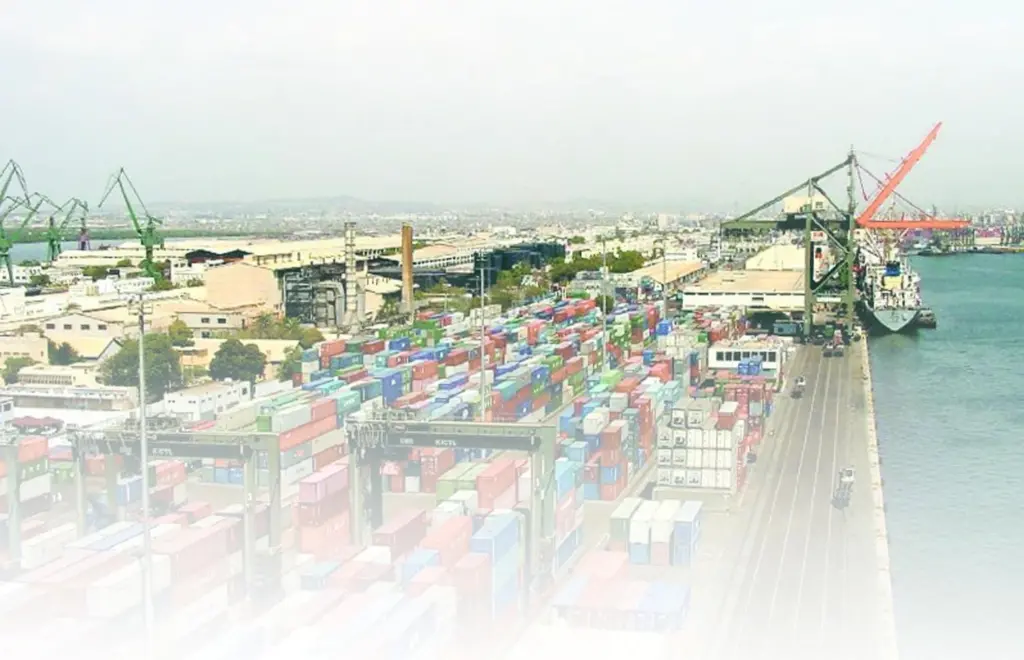
The initial phase of Pakistan International Container Terminal (PICT), located at Karachi’s East Wharf, opened on 31 March this year. In fact, PICT had commenced limited operations in August 2002, with a small pool of equipment consisting of two MHCs, three reachstackers, three front-loaders, one empty container handler and ten tractor/trailer combinations.
However, the full Phase I development required even greater lifting power. ZPMC was therefore contracted to supply two quayside gantry cranes with a 46 metre outreach and four 1-over-five and 1 + 7 stacking RTGs. Fantuzzi Reggiane chipped in with two 45-tonne reachstackers, one top-loader and two empty container handlers, while two smaller FLTs were also acquired from TCM (China) plus ten tractor and 20 trailer units from Texas-headquartered Capacity.
The immediate effect was the capture of two additional liner services which should enable throughput to continue its upward trend. For example, 59,145TEUs were handled in 2002-03, when 110 vessels called, rising to 90,543TEUs and 130 vessels in 200304. As from April, when the new ZPMC cranes became operational, PICT has reported monthly volumes of 10,500TEUs, almost double the previous average.
The $30m cost of the terminal was financed from various sources, including an August 2003 IPO; PICT now being the only publicly quoted container terminal to be listed on the Karachi Stock Exchange.
However, main shareholder remains Premier Mercantile Services (PMS), a mainstay of Pakistan’s box handling market since the 1960s.
PMS also raised investment from the International Finance Corporation (IFC) and the OPEC Fund for International Development, who stumped up a combined $17m in loans to underwrite construction work on Phase I, which was carried out by the China Beijing Corporation.
The four-berth terminal has a 600 metre quay and alongside draught of 12.2 metres, although this could eventually be dredged to 13.5 metres. Capacity at the 120,000 sq metre site is 150,000TEUs, although two subsequent phases are due to raise this first to 300,000 and ultimately to 450,000TEUs.
Main rival is HPH’s Karachi International Container Terminal (KICT), which in 2003 reported a throughput of 360,000 TEUs, up around 2% over 2002’s 358,500 TEUs. According to CEO Khurram S Abbas, KICT’s traffic will not be affected by the opening of Phase I of PICT since there is sufficient volume in the port for both terminals.
Furthermore, he notes that the expected shift of container traffic from geared to gearless vessels should also generate additional shipping line calls at both terminals.
Indeed, KICT has already embarked upon a Phase III expansion of the terminal in collaboration with Karachi Port Trust (KPT) with this in mind. This will result in 60% additional capacity coming on line through the acquisition and redevelopment of new surface area, the purchase of new container handling equipment and the deepening of the alongside draught to 14 metres.
“At present, there is no congestion at KICT and the terminal is capable of handling additional volumes, ” notes Abbas, adding that three additional post-Panamax cranes, eight RTGs, four reachstackers, two empty container handlers, 18 tractor-chassis combos and two FLTs are currently on order.
When asked about productivity, Abbas emphasises that the terminal has reached an average level of 24.8 moves-per-crane hour, which is due in part to KICT employing all dockworkers directly, with fixed salaries including additional incentives and benefits.
Nevertheless, productivity and service levels will improve thanks to the introduction of radio data terminals and automation projects covering the yard and the gate. Furthermore, Expert Decking and Equipment Control modules are being added to the NAVIS terminal operating system, whose software is also being upgraded.
Furthermore, the terminal is working with the Customs authorities on the implementation of an automated Customs clearance system in order to reduce dwell time at the terminal. “With the above mentioned initiatives underway, we are confident that KICT’s productivity will surpass our competitors in the region, ” emphasises Abbas.
Related Articles
 CONTAINER & CARGO HANDLING
 CONTAINER & CARGO HANDLING
 BULK HANDLING