![PortStrategy[GreenPort]](https://www.portstrategy.com/wp-content/uploads/2026/09/PortStrategyGreenPort.svg)





Cargo shift
Ports are looking to specialist solutions for bulk transhipments, as Dave and Iain MacIntyre find out
Whereas container transhipments are an everyday logistics task – and underpin the livelihood of some major relay ports such as Singapore – transhipping bulk cargoes can be a logistics headache for ports.
Remote ports with limited facilities and little appetite for expensive infrastructure investment are having to look to specialised solutions to help solve their dry bulk cargo transhipment challenges.
Plus, in South Australia, there is the example of a state government helping drive through a new port development to find a solution to its bulk transhipment woes.
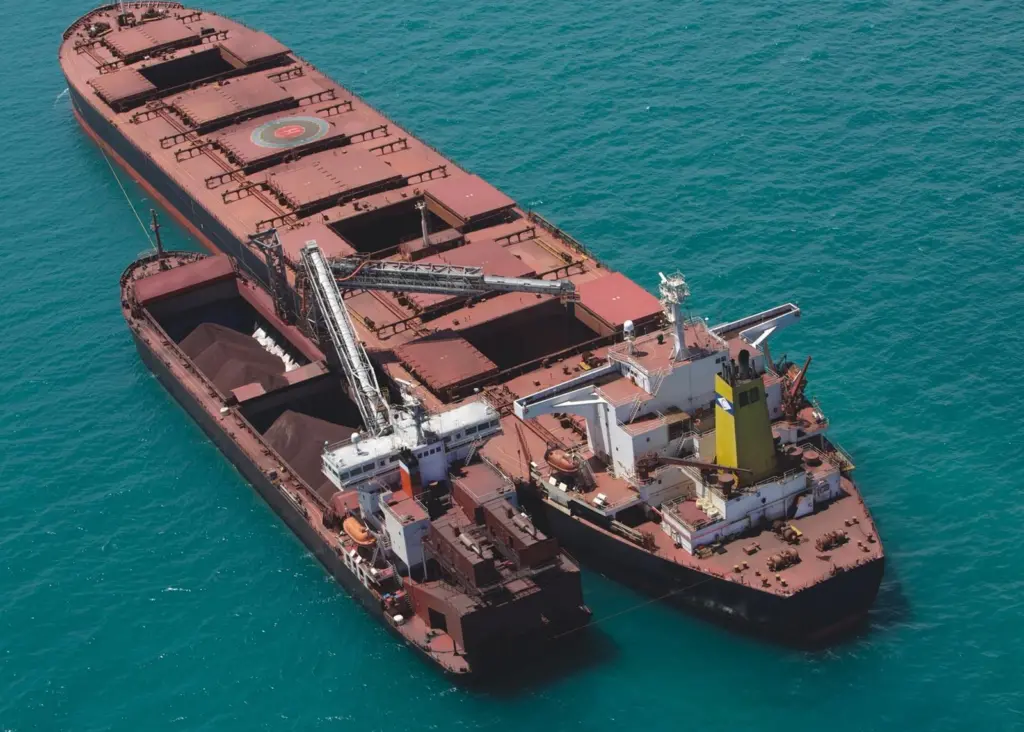
One company which has positioned itself in the niche of bulk transhipment provider is CSL Transhipment, which boasts the capability to develop tailored transhipment solutions from ports with as little as a five-metre draught, feeding offshore loading of export bulk vessels up to capesize.
CSL owns and manages two types of transhippers: gravity-based and crane-based transhippers. Crane-based transhippers feature a crane/shiploader that is separate from the cargo barge or integrated shiploader.
Gravity shuttle barges and vessels feature an integrated shiploader or a shiploader on a separate pontoon. Their sizes vary from large (32,000 dwt) to small (15,000 dwt).
Shuttle time
However, in a recent breakthrough CSL has recently launched a high-capacity gravity transhipment shuttle vessel (TSV) that can tranship cargo at up to 10,000 tonnes per hour and will handle annual capacities from three million tonnes to in excess of 100m tonnes. The design allows for all dimensions – length, beam and draft – to be adjusted to suit the requirements of a particular project.
The TSV ranges between 22,000 dwt and 60,000 dwt – or can be even smaller for severely-restricted ports and rivers.
Jakob Hansen, vice-president and managing director, CSL Transhipment/CSL Asia, says the TSVs provide a “dramatically improved” value proposition compared with older, often crane-based, options, and require only simple shore infrastructure and less or no capital/maintenance dredging.
“The modular and movable nature of transhippers provides inherent scalability and offers a realisable residual value once a mine comes to the end of its life.”
As well as increasing the potential dry bulk cargo throughput at tidal-constrained ports, CSL’s TSV minimises wharfside footprint by eliminating the need to stockpile and is both safer and more environmentally-friendly than shore-based solutions, says Mr Hansen.
“Furthermore, CSL supports mining companies from the pre-feasibility study phase and throughout the life of the mine. In the initial phase, CSL conceptualises transhipment solutions and provides a comprehensive analysis of productivity, throughput, lead time, risk and cost. When an investment decision is made, CSL provides the capital for the transhipper, builds it, owns it and operates it – and guarantees productivity.
“By charging on a per tonne basis, CSL offers mining companies a ‘pay as you earn’ approach.”
Guiding light
In terms of demarcation between company transhipping operations and the port’s interests, Mr Hansen says the port authority will set guidelines for any transhipment undertaken within its limits, while national regulatory authorities govern safety and environmental compliance in offshore operations.
Notable implementation of CSL’s transhipment solutions include Arrium (South Australia) where exports currently are 13m tonnes per year and are expected to rise to 20m tonnes, and ArcelorMittal (Liberia) where exports currently stand at four million tonnes per year and are forecast to grow to between 15m-20m tonnes.
Another example of a new transhipment solution being investigated is in South Australia, where the state is keen to unlock the iron ore resources that have the potential to provide significant benefits to not just the state itself but the national economy too.
However South Australia lacks the port infrastructure to get these resources to market.
Currently, bulk ore operations involve transhipping cargoes via barges, which restrict the options for major ore volumes to be moved.
Of the 250 ships which come through the Spencer Gulf each year, about 50 are capesize which have to anchor offshore and are fed by this method.
Now, South Australia wants to see the construction of bulk mineral transport, handling and shipping infrastructure to open the door to higher transhipment volumes.
Bonython boom
After several years of working to identify a suitable location and consortium to deliver these facilities, Port Bonython was selected by the State Government as the site for a new common-user deep water port for South Australia’s bulk mineral exports.
This decision was reached based on its location within an existing deep water harbour, the availability of development land, access to existing rail infrastructure and its proximity to iron ore mining projects in the region.
The solution involves building a 3km jetty out to 20 metres of water depth, with a cantilever traveller, giving direct access to deep draft ships. The jetty will be equipped with two 250 metre long shiploading wharves and two 4,000 tonnes per hour luffing shiploaders.
The transhipment port will be fed by a 17.5km railway spur from the existing Whyalla to Port Augusta rail line, with a 6km rail loop being created where the spur reaches its terminus.
A bottom-dump facility will be created for trains to offload their bulk ore, and there will be storage areas for ore to be held prior to being fed along the jetty.
Spencer Gulf Port Link has secured development rights from the State to plan, build and operate the new facility.
Spencer Gulf Port Link’s Stewart Lammin, the general manager of Flinders Ports, said the proposed export facility is key to unlocking the state’s multi-billion dollar iron ore industry.
“We’ve seen other states reap the economic benefits of the mining boom, it’s now South Australia’s turn,” said Mr Lammin.
“This state needs an efficient, cost-effective route to the global iron ore market that can be utilised by any mining company, large or small.”
Making an impact
Economic analysis carried out for the proposed Port Bonython Bulk Commodities Export Facility’s Draft Environmental Impact Statement (EIS) suggests that the project would contribute an additional A$10.2to the state’s economy in the next 30 years.
This economic activity is also predicted to create up to 270 jobs in the local economy and up to 630 jobs in the broader South Australian market during construction of the project. During the project’s operation it is expected that around 40 local people will be employed to run the facility with a further 790 jobs created in the South Australian market as a result of flow on economic benefits from the project.
The South Australian Government’s Development Assessment Commission (DAC) is overseeing the planning and approval of the project on behalf of the State Government.
Once the EIS process has assessed the issues associated with the project and engagement with stakeholders and the community has been completed, construction of the facility could begin in 2015.
The build phase is expected to take three years, with the possibility of exports starting from the common-user facility during 2018.
Related Articles
 CONTAINER & CARGO HANDLING
 CONTAINER & CARGO HANDLING
 BULK HANDLING