![PortStrategy[GreenPort]](https://www.portstrategy.com/wp-content/uploads/2026/09/PortStrategyGreenPort.svg)





Chennai Port – looking for space
Chennairefuses to be overshadowed by its neighbours, as Stevie Knight discovers
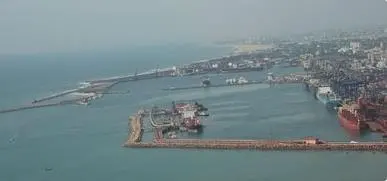
Chennai’s portion of the public-private partnership bonanza is a little less than many of India’s other centrally-owned ports, though the government’s vision is still aimed at raising its capacity by a respectable 50%.
To start with, the port has three docks, 23 berths and draught ranging from 12m to 16.5m and handled an all time high of 57.15m tonnes of cargo last year, registering an increase of 7% over 2007.
It is already investing heavily in upgrades, and at the time of writing was bringing its second container terminal into operation, which will reach full capacity by the end of the year.
The port is putting in road links, a car bay and has a ‘single window’ approach. It is also one of the few to have a shunting yard and rail operations inside the harbour.
Further, a mega container terminal with a continuous quay length of 2km with 18m-22m draught alongside and capable of handling 5m teu a year is expected to be operational from 2013. However, the projects have not been without their hiccups, and the cost of the mega terminal has risen by 21% – ascribed largely to reclamation and dredging work – a cost that the Chennai Port Trust is to bear.
Despite all this, the privately run port of Visakhapatnam, around 70 miles away from Chennai, expects to raise its capacity to almost 111m tonnes by 2012, and the port of Ennore has a planned capacity growth of almost 400% (to 64m tonnes) under the latest set of government initiatives.
The reason for this is relatively simple one of physical limitations. The port of Chennai is one of the oldest in India, and while it has grown over its colourful 126 year history – so has the city around it. When the Inner Ring Road was built in the early 1980s, it used to effectively bypass the city and was valuable for rapid freight movement. The city subsequently grew and subsumed the road – so the Chennai Bypass was planned to relieve congestion. It currently links some of the main roads and a second stage is under construction – but again it is being slowed by the city and now high-speed elevated sections are also being proposed to reduce travel time.
And the difficulty remains that there is relatively little room at the port for a high throughput of cars, which along with containers is one of its chosen cargos, says Eric Maurisson who visited the port to look at establishing a car manufacture-to-carriage route for EUKOR a while ago.
He added that though EUKOR is still trying to establish transportation, the situation has not improved. “Hyundai is already established in the region, and a joint Renault and Nissan factory is already being planned for the same area…” he explains, all putting pressure on available space.
However, the port is pursuing the idea of growing a multi-storey car store layer by layer, and thinks that this, along with the high speed road link, will help ease any problems. But Mr Maurisson is a little doubtful, and points out that putting car decks on the space limits options, saying that ports should naturally be looking at ‘flexibility and adaptability’ to changing circumstances – change being the one thing that virtually any port can be sure of.
Related Articles
 CONTAINER & CARGO HANDLING
 CONTAINER & CARGO HANDLING
 BULK HANDLING