![PortStrategy[GreenPort]](https://www.portstrategy.com/wp-content/uploads/2026/09/PortStrategyGreenPort.svg)





‘Deepening’ concerns
Dave MacIntyre analyses how Pt Terminal Petikemas Surabaya (TPS) has to be a mix of commercial operator, diplomat and pressure group to achieve its strategic ambitions.
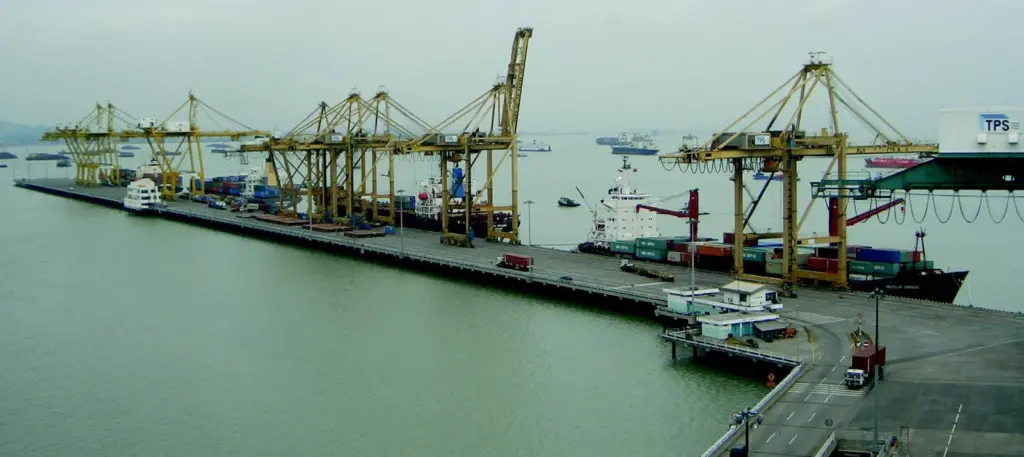
When the delicacies of Asian politics influence port decisionmaking, the ability of the port to fashion a long-term strategy for growth is always open to question. But five years after corporatisation, Surabaya’s international container terminal should have reason to feel pleased with itself. For the first time, in 2004, the joint venture between the Indonesian state-owned enterprise Pt Pelabuhan Indonesia (commonly referred to as Pelindo) and P&O Ports exceeded 1m TEUs in a calendar year.
But even as the terminal looks for a 10% increase in 2005 to 1.1m, TPS is facing a critical decision on an issue which is, quite literally, deepening – dredging of the approach channel to the port, Indonesia’s second largest.
Currently, this provides 9.5 metres draught, meaning that only vessels of about 1,300 TEUs can leave fully-laden. The largest ship to call at Surabaya is about 2,500 TEUs but has to depart with suboptimal loads because it “deadweights out”.
TPS is pushing for the state to invest in the US$50m necessary to deepen the channel to 12 metres over a critical 3km approach stretch, that would position the port to take vessels of up to 4,500TEU ships.
Although TPS is itself an alliance of commercial and political interests (Pelindo has a 51% share and P&O Ports 49%, reflected in the fact that the president director Adji Pamungkas is a political appointee and vice president director David Montgomery is from P&O Ports), there appears to be full management harmony in the commercial strategies adopted by TPS. And this agreement is apparent in the commercial and political pressure being brought to bear by TPS on the Indonesian authorities to tackle the issue of dredging.
Montgomery says a decision is crucial to Surabaya holding onto its growth patterns, and not slipping back to a secondary port status.
“If investment in a deeper channel is delayed, or is not forthcoming, there will be a lot of damage not just to Surabaya as a port but also to the economy of Eastern Java and Indonesia as a whole. The port is important as a container gateway and for the copper ships, the grain trades and the oil trades. All of these markets are looking for bigger vessel sizes, which they cannot achieve at present.
“We have made it quite plain to the Minister of Transport that dredging is essential. Without it, no one is going to invest in further port facilities to assist the growth of the port.”
One of TPS’s fears is that without the capacity to receive larger ships, Surabaya will lose its status as a direct port of call on some liner strings, and instead be served only by feeder services from the Malacca Straits hub ports of Singapore, Tanjung Pelepas and Port Klang.
“Trade in Eastern Java would certainly suffer if that were the case, ” says Montgomery. “Intra-Asian trade is one of the world’s fastest growing, and Indonesian trade with China in particular is forging ahead.
We need to be able to service the trade with direct calls. For that we need to be deeper. The shipping lines are calling for it to happen.
“We are anxious as P&O Ports to see our investment grow, having made a US$175m investment, and for the port itself to prosper, ” he continues. “That is why we are pushing the government and the port authority to look at the longer-term interests.”
There is another reason for putting investment decisions on the agenda now. As part of the charter between Pelindo and P&O Ports, expansion of the container terminal must be planned for when the terminal reaches 75% of capacity. With a target this year of 1.1m TEUs throughput, TPS is at about 55%, and therefore still has something to spare before crisis point is reached. However, the trigger point is at the back of the TPS partners’ minds, and an agreement on the strategy forward would certainly be helpful.
Currently however, because of the complex and sometimes fragmented nature of Indonesian politics, a straightforward decision on dredging is not the only consideration facing the government, its Pelindo agency and the regional Surabayan authorities.
Build a new terminal?
One alternative suggestion is for the development of an entirely new container terminal only 1km away as the crow flies, but on the other side of the bay at Kali Lamong. Another is for a new terminal on a greenfield site 50km away on the island of Madura necessitating a bridge to transfer cargo by road to and from Java.
There are also other, more subtle cross-subsidisation issues, which influence the political landscape. Pelindo oversees a mass of small ports throughout Indonesia most of which are still dependant on old conventional vessels and loading methods. Few of these ports are attractive by normal commercial criteria and therefore the profits accruing from investments such as TPS go to assist them.
The government also regulates charges for the stevedoring of domestic containers. This means that terminals such as TPS operate their domestic trades at sub-economic levels. The feeling is that there is a variety of regulations and decrees relating to port operation and performance and that these overlap and form a muddied basis for guiding the ports towards a more commercial model. Instead, there is scope for the various institutions governing Indonesian ports to act according to self-interest. This is seen as being one of the reasons why Indonesian ports are less successful in competing for a share of the regional shipping market, compared to neighbouring countries such as Malaysia, Singapore and Thailand.
The Indonesian government itself appears to recognise some of the flaws in its ports model. Recently, the Indonesian House of Representatives sought stakeholder input into the question of how port legislation can be tidied up and the tasks and functions of each institution made more certain.
An example of the frustration within government circles themselves at the complexity of Indonesian port law can be seen in the comments of Toto Dirgantoro, president director of Pelindo. In comments reported in the local maritime newspaper, Ocean Week, he said that due to the absence of a clear law on port affairs, ports in Indonesia tend to focus on returns, not on public service. “The role of Pelindo is unclear, whether to provide public service or to find high profits, ” he said.
If Indonesian government agencies themselves have difficulty in determining their boundaries and functions, it is no wonder that a terminal operator has difficulty in obtaining the clear planning support or funding mechanisms to convert a commercial strategy into reality.
Despite this, TPS has managed to achieve significant results since corporatisation in April 1999, embarking on a process of steady improvements in both productivity and efficiency.
This has been assisted by an investment of over US$60m in new equipment and facilities including four IMPSA panamax gantry cranes, 12 Konecranes RTGs, three container-handling machines from Fantuzzi and Kalmar, 35 new Volvo prime movers and double trailers to transport containers the 1.2km from the terminal to the quay cranes on its international wharf, development of 12ha of container yard, and a new container terminal computer system from RBS in Sydney.
The basic ground work and infrastructure is there. Now, all that is needed is a clear mandate from the Indonesian politicians.
Related Articles
 CONTAINER & CARGO HANDLING
 CONTAINER & CARGO HANDLING
 BULK HANDLING