![PortStrategy[GreenPort]](https://www.portstrategy.com/wp-content/uploads/2026/09/PortStrategyGreenPort.svg)





Delta Dreams
The Delta Plan should be a win-win strategy for Spains second port aimed at accommodating the needs of both container and auto clients. Alex Hughes reports from Barcelona.
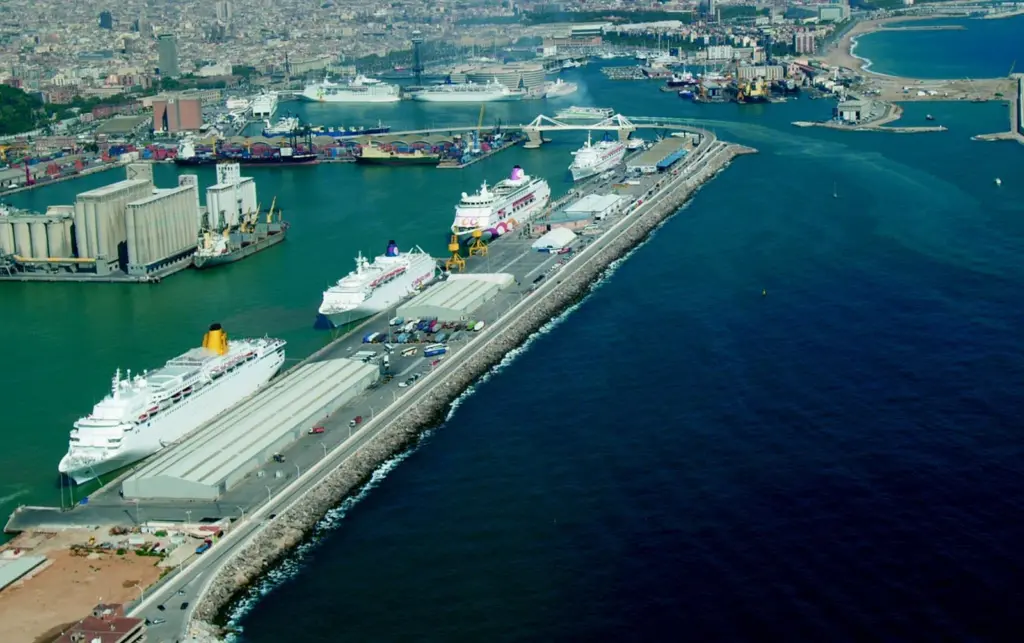
Barcelona port authority has recently awarded a tender for the construction of the first phase of a new southward expansion of the port. Popularly known as the Delta Plan, the idea is to divert the existing Llobregat River away from the port to free up new land for development as maritime terminals.
In its initial phase, 62ha of new land will be added, allowing construction of the third international container terminal to go ahead;
a tender to manage the terminal is due to be issued in this year. The aim is then to have a basic box handling facility up and running by 1 January 2008. A second phase expansion, which would be opened the same year, would bring the total operating area to 110ha.
On the face of it, the Delta Plan appears to be a win-win situation for all concerned. The port will gain more operating area and be in a position to attract additional traffic, thereby allowing it to compete not only against major Spanish Mediterranean rivals such as Tarragona and Valencia, but also to establish itself as a true South European hub port for both containers and new vehicles.
Nevertheless, one major sticking point remains: if neither incumbent box terminal operators TCB or Tercat is awarded the concession to operate the third terminal, thereby freeing up much needed terminal space in the existing port, then blue chip car terminal operators, Autoterminal and Setram, currently desperate for additional surface area of their own, will have their own expansion plans effectively curtailed, because they will have nowhere to go. At present, Autoterminal and Setram occupy a major parcel of land immediately south of the existing Tercat box terminal. They are desperately keen to see Tercat move to the Delta expansion area, because traffic at their own terminals has reached such dynamic levels that expensive multi-level storage facilities have had to be built to accommodate ever growing numbers of cars, while additional compounds have had to be established in remote areas.
The decision by the two car terminals to build upwards rather than seek more horizontal space is significant in that it implies a long-term investment by the two operators in their businesses in the port. At present, for example, Autoterminal operates two multi-levels of its own and has half shares in a third, which it owns jointly with rival Setram. Autoterminal has also recently been granted permission to build a third multi-level at a cost of ?4.8m. This will have 12,369 sq metres of space distributed over four floors and be capable of accommodating 2,893 units. Setram, in turn, is to build yet a further multi-level exclusively for its own use.
These two businesses were first established with a view to handling the burgeoning exports generated by Spain’s automotive industry, which is nowadays the second largest in Europe. However, the recent eastward expansion of the European Union is already seeing car production plants migrating to countries such as the Czech Republic and Turkey to take advantage of low unit labour costs. This will understandably result in a rundown of Spain’s own production capability.
Nevertheless, residual manufacturing will continue to take place in the Iberian peninsula, although the great bulk of cars that Barcelona hopes to continue handling will be in the form of deepsea transhipped vehicles, produced in Japan and other Far Eastern countries, and then rotated out of what Autoterminal and Setram hope will be their own hub facilities serving Italy, Southern France, Spain and Portugal.
PLANS COULD BE UNDERMINED However, these well-laid plans could well be wholly undermined if Tercat is unable to secure permission to move operations to the Delta expansion zone. With up to five multi-levels expected to be in place by the time the third container terminal begins operating, it would prove impossible to transfer either Setram or Autoterminal out of their existing concessions, without first having to pay them serious amounts of compensation.
A similar situation occurred in Bilbao two years ago. When tenders were issued for two container terminals in its Outer Harbour expansion, incumbents MacAndrews and TMB declined to enter a joint bid, allowing newcomer ATM to secure one terminal concession and TMB the other. This would have left MacAndrews effectively stranded in an area of the port earmarked for other traffic. It was only after some behind-the-scenes horse-trading, involving the buyout of the MacAndrews terminal by ATM, that container traffic could be concentrated in the Outer Harbour.
Asked whether the port authority would like to see a big multinational operator such as P&O Ports, Hutchison or PSA commence operations in the new expansion area, or whether it believes either TCB or Tercat owner the Mestre Group has sufficient financial resources to beat out such competition, a spokesperson instead preferred to note: “The port authority is in contact with all parties showing an interest in managing the new terminal in the port’s expansion zone, be they international operators or Spanish companies. At the same time, we are trying to define terms and conditions governing the eventual concessions for future terminals.”
However, while the movement of Tercat to the expansion zone would considerably help in any cascade of freed-up port land to other operators, there is perhaps a strong case to be made for bringing in a third operator, especially one able to wield considerable clout in the industry. This is because, in recent years, Barcelona has seen its position as Spain’s second port in terms of TEU throughput slowly eroded by main rival Valencia, which is now more than consolidating its position as the country’s main import/export port and is even making significant inroads into Algeciras’ transhipment business, if figures released for 2004 are taken as part of a growing trend.
“Despite our current space problems, Barcelona experienced notable increases of traffic during 2004, ” insists the port authority spokesperson. “Furthermore, we expect the port to establish itself as the Mediterranean’s leading maritime facility as from 2008, which is when terminals in the new expansion area come on stream. At the same time, the aim of the port is to maintain its presence in the Spanish hinterland, whilst at the same time expanding, where possible, its penetration of the hinterland of southern European. In order to do this, it will be fundamental to increase the use of rail, which will be helped by the construction of a new standard gauge rail link from Barcelona to the French border. In effect, such a link could convert Barcelona Port into a truly European port.”
In the meantime, it is not only TCB and Tercat that are operating at the limits of their nominal terminal capacities, but rather the whole port is close to its maximum throughput level. However, the port authority recognises the gravity of the problem currently afflicting the two box handling facilities and insists that until the first phase of the Delta Plan is inaugurated, temporary areas will be allocated as container storage depots. Temporary compound space is also being found for the two car terminals. It is not an ideal situation, but the best there is until the Delta Plan is fully implemented.
Related Articles
 CONTAINER & CARGO HANDLING
 CONTAINER & CARGO HANDLING
 BULK HANDLING