![PortStrategy[GreenPort]](https://www.portstrategy.com/wp-content/uploads/2026/09/PortStrategyGreenPort.svg)






Doing more with less
Draught issues have failed to dent throughput at Indias gateway port, as Stevie Knight discovers
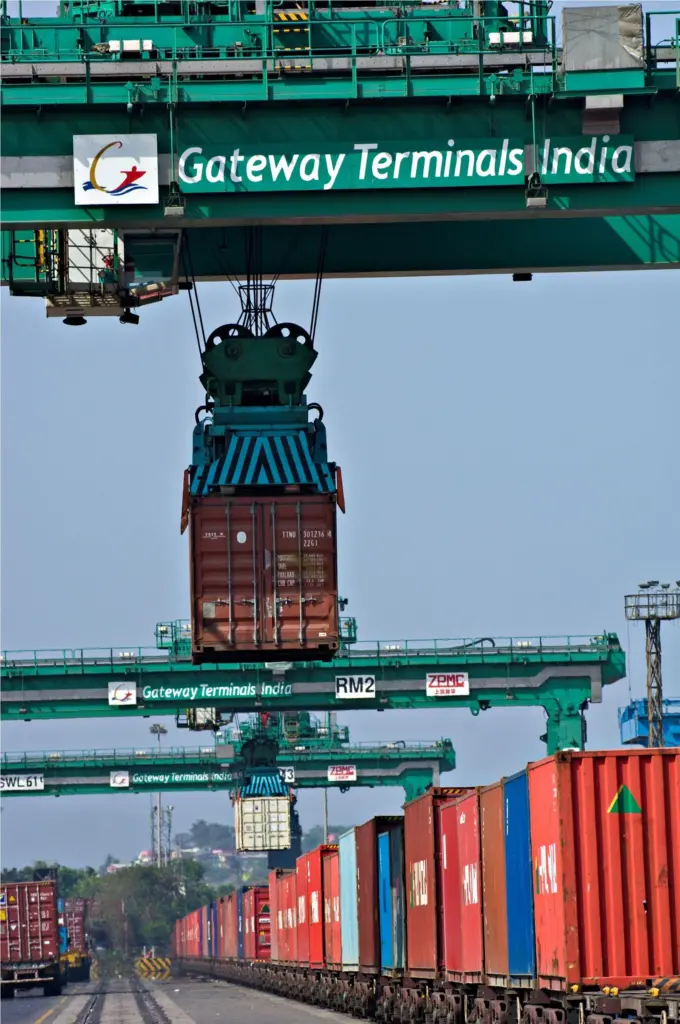
Jawaharlal Nehru Port, also known as JNPT or Nhava Sheva, takes in around half of the country’s maritime traffic, but manages “to do more with less”, says Sandeep Mehta of Gateway Terminals India (GTI).
“One of the most persistent problems has been its ongoing issues with draught,” says Mr Mehta. JNPT, which has three terminals, JNPCT, NSICT and GTI, shares a 21 km long main harbour channel with Mumbai Port. The channel at present is around 10.5m metres depth, so at most it can handle vessels of 12.5 metres or occasionally 13 metres with the tide.
JNPT is one of the government owned ‘major’ ports which runs on a landlord basis, but has not been immune to the dredging issue which has been circling around for five or six years, dogged by complications.
In 2009, JNPT floated a tender but abandoned it when the bids came in around 20% more than estimated: however, this was still at the height of the dredging boom, just before the recession hit the global industry. Further, it seems a similar programme was attempted in 2006, with JNPT and Mumbai Port Trust (MbPT) sharing the cost on a 7:1 basis – but it didn’t get the go ahead from the Shipping Ministry.
However, Mr Mehta adds, since India’s seaborne trade has increased by over 14% in the last financial year, the Ministry of Shipping in India is now gearing up to allow private investment in dredging works at major ports – and bigger, deeper projects may be on the horizon to avoid more frequent intervention, with the ports picking up the maintenance dredging afterwards.
JNPT and MbPT are now involved in a special purpose vehicle (SPV) that aims to execute both the civil works and maintenance dredging programme. Further, it is looking at transforming the morphology of the banks as well – a move based on pressure by the Shipping Ministry after a very nearly disastrous collision last August which resulted in an oil spill and both ports being closed for more than a week.
JNPT and MbPT are now looking to fast track the project, opening up the tendering at the same time as going for the necessary approvals. JNPT is also in talks with the Japan International Co-operation Agency for a financial deal.
However, the burden on the external infrastructure, explains Mr Mehta, is about to get heavier as the new central government plans for JNPT include the public-private development of a 4.8m teu fourth container terminal.
The JNPT authority is understandably excited by the prospect of both dredging and terminal projects, and says the total investment “could raise its world ranking in terms of volumes from 20th to 10th by 2015”.
Central to its ambitions are the Container Freight Stations (CFS) which handle and process all the boxes going in or out the landside gate. Although there are rail links to more distant locations, three quarters of the containers arriving go through local depots.
“Movement to these depots is vitally important,” says Mr Mehta. “The problem is, although these CFS are only a few kilometres away, the roads to them aren’t really capable of handling the 3m teu already going through them, and this isn’t including the containers that would come from another, fourth terminal which would add another 3m teu onto existing volumes.”
Added to this, there is the matter of limited capacity on the rail connections to the National Capital Region, which accounts for 65% of all rail container freight traffic in India. “It is electrified, so there’s no room for double stacking,” says Mr Mehta. “While there has been mention of a dedicated freight corridor being brought forward, it’s still six years off at minimum,” he adds.
Mr. Mehta’s feeling is only after all these pressing issues are sorted out will the fourth terminal be able to function to its full capacity.
But despite the difficulties, he says: “We still keep managing to do more with less here.” He adds that the two private terminals at JNPT – run by DP World and APMT – are working “well beyond their apparent capacity” at nearly double the rate you’d expect from comparable quay lengths.
Related Articles
 CONTAINER & CARGO HANDLING
 CONTAINER & CARGO HANDLING
 BULK HANDLING