![PortStrategy[GreenPort]](https://www.portstrategy.com/wp-content/uploads/2026/09/PortStrategyGreenPort.svg)





DP World ZPMC article addition
Do large operators get preferential service agreements with the Asia crane manufaturers? Alex Hughes talks to DP World to investigate
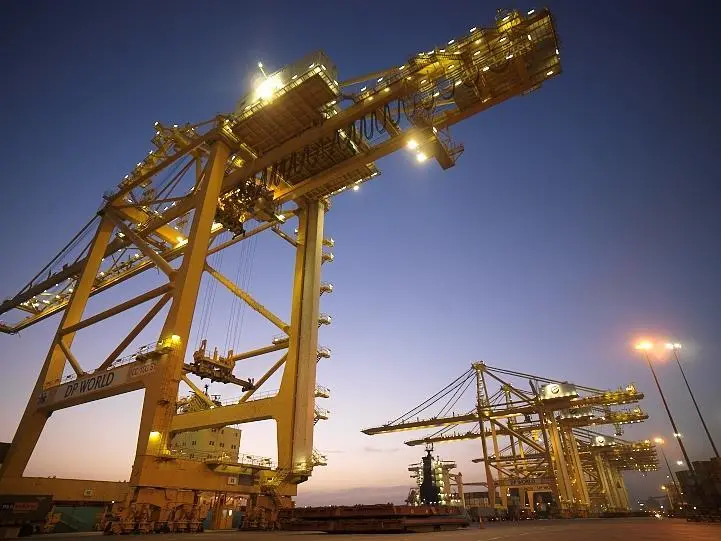
ZPMC has been particularly successfully in selling cranes to the major global stevedoring groups, being nowadays one of the few manufacturers remaining with sufficient capacity to meet volume demand. DP World, keen to take advantage of keenly priced handling equipment, is already one of its major customers. At its Jebel Ali operation in the Gulf, the group nowadays operates 18 ZPMC quayside gantry cranes and 79 rubber-tyred gantry (RTG) cranes, all of which feature predominantly Chinese rather than European or US components. A further 21 all-Chinese quayside gantries and 42 RMGs are also on order.
Port Strategy posed the question of reliability to Andrew Adam, DP World’s vice president for Global Engineering & Operations. He responds: “There have been some challenges that we are continuing to work through with the supplier. In respect of sourcing parts and components from China, this is a little more difficult than is the case with, for example, European companies, but we work closely with the Chinese manufacturers to make sure we maintain productivity at the terminal.”
Nevertheless, Mr Adam stresses that this has not really affected DP World policy in terms of crane procurement. In general, he observes, there are many factors that have to be taken into account when considering with whom to place equipment orders. The availability of spare parts or components is simply one of these.
Despite the importance of the United Arab Emirates, ZPMC has not yet felt the need to establish a local agent, with operators in the region dealing directly with Shanghai. However, Adam reveals that the manufacturer has a team of 30-40 people permanently on site. These have been working alongside DP World in the Gulf for more or less the last four years and, as part of a range of activities, do assist in tracking down necessary components and spare parts from China as the need arises.
Asked whether he thought DP World, as a major international group, had a distinct advantage over smaller terminal operators in obtaining parts, Mr Adam says that this is true to a certain extent when tracking down both Chinese and non-Chinese spare parts. But he also says that DP World, through it various specialist owned companies, is always researching new ideas and relationships with suppliers and vendors in order to provide improved services to its container terminals worldwide.
“Reliability is clearly important to us in providing quality service to our customers and any breakdown is therefore ultimately unacceptable. Inventory holdings have to be accurately evaluated to ensure appropriate levels are held to mitigate risks of ‘unacceptable’ outages. There is always a requirement for a specific level of so-called ‘insurance stock’ depending on the location,” says Mr Adam.
As for there being any technical differences between Chinese components and their European counterparts, he says that, these do exist, but that encouraging progress is being made. However, he adds that innovation at the component level is being driven more by European manufacturers.
DP World does remain open to working with specialist part logistics companies, with Mr Adam acknowledging that several have been in business for a number of years and have effectively carved a niche for themselves in supporting some of the more isolated terminals. The Dubai-based group will always look to work with such providers to ensure maximum quality and price competitiveness in the spare parts and logistics business.
On the much broader question as to whether the overall spares and components supply market could be said to be improving, getting worse – as several operators have told PS – or possibly even getting better, Mr Adam responds: “This is not an easy question to answer. The overall spares and components supply market we don’t believe has changed that much. How a terminal or organisation utilises expertise that is out there may be the differentiator.
“The original equipment manufacturer (OEM), as in most industries, is an expensive option for spares and components, although quality is usually not an issue. The danger is that terminals looking for cheaper alternatives may not understand all the risks associated with that.
“Being able to tap more directly into the OEM component manufacturer is the way forward and DP World is working with specialist companies to improve our market intelligence regarding this matter and ensuring a strong supply line, with known high quality and at competitive prices.”
Related Articles
 CONTAINER & CARGO HANDLING
 CONTAINER & CARGO HANDLING
 BULK HANDLING