![PortStrategy[GreenPort]](https://www.portstrategy.com/wp-content/uploads/2026/09/PortStrategyGreenPort.svg)





Durban deliberates
Durbans new Pier 1 is set to deliver major new capacity and switch to an RTG system in the process but the jury is still out on the role of the private sector.
Port capacity in Durban is set to receive a major boost with Transnet, the body that owns the real estate of the South African ports, and South African Port Operations (SAPO), the container terminal operator, investing heavily to meet shipowner needs and the expanding needs of cargo shippers and consignees.
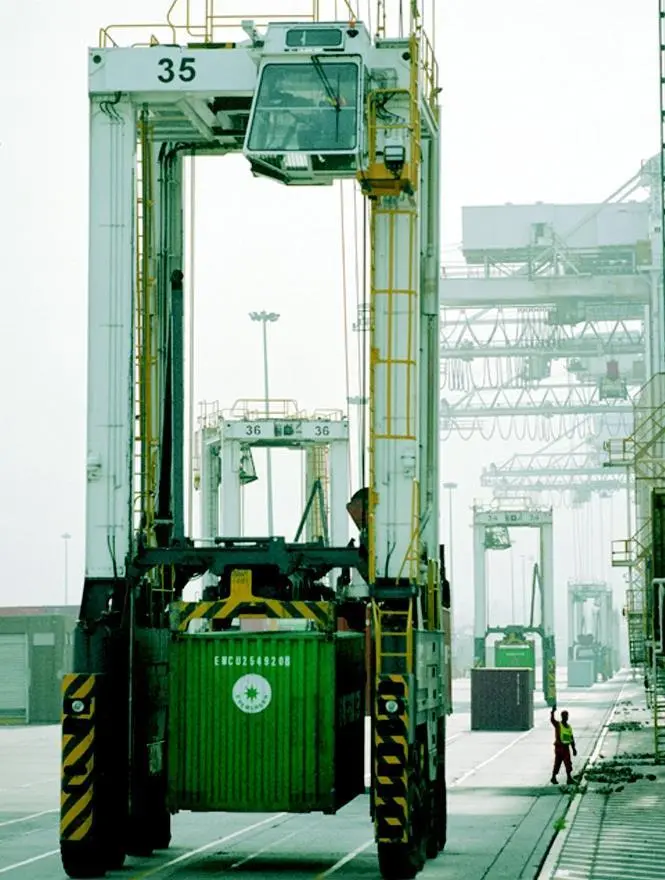
Transnet has earmarked US$227m in its new five year infrastructure plan, approved late in 2004, to develop a container handling facility at Pier 1, the premier site earmarked to provide new capacity over the long-term. Some operations are already undertaken here – around a hundred thousand moves per year – mainly using older straddle carriers that have been transferred to this location from Durban’s current main container handling facility, the Durban Container Terminal which handled the lion’s share of the port’s 1.69m TEU throughput in 2004 representing a 19% increase over the previous year’s total.
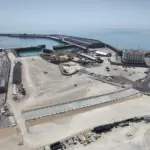
The planned new operation at Pier 1 will be developed in phases with the existing pier being completely repaved and the quay works that are required to kick-off planned extension works likely to start around 2008. The landside extension will be implemented around 2010-2011 and when fully developed the new terminal will offer an annual capacity in the order of 2.5mTEU/yr.
The thinking with regard to container handling equipment arrangements is interesting. Unlike at the Durban Container Terminal which features one of the largest straddle carrier operations in the world, SAPO is set to introduce an RTG system at Pier 1. For the phase one development it is anticipated that 12 or more RTGs will be required, equipped with automated container positioning systems, and five new ship-to-shore gantries along the quay. The depth alongside the quay is presently 12.6 metres but in the future this will be deepened to 16 metres.
Other prominent features of the landside operation will include a rail terminal, featuring three parallel rail tracks, with a truck lane both sides of the tracks and served by the same configuration gantries as used in the main terminal area: 6+1. Presently, rail accounts for around 15% of the movement of containers to/from Durban but SAPO is optimistic that this may go as high as 50% at Pier 1, possibly assisted by it getting directly involved in the container rail business.
Substantial reefer storage will be provided and again the handling power in this area of the terminal will be provided by RTGs.
Clearly, comprehensive plans are being laid for the development of Pier 1 in Durban and when implemented they will provide extensive new capacity that will meet user requirements over the longer term.
In the meantime, however, significant expenditure is also being undertaken at the Durban Container Terminal to raise efficiency levels and push up capacity. The most notable development in this respect is the order recently placed with Kalmar for 53 new straddle carriers which follows on from an order also placed with Kalmar in 2001 for 60 straddle carriers. The latest order includes 15 one over three (four high) machines for Durban, unlike the previous order which was exclusively for three high units, and this feature in particular will enable the terminal to lift throughput capacity.
Together these two orders represent the two largest orders for machines of this type placed with Kalmar and in both cases a significant number of the machines were ordered with specific requirements in Durban in mind. SAPO facilities in Cape Town and Port Elizabeth also feature straddle carriers as the main handling muscle employed on the landside.
OPERATOR ARRANGEMENTS Port privatisation has long been talked about in conjunction with the Durban and other container handling facilities in South Africa and while it is still theoretically under discussion – as highlighted in a the speech Government Views on Public-Private Partnerships in the Maritime Sector made by Alec Erwin, Minister of Public Enterprises – the reality is that the more likely mechanism to be employed to introduce private sector expertise in the first instance is PublicPrivate Partnerships. It is not inconceivable, for instance, that Pier 1 may be considered for this type of arrangement whereby a terminal operator takes a minority stake in the operation and government effectively remains in control with the majority stake.
At a practical level, this is also seen to be a much more unionfriendly solution but there again the situation continues to change and change again in South Africa regarding the introduction of private sector expertise into the country’s container handling operations. For example, another line of thought that appears to have surfaced recently regarding planned new container handling operations, including the new Coega terminal, is that it is perhaps in the interest of the public sector to operate these facilities in the first instance in order that a proper understanding of their worth can be gained prior to introducing the private sector.
New capacity is coming but as usual the jury seems to be still out on the future role of the private sector.
Related Articles
 CONTAINER & CARGO HANDLING
 CONTAINER & CARGO HANDLING
 BULK HANDLING