

Empty-handling argument doesnt stack up
Manufacturers of reachstackers and competing empty container handling gear differ about whether a reachstacker is the best piece of equipment, as David Foxwell finds out
There is an oft quoted phrase – beloved by feminists – that “the best man for the job is a woman”, and when it comes to the question of whether a reachstacker is a suitable, cost-effective tool for handling empty containers it seems that many manufacturers are actually of the opinion that the best tool for the job is not a reachstacker at all, but a good old-fashioned forklift.
Handling empty containers is a fast-paced job. Containers have to be moved or stacked quickly and efficiently,and stacked high and close together in order to exploit the available land area to the full.
As they expand, and handle more and more containers, many ports are restricted in the amount of space they have available to stack ’empties’ and so the ability to stack high and use a minimum of ground space becomes ever more important.
Stacking empties is also a precise and timeconsuming task, in which straightforward, simple and accurate positioning of containers is a ‘must’ so it is important that whatever kind of machine is used, the truck chassis, the lifting mast/boom, and the side spreader, are beefy enough, and stable enough, to do the job.
The argument in favour of using reachstackers for empty container handling rather than using a simple vertical mast machine is that they are more flexible. Some manufacturers such as CVS have invested significant sums in developing twin-lift reachstackers for empties, and claim that handling a couple of empties at a time can improve efficiency by up to 30%.
Others have responded to the situation by offering customers a mix of products – including reachstackers and vertical mast machines for empty container handling – but several are of the opinion that when it comes to handling empties, the reachstacker can’t compete with less sophisticated, but ultimately more cost-effective machines.
Fantuzzi, for instance, states that empty container handling reachstackers are less productive than FLTs, less manoeuvrable (because of their larger size), and more expensive, but argues that they can provide the sole solution to empty container handling when a high level of container selectivity is required, when containers have to be rotated, and where operations include handling empties to and from rail.It also argues that a reachstacker may be a better choice where there are height restrictions (something manufacturers of FLTs disagree with).
Kalmar, for instance, has two empty container trucks ranges, the ContChamp empty reachstacker for high, top lift, stacking, and narrow gangways, and the Kalmar range of mast trucks, which are marketed as costeffective empty container handlers, with a stable design and with side spreaders for twist-lock (single) or hook handling (double stacking).
Stacking empties is a precise and time-consuming task, and simple and accurate positioning of containers is a must. The chassis of the truck, and the lifting mast/boom and the spreader need to be strong and stable,but the machine mustn’t be too big or unwieldy.
Thus, the ‘light’ version of the ContChamp was designed specifically to meet these demands, and the ‘light’ combines much of the technology employed in the design of the full-size ContChamp with experience gained in the design of smaller trucks.
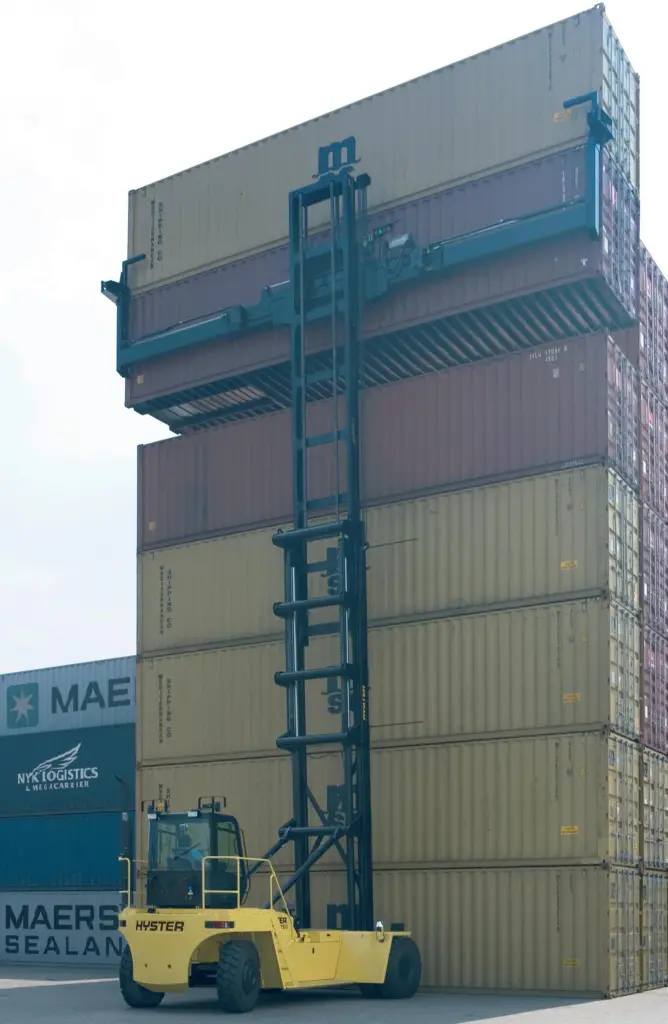
However, as Antoon Cooijmans, product manager – big trucks at Hyster, Nijmegen in The Netherlands tells Port Strategy,Hyster, unlike Kalmar, does not produce a reachstacker for empty container handling,and focuses exclusively on the market for reachstackers for laden containers.
“We have been talking to users of empty container handling reachstackers over many years, and it seems that the choice between empty-handling reachstackers as opposed to the more popular FLT type, usually comes down to two criteria,” Mr Cooijmans explains.
“These are, firstly, stringent demands for a low height machine, due to an overheight obstacle;and,secondly,personal preference.”Mr Cooijmans says Hyster has not encountered buying decisions based on second row stacking capability – of the type made possible with a reachstacker – or decisions made purely on ‘cost per container moved’.
“A typical example is Antwerp Port where FLTs are used for empty container handling and reachstackers are not. This is in spite of the fact that many of these empty-handling FLTs had to be modified for a low drivethrough height (using a triplex mast and ‘lay-back’ mast tilt) to enable them to pass underneath the several 5.50m high bridges in the port,”Mr Cooijmans tells PS.
At least for the time being,says Mr Cooijmans,Hyster remains unconvinced that reachstackers are the right machine for empty container handling,or cost effective machines to handle empty containers.
Hyster’s ‘take’ on the market is echoed by other manufacturers too, such as Linde, whose business development director Davide Bertozzi tells PS that the company decided a while ago not to build a reachstacker for the empty container handling market. Instead, in 2007 Linde will launch a new range of vertical mast machines for empties.
“Using a vertical mast machine is faster, and is perfectly suitable for the way most empty yards are arranged,” Mr Bertozzi explains. “In 95% of them it’s a case of ‘last in, first out’. That’s not the case with laden boxes, of course, but in an empty yard a vertical mast machine has the edge over a reachstacker because it’s much more economical, and because components like the hydraulics are less expensive.”
As Kalmar itself noted recently, in order to cope with new business that will boost its container throughput by some 500,000 teu per year, the Port Authority of Jamaica recently ordered 24 four-high, seventh generation Kalmar CSC 450 straddle carriers,and chose to invest not in reachstackers but in six seven-high Kalmar empty container handlers for its facility at Kingston Container Terminal.
Nonetheless, in the right circumstances, a reachstacker is one of the most flexible options for empty container handling, notes Kalmar, quoting examples such as German container terminals along the Rhine where operators are investing heavily in systems that will allow them to tranship containers up to 45ft and pallets up to 12m between water, rail and road.
In the last three years, Kalmar has sold around 30 machines for the transhipment of full and empty containers along the Rhine, and flexible reachstackers are employed for handling pallets and stacking full and empty containers up to five high. However, Kalmar’s specialised front-lift trucks are also employed for empty container handling in the nearby terminals, which suggests that the choice of reachstacker or FLT is very much site specific.
A typical Rhine terminal is Rheinwaal in Emmerich, which tranships around 50,000 teu annually in an area if 35,000 m sq. Volumes are on the increase but, for reasons of space and heavy competition upstream on the Rhine and in the Netherlands,Rheinwaal will stop at around 60,000 teu-70,000 teu.
At Rheinwaal, a ContChamp reachstacker with a lifting capacity of 45 tonnes and an empty container handler are currently in operation around 1,500 hours a year.The empty container handler comes from Kalmar’s current DCE range, which differs from more familiar machines in that the front axle has a wider track and it comes with special lift gear, installed at Emmerich, for four-high stacking.
Related Articles
 CONTAINER & CARGO HANDLING
 CONTAINER & CARGO HANDLING
 BULK HANDLING