![PortStrategy[GreenPort]](https://www.portstrategy.com/wp-content/uploads/2026/09/PortStrategyGreenPort.svg)






Fuel of the future
We cant stay wedded to oil for ever, so whats the alternative for ports of the future, asks Stuart Pearcey
The mix of emotions among Americans in general, and Gulf Coast residents in particular, is as complex as the mix of seawater, ecosystems and oil from the stricken Deepwater Horizon’s drilling operation.
Some are angry, some moved to tears, many a mixture of both. The finger-pointing and accusations have begun, and no doubt will rumble on through the courts for years.
But the really important question; the $64m-dollar one at the heart of the matter, doesn’t seem to be getting a great deal of airtime just yet. It’s not about cleaning oiled seabirds, restoring the shellfish industry, or killing dolphins. It’s more serious than that. It’s about the future of life as we know it.
The fact of the matter is that all of us have helped to back the oil companies into a corner. Our thirst for growth has made them reach further and deeper to tap into ever-more inaccessible oil resources in order to keep alive the global oxymoron – that while we all know the oil’s going to run out, we want to continue living, and even developing, a lifestyle based on its consumption.
What’s more, the greater the difficulty in bringing oil ashore safely, the more it costs, and the more those costs are heaped around our ears, driving us to find other efficiencies, whilst being kicked repeatedly in the seat of the trousers by our carbon footprint.
Towards the end of June President Obama promised to wean America away from its dependence on oil, and in doing so increased the size of the blip on the world’s radar screen caused by that $64m-dollar question.
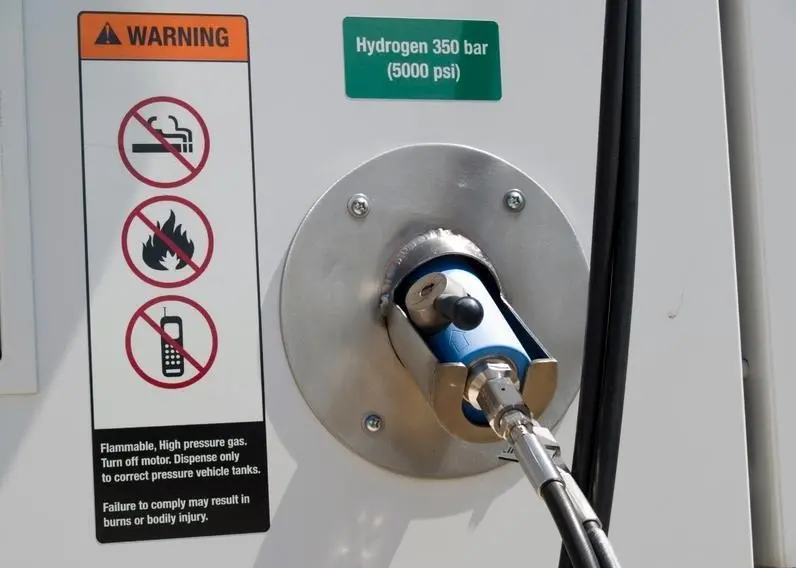
The answer to the question may yet prove to be the near-miraculous conversion of water not into wine, but into free and virtually limitless fuel – and a fuel that can be created by any port operator anywhere in the world for use in terminal tractors.
And it’s a company in Sheffield – just about as far from the sea as it’s possible to get in the UK – that’s in the vanguard of the technology that will make it possible.
Leading the way up the road to this ‘free-fuel Utopia’
in the UK is ITM Power, whose chief executive Dr Graham Cooley has just been appointed to Executive Committee of the US Fuel Cell Council (USFCC). It’s a member-led industry association that aims to promote the development and use of fuel cells, as well as influence public policy for the industry. “That’s a great coup for us, especially after President Obama’s promise to reduce America’s dependence on oil,” Charles Purkess, the company’s marketing and PR officer, tells
Port Strategy.
And the ability to use hydrogen technology to power vehicles doesn’t require them to have hydrogen fuel cells. A ‘transitional’ step is the hydrogen internal combustion engine, allowing retention of normal production techniques in a dual-fuel vehicle.
It’s possible to have the hydrogen delivered, but a step further can be taken with the creation of on-site generation. “All that’s needed to produce hydrogen are water and electricity, and both can be created on site,” he says.
Capturing rainwater and the ability to generate electricity from an in-house renewable source would provide all the raw ingredients to keep hydrogen-powered vehicles on the move.
“Hydrogen can be used as a store for energy for a long time. If it’s produced where it’s used, then that not only eliminates the carbon footprint associated with moving tractors and trailers about, but also the footprint associated with fuel delivery,” he says.
“More importantly, using renewable energy to produce your own fuel at the point of use secures supplies, and eliminates cost. Once the technology is set up, you’re effectively producing fuel from water. It’s a powerful dimension of business planning.”
And since port operators take a hammering about particulate emissions from truck fleets, the switch to hydrogen would remove another headache.
“The benefits are significant, and will become more so as the technology develops, and that’s happening all the time,” he says.
Those benefits of using hydrogen as a fuel are well recognised in America, where forklift fleets using it are common, says Mr Purkess.
Texas-based truck-builder Capacity is working with Vision Industries from Los Angeles to take the technology into mainstream terminal tractors. Its ‘Zett’ (zero emission terminal tractor) is claimed to be able to work for sixteen hours without refuelling.
Since their entire working life is spent within the confines of a port, they need never be far away from a central refueling point.
That’s another reason to go down the hydrogen route, for while battery-powered vehicles don’t, in themselves use fossil fuels, charging does take a considerable time, during which the truck is unable to make a contribution to running the port. The hydrogen truck can be re-fuelled in a matter of minutes, after which it’s back on duty again.
Says Vision Industries chief executive Martin Schuermann: “This is a new market sector for Vision, and we believe that the marketplace will readily embrace a zero emissions terminal tractor that features significant operating cost savings when compared to conventionally-powered diesel terminal tractors.”
And if any further proof of the viability of hydrogen as a fuel were needed, then it’s to be found in the third world, where Mahindra and Mahindra has launched the world’s first three-wheeler powered by the gas.
The company is one of only two in India to feature in the Credit Suisse ‘great brands of tomorrow’ study list, picking it out as one to watch for the future as the world’s economic epicentre shifts to the east.
Its little truck is predicted to make a big impact in India, in both its passenger and cargo variants. But that impact could have much wider implications for us all. Dr Mathew Abraham, Mahindra’s R&D general manager, says: “Hydrogen is the technology and fuel of tomorrow, and is the long-term solution to pollution, energy security and concerns about carbon dioxide emissions.”
The sooner the ports industry takes that message on board, the sooner we’ll feel an economic benefit. And the Gulf Coast crab and lobster fishermen will be able to breathe a little more easily too.
Related Articles
 CONTAINER & CARGO HANDLING
 CONTAINER & CARGO HANDLING
 BULK HANDLING