![PortStrategy[GreenPort]](https://www.portstrategy.com/wp-content/uploads/2026/09/PortStrategyGreenPort.svg)





Full steam ahead
Booming German coal imports are being hotly chased by ports in the know, as mainland Europe powers ahead with generation plant developments. Mike King sees what all the fuss is about
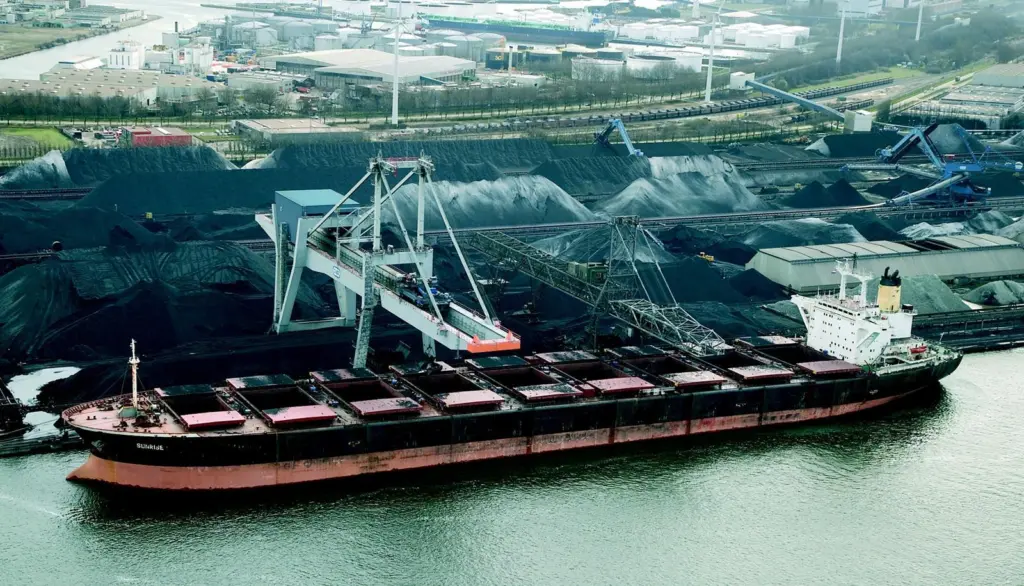
Europe’s leading dry bulk stevedores are racing to secure market share as the power sector’s reliance on imported thermal coal intensifies. Germany’s replacement of older generators and closure of domestic coal mines are the main drivers of fresh demand, but plans to build new waterside power plants in the Netherlands are also causing a stir among port managers.
According to Dr Ing Wolfgang Ritschel, managing director of the German Coal Importers Association, Germany imported 40m tonnes of thermal and coking coal in 2005, a figure he expects to jump substantially in the coming years.
How big the eventual rise will be depends on how quickly domestic and Polish supplies are phased out in accordance with European Union laws governing subsidies, and how many new power projects get the green light from planning authorities. Although Dr Ritschel insists it is impossible to predict with any certainty, analysts and senior figures in the port sector are convinced German thermal coal imports alone will have mushroomed by a further 12m tonnes by 2010, or 2012 at the latest.
“Every big power company is looking at this, ” says Dr Ritschel.
“There are about ten coal-fired power stations at the planning stage and they will use bituminous or lignite coal. Some will replace older power stations so this not all additional demand, some of it is replacement capacity.”
Last year, of the 40m tonnes of coal imported to Germany, 12m tonnes arrived via German harbours, with the remaining 28m tonnes delivered by barge and rail from the Antwerp-Rotterdam-Amsterdam (ARA) ports. “Imports into German ports may have risen since 2000, but the majority comes from the ARA harbours and that won’t change in the future, ” says Dr Ritschel.
For terminals looking to win this business, the relative cost effectiveness of their hinterland rail and barge links will be critical, he says: “The new power stations will be built by the water so they can receive supplies by barge. The older power stations are not on the water so imports will arrive direct from the ARA ports or via Duisport by rail. Guaranteeing cost-effective and timely supplies will be significant in the sourcing process.”
Despite European efforts to introduce more rail competition, one of the biggest obstacles facing coal importers is the strong competitive position of Deutsche Bahn and its array of logistics subsidiaries. Last year, the company further flexed its muscles by buying one of its few competitors in the bulk sector, RAG’s logistics subsidiary, Rag Bahn und Hafen.
“Our members are not satisfied with DB because there’s no competition, ” says Dr Ritschel. “This makes it too expensive, especially on lines where there’s no competition and DB is not very customer-orientated.
“We will try to have talks with them so they improve their commercial behaviour.”
The long-heralded opening of the Betuweline linking the Netherlands to the heart of the Ruhr at the start of next year will give a much needed rail capacity hike and offer coal importers more rail options, says Paul Goris, commercial director of Rotterdam-based stevedore EMO, which handled over 19m tonnes of coal last year.
“We will be a big supplier to the Betuweline, ” he says. “Some of the companies in Germany are dependent on rail so this opens up new business for us and gives us alternatives when inland water levels are low.”
As part of a recent €35m investment intended to preserve the company’s position as the leading capesize terminal in Europe, EMO expanded capacity in July by installing a new train loading station. Total bulk capacity will rise again in June 2007 to reach 42m tonnes when a sixth stacker-reclaimer comes on stream. This will give EMO – subject of a takeover bid from rival Sea-invest which is currently under investigation by the European Commission – substantial scope to seize a sizeable share of the increase in German coal imports, says Mr Goris.
Antwerp Port Authority, where Sea-invest is the main bulk stevedore, is also chasing the German coal import market. A total of 9.3m tonnes of coal passed over the port’s piers last year and the port authority is keen to see this grow.
Critical to competing with Dutch rivals will be the reopening of the Iron Rhine rail link to Duisburg which, because of its shallower gradients, will offer savings on bulk hauls to the industrial heartland of Germany. However, the project has been in limbo for almost a decade now, largely because the line passes briefly into Dutch territory, prompting a long list of political spats. The port authority, as ever, remains hopeful of resolving the issue in the “near future”.
Of the German ports, Duisburg saw coal throughput fall 23% yearon-year to 4.4m tonnes, Wilhelmshaven received 1.5m tonnes of coal in 2005, Nordenham/Weserport posted throughput of 1.9m tonnes, while Bremen and Rostock each boasted volumes of 1.2m tonnes.
Hamburg, though, is the biggest coal handler, averaging around 12m tonnes of throughput each year.
Within Hamburg, which plans to make draught improvements on fairways that will benefit bulk carriers, Hansaport is the leading coal stevedore, handling 4.7m tonnes last year.
In 2005, the company opened a new coal storage area and installed a fifth stacker-reclaimer and fourth grab crane at a total cost of ?17m. As a result, managing director Erhard Meller expects coal volumes to increase to 5.5m tonnes this year.
He believes Hamburg is serving a captive market in northern Germany immune from ARA competition because of the local nature of Hamburg’s bulk customers. “It’s too far from the ARA ports and the costs after sea freight are too expensive, ” he says.
At Amsterdam, investment is also moving ahead with leading terminals upgrading facilities and the port improving draughts to help attract more coal-carrying capesize vessels.
The port entrance at Ijmuiden was dredged from 16.5m to 17.2 metres in 2005, and then down again to 17.8m in spring this year.
“We’re also looking at ways we can improve the lightering facility to offer further savings, ” says the port authority’s bulk manager, Lex De Ridder.
If it can leap the various environmental hurdles still in its way, Amsterdam-based Rietlanden will have a further 360m of berth space available by the end of summer, adding 4m tonnes to Amsterdam’s total capacity. This will rise again if Rietlanden proceeds with two further expansion plans to enhance storage facilities and barge handling through 2008-2009.
OBA, another major coal handler at Amsterdam, is also planning a new capesize quay adjacent to its existing facility which will add 360m of berth and is due on stream in September.
Like all the ARA ports, Amsterdam’s coal throughput was affected in 2005 by the quayside storage backlog that built up at the end of the year. This was caused by low inland water levels which drove up the landed cost of coal prompting a number of power stations to draw down stocks.
As a result, coal throughput at Amsterdam fell to 12.6m tonnes last year. As the new capacity comes on stream, however, Mr de Ridder predicts this will rebound in 2006 to at least 2004’s total of 13.8m tonnes.
Related Articles
 CONTAINER & CARGO HANDLING
 CONTAINER & CARGO HANDLING
 BULK HANDLING