![PortStrategy[GreenPort]](https://www.portstrategy.com/wp-content/uploads/2026/09/PortStrategyGreenPort.svg)




Getting free zones right
Foreign direct investment (FDI) is key to free trade zone development, but cooperation between all stakeholders is needed for success.
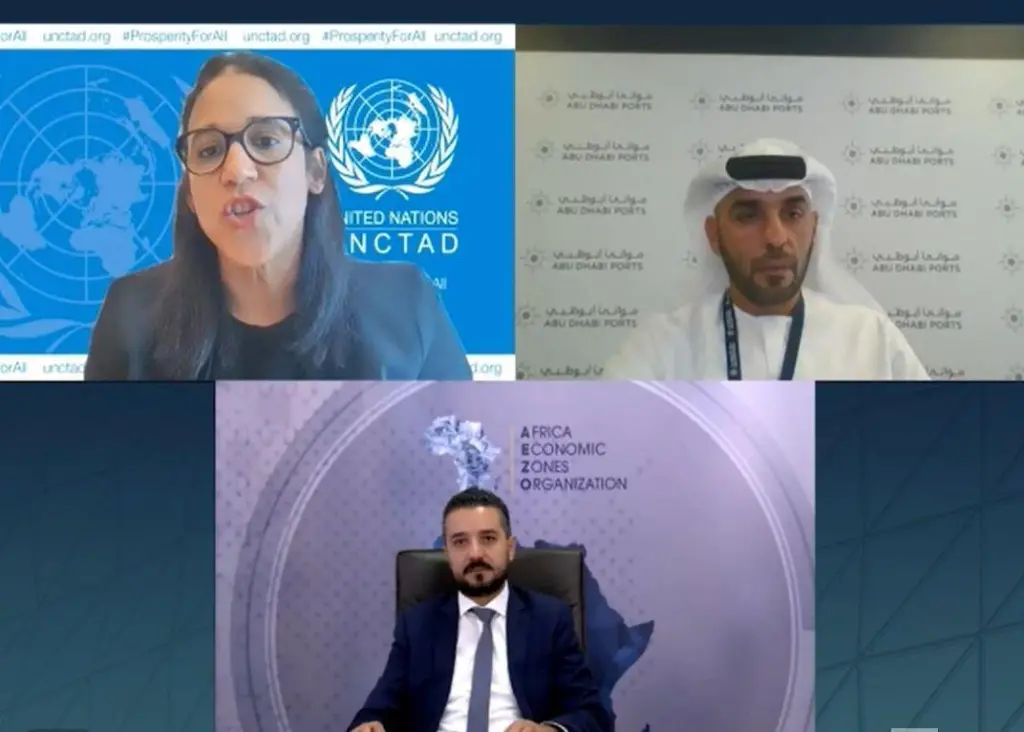
This was the consensus of the participants in the Free Zone Development session of the IAPH World Ports Conference 2021, who highlighted the role that ports can take in free zone development.
Ahmed Bennis, secretary general at the African Economic Zones Organisation (AEZO), and group development director of Tanger Med, said ports and special economic zones (SEZ) are playing a key role in transforming Africa. SEZ should bring a transformational change to the country concerned by attracting quality FDI, this can result in an attractive trade volume for ports.
“The synergy between ports and economic zones would definitely contribute to reduced cost of trading, optimised logistics flows, and streamlined trade facilitation procedures but this will not be achieved without a solid partnership, continuous corporations, and a robust collaboration between ports and economic zones, involving all stakeholders.”
An SEZ must be designed as a component of the country’s strategy and all stakeholders should be involved. The right business model, plus flexibility is needed. He stressed fiscal incentives alone are not enough to attract FDI and should not be the main differentiator.
Infrastructure, programme planning and management and attention to trade facilitation are amongst the factors that can determine the success of a SEZ.
He highlighted the Tanger Med zone in Morroco with over 800 companies within the zone, the Djibouti port free zone, and Gabon Special Economic Zone (GSEZ) as success stories.
Abu Dhabi Ports perspective
Abdullah Humaid Al Hameli, head – Industrial Cities & Free Zone – Abu Dhabi Ports & chief executive officer – Khalifa Industrial Zone Abu Dhabi, said connectivity between the free zone and port speeds up industrialisation and the commercial development of a country.
He said efforts to attract FDI to Khalifa has included diversification of the economy, cheaper services, better connectivity from ports to international markets. Government policy and regulation to enable attract FDI is also essential.
“The ports and the economic zone work closely together as one team.” Investors in the economic zone see support from the ports, its operations and services, and vice versa, he added.
However, he warned: “If they don’t manage to offer the best for the investor they will fail.”
A broader view
Kunio Mikuriya, Secretary-General, World Customs Organization said: “Free zones have served as national and regional economic growth drivers by encouraging foreign direct investment, in particular by offering fiscal incentives and less government regulations and red tape.”
He added: “There is no denying that free zones have significantly contributed to the competitiveness of international ports.”
He said they have also supported ecommerce by providing logistics hubs, however he acknowledged concerns from organisations including the EU that free zones should be implemented with caution as they attract illegal activities.
The OECD Council adopted recommendations on the management of free zones to curb illicit trade in 2019. The International Chamber of Commerce worked with the WCO to conduct research, based on this the WCO delivered Practical Guidance on Free Zones. The WCO Council formally adopted this in 2020.
Port authorities can improve the business environment and economic competitiveness of trade zones by joining a force to combat crime, noted Mikuriya.
Custom procedures in free zones are now more streamlined and can now contribute to the safety and security of supply chains without sacrificing the efficiency of trade flows, he said. Digitalised processes also help efficiency and security.
The session was moderated by Dr. Amelia U. Santos-Paulino, chief of the Investment Research Section at UNCTAD’s Division on Investment and Enterprise, and deputy editor of the Transnational Corporations Journal.
Related Articles
 CONTAINER & CARGO HANDLING
 CONTAINER & CARGO HANDLING
 BULK HANDLING