![PortStrategy[GreenPort]](https://www.portstrategy.com/wp-content/uploads/2026/09/PortStrategyGreenPort.svg)





Ghanaian aims high
Privatisation of the Ghanaian ports of Tema and Takoradi has been ongoing since 2000 as part of a World Bank-supported modernisation programme. But while Oscar Cudjoe, public affairs manager for Ghana Ports & Habours Authority (GPHA), accepts that the introduction of new companies has been a success, he says that there is still more work to be done by the private operators.
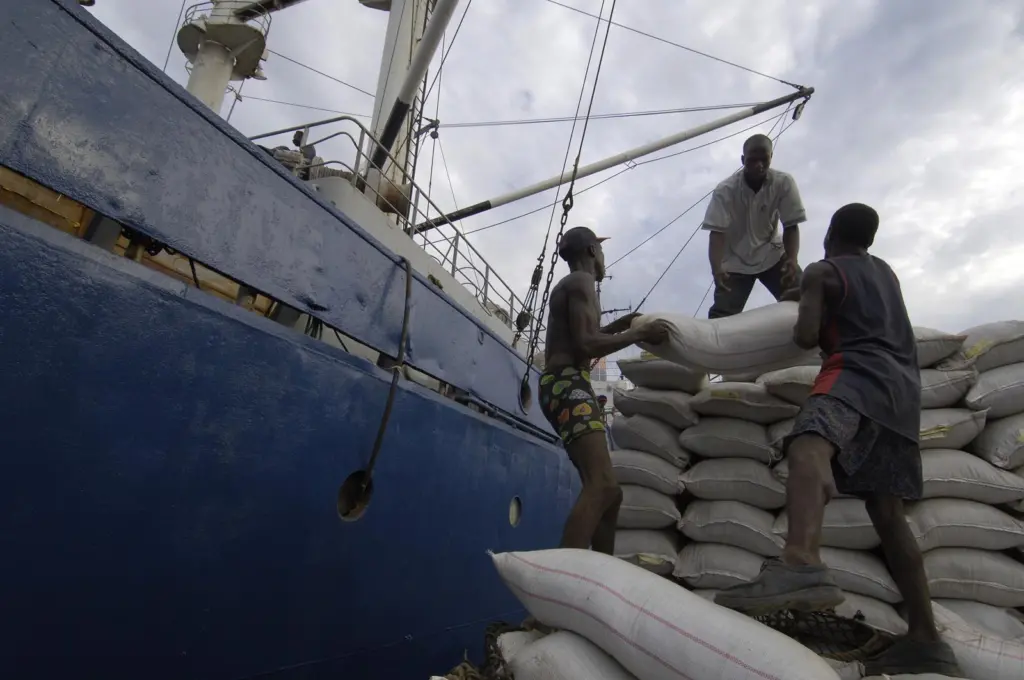
“I would say the introduction of private stevedoring companies has been around 70%-80% successful, although not everything has gone according to plan,” he saysin a conversation with
Port Strategy
. For one, many of the dock workers made redundant by GPHA as part of the privatisation process have been taken on by the new stevedoring groups, sometimes at better salaries. Others have joined the recently established Ghana Dock Labour Company, which was set up by the GPHA to provide an additional labour pool.
In Tema, nine private groups now provide 75% of all stevedoring services across a range of terminals, excluding that of the container terminal. Eventually,Tema Port Authority will hand over all operational responsibilities to third parties, allowing it to concentrate wholly on landlord and regulatory functions. In Takoradi, the situation is similar, although the various private companies there are not terminal-specific operators.
“The Ministry, at one time, flirted with the possibility of making stevedoring a free for all. In other words, each group would be totally responsible for capturing its own cargo,” says Mr Cudjoe. “This was not well received. It wasn’t that the private companies were afraid of competition, but rather that they had invested in new equipment, mostly heavy duty forklifts (FLTs), using bank loans. They were worried that, in a fully liberalised environment, they might not have been able to pay back those loans. So, at least for the moment, that idea has been dropped.”
On April 1 2007, Tema witnessed the transfer of its Quay 2 container terminal to a joint venture concessionaire, Meridian Port Services, for a period of 20 years. The port authority retained a 30% stake in the venture, with the remaining equity divided between APM Terminals and Bolloré.
Investment of $54m will be made in infrastructure and $35m in superstructure, while the concessionaire will also have to pay an annual lease fee, as well as royalties, which will consist of 25% of gross stevedoring revenue and 10% of gross shore-handling revenue. GPHA will be the direct financial beneficiary.
The national port authority has also stumped up cash for three ZPMC ship-to-shore cranes and four rubber-tyred gantry cranes, in addition to various reach stackers, FLTs and terminal tractors.
“Tema can now handle non-geared vessels, which means that productivity has dramatically increased,” says Mr Cudjoe.
Tema, which handles 70% of Ghana’s seaborne freight, is also being promoted as the natural gateway to the landlocked states of Burkina Faso, Mali and Niger. Mr Cudjoe says that, initially, the GPHA had been unsure whether these Francophone nations would be happy to deal with an English-speaking country. However, by providing efficient, secure and affordable facilities at Tema, transit cargo has begun to notably increase. Key to ensuring that this cargo remains channelled through the port is providing a relatively congestion free environment, which the port currently offers.
“All three countries tried out our facilities, liked what they found and are now building their own warehouses within Ghana, which is a sure indication that they intend to stay,” Mr Cudjoe says.
Rising levels of cargo will also inevitably pull in larger ships. With this in mind, the GPHA instituted a major dredging programme recently at both ports. At Tema, which is predominantly an import port, a maximum draught of up to 12 metres is now available. Takoradi, which is very much the junior partner, has carved out a very definite export niche for itself. Both ports, however,handle a very broad spectrum of cargo.
Related Articles
 CONTAINER & CARGO HANDLING
 CONTAINER & CARGO HANDLING
 BULK HANDLING