![PortStrategy[GreenPort]](https://www.portstrategy.com/wp-content/uploads/2026/09/PortStrategyGreenPort.svg)





Goodbye to the City Centre
Alex Hughes reports on developments at Brazils leading port.
Traffic at Santos is inexorably rising. Last year for example, throughput amounted to 67.6m tonnes, a rise of 7.6m tonnes on 2003 and a whopping 57% higher than volumes handled in 2000. Santos currently accounts for 25% of Brazil’s foreign trade and is indirectly responsible for 55% of the country’s GDP.
Domestically, its hinterland encompasses 45% of the total consumer market for the country and serves the major industrial area centred on the Sao Paulo conurbation.
According to Antonio Alfredo Matthiesen, the marketing and business development superintendent of the Port Authority (Codesp), the growth of the surrounding city has effectively prevented further expansion of existing facilities on Sao Vicente Island, the port’s traditional heartland.
Instead, new expansion will be limited to development either in the socalled Santos continental area or in Guaruja, both on the left bank where all recent construction has taken place.
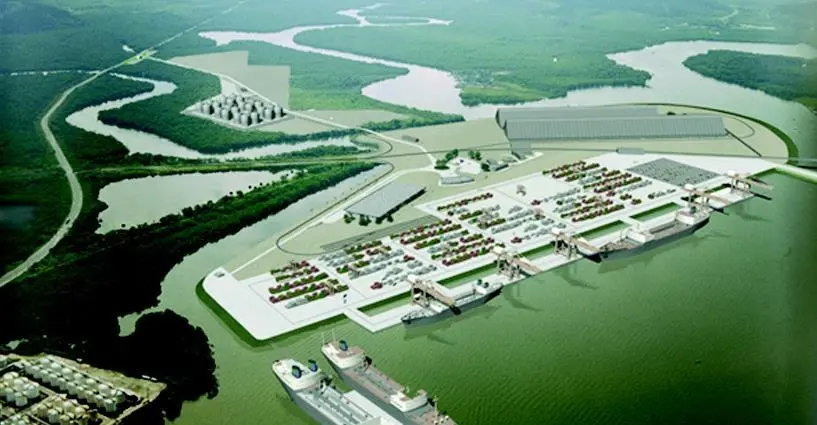
Indeed, it is on the left bank where the port’s leading dedicated container terminal, Santos Brasil, is to be found, although right bank terminals Libra Terminais and Tecondialso handle containers. Combined throughput for all three amounted to 1.882m TEUs in 2004, with annual throughput increases of 25%-30% now common. While Santos Brasil, which currently accounts for half of all containers handled at the port, is doubling its operational area, even this will be insufficient to absorb all future growth, hence the decision by Codesp to go ahead with a new left bank development, known as Embraport.
FIRST OF SEVERAL Embraport is the first of several planned expansion projects, being a private sector development by the Coimex Group. In a 1m sq metre zone, terminals handling liquid and dry bulk, boxes, cars and agribulk will be established. This will add a further 400,000TEU capacity to the port’s already burgeoning container trade, in addition to providing space for 300,000 cars, 1m tonnes of solid bulk (mostly soya and sugar) and 4m of liquid bulk. Initial phases of the US$70m site are expected to commence operations as from 2010.
A further development, the Barnabe-Bagres harbour, will bring on stream 6m sq metres of new land. 11km of quay are planned divided into fifty 220 metre long berths, each with back up land of 120 sq metres. The basic infrastructure investment which will have to be funded by the federal government, has been costed at US$680m.
However, while this would theoretically double the capacity of the existing port, the idea is instead to transfer part of the existing right bank handling operation to this new area, allowing land currently occupied by the port to revert to the city for leisure development.
In the meantime, Codesp is having to undertake major dredging work simply to ensure that new generation vessels coming on stream can continue to access existing terminals. At present, vessels drawing no more than 13.5 metres can be accommodated alongside the quays, although up to 15 metres is available in the access channel.
“We are aiming to deepen to a minimum of 17 metres, ” explains Matthiesen, adding that this requires major quay reinforcement as well. However, he points out that the very first 5,500TEU container vessel, operated by Hamburg Sud, recently made her maiden call, while bulk carriers of up to 80,000dwt regularly dock to load soya.
“Ships can only get bigger, ” he says, explaining that the port’s hinterland has been considerably expanded thanks to major rail connections with the interior, while shortsea shipping connects with ports in the north of the country, as well as those in Argentina and even Paraguay and Bolivia (via the Tiete-Parana inland waterway, which begins 200km distance in Sao Paulo).
“At the moment, the government is keen on promoting soya exports and will therefore provide us with the money to add necessary infrastructure, although Codesp’s current role is limited to that of landlord, leaving private sector companies to fund all other development, ” explains Matthiesen.
Indeed, today around 60 concessions are held by private investors, with many of these having around ten years still to run. This, plus the need to recoup investment, is effectively delaying the abandonment of Sao Vicente Island until the end of that period.
Related Articles
 CONTAINER & CARGO HANDLING
 CONTAINER & CARGO HANDLING
 BULK HANDLING