![PortStrategy[GreenPort]](https://www.portstrategy.com/wp-content/uploads/2026/09/PortStrategyGreenPort.svg)





Grain handling article
Grain terminals seem to be weathering the economic storm, but equipment manufacturers are having a tougher time of it. Alex Hughes reports
There’s a rumour doing the rounds in the grain handling business that the economic downturn might have actually boosted trade.
While the box brethren languish, the grain boys have been stoically working to keep their businesses rolling.
Tilbury Grain Terminal, the largest in the UK, believes that the current global economic downturn has had no real effect on business in terms of volume. Indeed, lower freight costs appear to be actually helping its customers.
Flexible discharge company Nectar marketing managing Guy Wilkes goes further to describe the industry as reasonably buoyant, although he concedes that it now faces a different set of problems.
Pre-global economic downturn both freight rates and commodity prices were too high for many of the company’s end users, particularly those in emerging markets. Although these have now fallen to more acceptable levels, some clients are now finding it difficult to obtain credit and finance, despite a market for grain being available.
Belgium manufacturer Vigan’s commercial director, Alain de Visscher, agrees. His company is still recording a lot of enquiries and/or tenders from the grain handling sector, but the lack of financial resources means the purchasing process is slower.
Nectar, for one, can rest on its other group activities as a fall back in times of waning equipment sales, whether a result of financing troubles or not. Lightening duties form part of the company’s service portfolio. To this end, it owns fenders, which allows it to position chartered coasters alongside deep sea vessels, and puts pneumatic equipment on board to allow grain transhipment to be undertaken. Both the coaster and the deep sea vessel can then enter the port and discharge their cargo, all overseen by the company’s experienced marine personnel.
Bagging, which adds significant value to a bulk grain consignment, is also a regular service that Nectar provides. In fact, if discharge involves a four hold vessel, individual bagging machines will be positioned alongside each hold to ensure that agreed hourly unloading rates can be made.
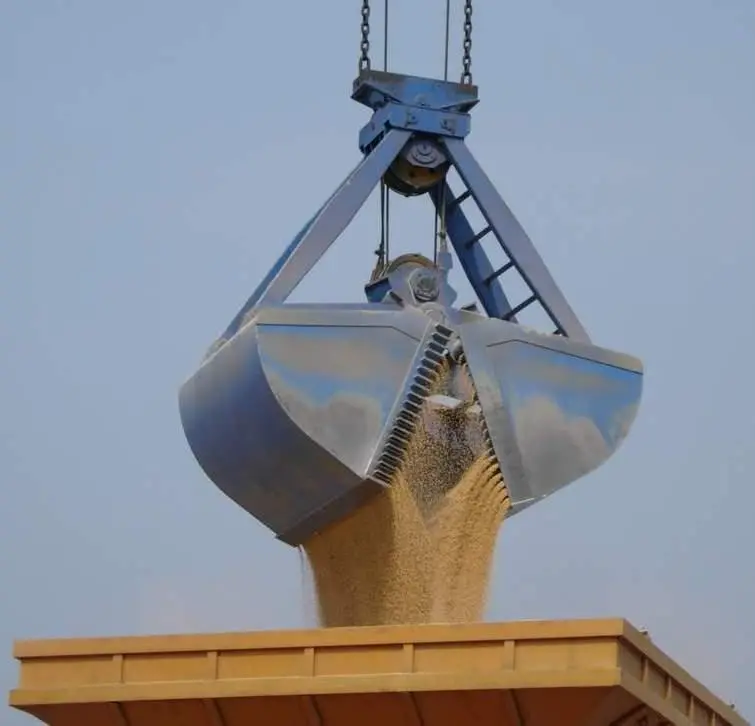
“If our client uses a geared vessel, we will specify what gear it must have on board so it is compatible with our own equipment. We do also hire mobile cranes and put them on the decks of vessels. Whether we use grabs or pneumatic equipment depends on a number of factors, most notably the discharge rate. Some clients also specify one or the other. However, in general, grain is easier to handle with pneumatic equipment,” says Mr Wilkes.
Grain handling equipment manufacturers also have to keep an eye on China, especially in a tighter market.
While Vigan believes that cheaper Chinese manufacturers are not that competitive yet on major projects, some Chinese suppliers may try to break into the market on smaller capacity machines that can discharge less then 100 tons per hour
However, questions remain regarding quality and reliability, says Vigan’sMr de Visscher.
In terms of what role reliability plays in securing sales of grain discharge equipment, Mr de Visscher says that this is a key factor. Vigan, he says, has proven this time and again by selling to major industry players, such as Cargill, ADM and Heineken group, to name but three. He also stresses the overall importance of maintenance in keeping units running.
“The key success factor is good management of the human and/or physical resources,” he says. “Pneumatic equipment is easy to use. In emerging markets, for example, we incorporate the simplest and most reliable components into the machines to ensure that day-to-day use of our equipment is never a major concern for our customers. The customers’ own technicians should easily be able to carry out routine maintenance, which in turn makes it simple for Vigan to efficiently service units as and when required.”
Nevertheless, he does concede that there may be some difficulties in certain geographical areas due to poor local availability of components and/or restrictions on the importation of spare parts, which some countries impose.
Asked as to what improvements can be made to pneumatic equipment to ensure a faster return on investment, Mr de Visscher says that many are possible and that all manufacturers are working on these. He lists better unloading efficiency and the reduction in all types of costs, namely those linked to energy, maintenance and personnel, not to mention getting the initial purchase price down and providing enhanced after sales service. Pneumatic unloaders, he adds, have to be as flexible as possible to make them as attractive as possible to potential customers.
Related Articles
 CONTAINER & CARGO HANDLING
 CONTAINER & CARGO HANDLING
 BULK HANDLING