![PortStrategy[GreenPort]](https://www.portstrategy.com/wp-content/uploads/2026/09/PortStrategyGreenPort.svg)






In the driving seat
The next generation of car carriers will place greater demands on terminal operations.
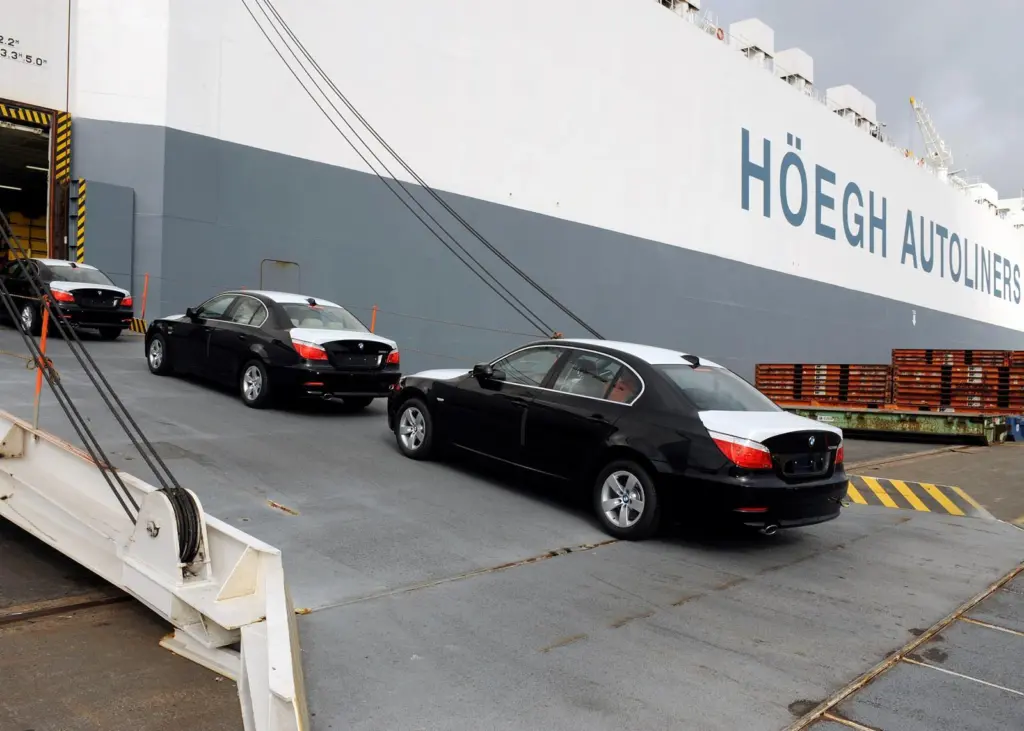
The shipping spotlight may be on container trades with the arrival of the first of Maersk Line’s 18,000 teu Triple-E ships but the challenges of dealing with a new generation of vessels is equally apparent in the niche world of vehicle trades.
As the next generation of car carriers come on stream, what are the implications for ports? Not only do the normal issues of draft, turning circle and 24/7 operations come into play as with other ship types, but there are other factors specific to the vehicle trade — yard space to store cars being one.
Plus carriers may wish to opt for value-added options such as pre-delivery inspections and vehicle-enhancement work which increases their footprint within the port boundaries.
Partly, the push in car carrier design is being influenced by the Panama Canal upsizing. Pure Car and Truck Carriers are volume-critical ships rather than weight-limited, so any opportunity to increase size is a major boost.
Ocean link
Former Wärtsilä Ship Power Technology’s head of conceptual design, Oskar Levander, predicted in an article in the Wartsila Technical Journal that car carrier design could perhaps be influenced even more than container vessels by a larger link between the Atlantic and Pacific oceans.
“Special purpose built car carriers were introduced in the 1960s, and have since taken on the very distinctive look that has remained more or less the same during the last decades … As there are limitations to the main dimensions, these ships have grown upwards with all corners stretched to the max, resulting in a very boxlike shape,” he wrote.
“With the larger locks in the Panama Canal due to be opened soon, the shipping industry is quickly approaching a new era. This expansion will change the PCTCs’ most critical limitation, the maximum allowed beam, which will increase from 32.2 metres to 49 metres. This will fundamentally influence the design of PCTCs, allowing new alternative concepts.”
Apart from beam size, the other major constraint has been a maximum length usually below 200 metres because of restrictions in Japanese ports. Taken together these parameters limit the deck area size, and in order to increase capacity and gain efficiency of scale benefits, the only option for the designer has been to add more and more decks.
Theoretically, the traditional PCTC can carry up to 6,500 cars, but recent years have witnessed some PCTCs with a capacity of over 8,000 cars. This has been achieved by increasing vessel length and the abandonment of the old Japanese port limit.
Next generation
Several of the main car carrying companies have responded to the opportunities offered by the Panama Canal upgrade by placing orders for next-generation type PCTCs.
NYK for example has ordered four, two of which will be built by Imabari Shipbuilding at its factory in Marugame city with technical assistance being provided by Mitsubishi Heavy Industries. All four vessels are scheduled to be completed in 2014 to 2015.
The new vessels are part of the investment plan contained in NYK’s medium-term management plan ‘More than shipping 2013’ and will be the first PCTCs to be built by the company since the onset of the financial downturn in 2008.
NYK expects the worldwide demand for PCTC transport to steadily expand and these new vessels will be up to three metres wider than current PCTCs.
Terminal task
Simply ordering bigger ships is only one part of the equation, however. Terminals have to be able to handle them.
From the carrier perspective, how do the major players see both the market situation and the relationship with terminals developing?
Höegh Autoliners recently placed an order with Xiamen Shipbuilding Industry for three next-generation PCTCs with options for more. The vessels will be post-panamax, with a carrying capacity of 8,500 cars and are to be delivered from 2015.
Höegh Autoliners chief operational officer Øyvind Ervik sees the supply/demand situation trending towards a relative balance. Operators have started to increase their newbuilding orders, despite an uncertainty in the market.
“The new vessel orders are larger than before, with the new post-panamax size coming to reality, and we can already see the tendency of large-size tonnage being placed in the East Asia to Europe trades, while medium-size tonnage is moving into short-sea and regional trades. This is a reflection of the more complex trade patterns that we see emerging amongst our customers.”
Wide load
In terms of the increase in size of PCTCs, Mr Ervik says the bulk of the newbuilding orders are keeping within the 200 metres length limit, and generally do not have larger draft, just wider beam.
While this alone will not have much operational impact on terminals, some ports nonetheless are “running out of time” when it comes to equipping overall to be able to accommodate the new post-panamax trend in PCTCs.
“Another aspect is that the small feeder vessels below 1,500 CEU [car equivalent unit] capacity, often with straight stern ramp, are being replaced by smaller or medium-sized PCTCs. These require the same berths as the larger ocean-going vessels, so some of the old pontoon berths and ro-ro berths become idle, and we see increasing demand for the regular berths.”
As for yard space to store vehicles, Mr Ervik says this continues to be a problem in many ports, and with larger vessels and larger loads this may be accentuated. “Car terminals generally create less throughput than especially container terminals, and are often not the favoured option for the landlord, so space shortage in car terminals is likely to continue to be a bottleneck.”
Asked if terminals are being pro-active in their planning for double-deck parking, he says there is a lot of emphasis on this but adds “we have still not seen enough projects come to fruition. At the end of the day it comes down to who does the investment, and how long contracts are being given out.
“Certainly municipalities benefitting from shore-based jobs should do more to create infrastructure supporting car manufacturing facilities.”
Quay challenge
From the terminal operator perspective, the pressures of changing trends are evident.
Xavier Vazquez, managing director of Autoterminal Barcelona, says his terminal has only had two wharves with sufficient capacity to berth the new vessels, and in some cases, only one.
“In the end, and due to the increase in size of PCTCs, the Port of Barcelona has allocated us two new wharves, one of them with a length of 331 metres, to be able to operate with these vessels.”
As for yard space to cope with the greater exchanges, he says Barcelona has sufficient space overall, but needs to adapt its work methods to the increased volume so that operations are not limited by lack of space in areas close to the berths.
Autoterminal Barcelona has also been proactive in planning for double-deck parking. Of the terminal’s 750,000 sq metres of concession, 460,000 sq metres are covered slots located in five multi-storeys, the first one built in 1998 and the last in 2008. In total, it has 25,000 covered slots out of a total of 40,000 vehicle spaces.
Says Mr Vazquez: “Autoterminal has had a value-added centre since 1996. At present, it has a 6,000 sq metre warehouse with two washing booths, a workshop with three paint cabins and nine preparation areas, a centre for film installation etc., all complying with the highest manufacturer’s demands.”
Dual purpose
Straddling both carrier and terminal role is Wallenius Wilhelmsen Logistics. The WWL logistics business model, focused on supporting customers’ supply chains from factory to dealer or end customer, has led to the company becoming both a terminal operator and a supplier of vehicle processing, ocean and inland transport.
WWL is another building post-panamax vessels, with two vessels ordered from Hyundai Heavy Industries due for delivery in 2014 and 2015. The agreement also includes an option to build another two vessels.
Announcing the order, Jan Eyvin Wang, president and chief executive of Wilh Wilhelmsen ASA (WWASA), said that while the new locks in the Panama canal can accommodate vessels up to 366 metres long, “our vessels must be able to call all ports where we load and discharge cargo. The vessels will have a car-carrying capacity equivalent to 7,930 CEUs, be 200 metres long and have a beam width of 36.7 metres, approximately 4.3 metres wider than today’s car carriers.”
WWL’s chief operating officer Kai Kraass says long-term underlying growth in the market is strong. This, plus the need to increase efficiency as well as meet environmental regulations, is fuelling the industry shift to bigger vessels.
“Size is a big efficiency driver when it comes to cost per unit transported, and vessels in the 8,000-CEU size will be the new normal.”
Turnaround targets
Currently, WWL’s 13 terminals around the world can cope with any size of vessel but Mr Kraass says that moving forward, the turnaround time in ports needs to be significantly reduced, meaning that operations need to be more efficient and agile.
“I believe terminals will need to provide 24/7 services. There is also more to be done on the IT side to optimise loading, discharge and stowage planning; tracking as well as visibility technology, and KPI reporting needs to develop.
“Environmental regulations will also mean increased demand for services such as underwater propeller cleaning, bunkering of low-sulphur and alternative fuels, waste management, etc.”
He says terminals today have an increasingly-important role in helping customers balance supply and demand in a region, so space is crucial.
“A good terminal should be scalable and flexible enough to cover seasonality and extreme market variations. For example, we operate hub services on our terminals in Panama, Zeebrugge and Singapore. Using a distribution hub, the customer can ensure a steady production flow and short delivery times to end market despite unpredictability of demand, maintain and customise the product.”
Mr Kraass says some WWL terminals already have double-deck parking and the company is looking at increasing space in the future in this way.
A key challenge, says Mr Kraass, is for ports and terminals to work closer together to find efficiencies and deliver service quality across the operations.
“It is not enough that one service is delivered perfectly if the next is not ready to take over or causes cargo damage. We are concerned with having a smooth service from pilot to pilot and how we can optimise that entire process, and not just the parts.
“A really good terminal functions as a lead terminal provider to get the smoothest process and highest efficiency. We need to follow the same thinking as the airline industry when they radically reduced ground time.”
Related Articles
 CONTAINER & CARGO HANDLING
 CONTAINER & CARGO HANDLING
 BULK HANDLING