![PortStrategy[GreenPort]](https://www.portstrategy.com/wp-content/uploads/2026/09/PortStrategyGreenPort.svg)



Iron Grip
Stuart Pearcey discovers that burgeoning demand for iron ore is having a monumental impact on port development in China and Australia
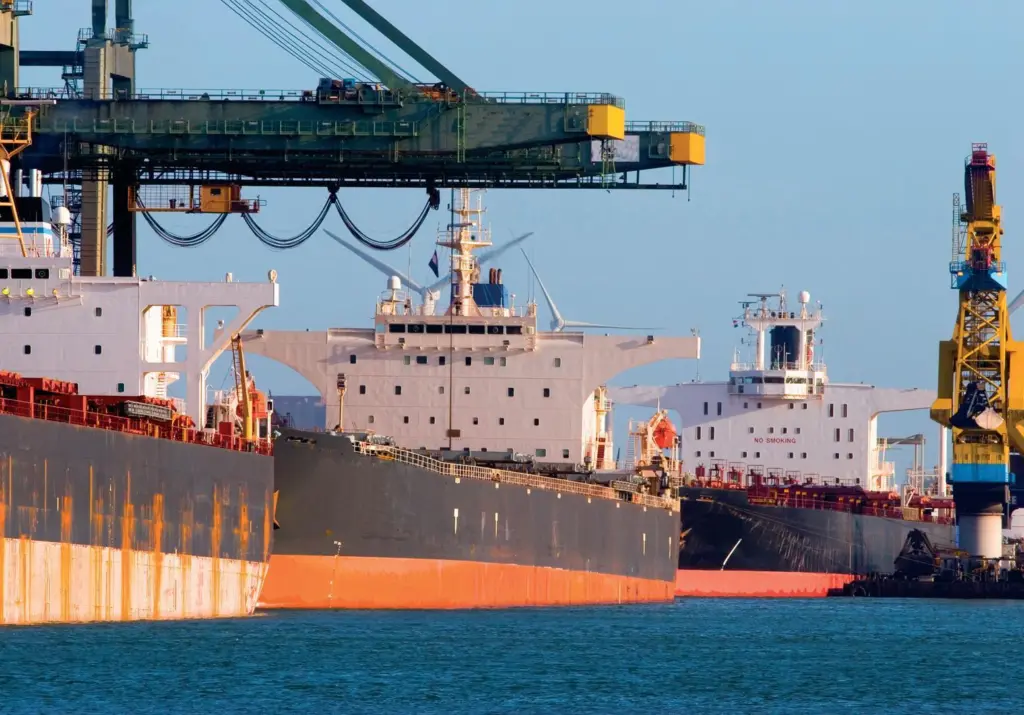
The vortex of China’s economic development is sucking in raw materials at an unprecedented rate.
The breakneck speed of growth that turned it into the world’s economic centre of gravity – about 10% a year – is entirely dependent on steel, without which nothing can be made or moved.
But there can be no steel without iron ore and coal, and the means of production of one is often on an entirely separate continent from the other.That means ships and ports could become an unwilling bottleneck in the race for growth; a fulcrum around which the rate of development will be sustained or restrained as steelmakers seek to shuttle large bulk cargoes around the globe.
The scale of the increase in demand for steel lies at the root of the problem, and is in part the cause of the feeding frenzy of ships waiting for coal off Newcastle in Australia,or for iron ore off Brazil.In either case,the wait for a cargo was last month predicted to be as much as three weeks.
China’s consumption of steel is forecast to rise by more than 8% a year for at least the next three years. That amounts to 33m tonnes – and that’s just the extra production. The country’s consumption of the ubiquitous metal is part of increasing global demand, meeting which is exercising the minds of all steelmakers.
So how big is the demand shift; how big the shipping mountain to be climbed? Cue the Iron and Steel Statistics Bureau (ISSB),keeper of data on the steel industry worldwide.Their comprehensive figures reveal that in 2006 China made almost 420m tonnes of steel, getting on for four times what it made as recently as 1997.Asia as a whole doubled its steel output over the same period. It’s hardly surprising that China overtook Japan as the world’s largest buyer of iron ore during the decade.
The biggest ore supplying countries (of the 100-plus for which the ISSB keeps records) are Australia,at 250m tonnes, and Brazil at about 230m tonnes. Output from both has doubled in the last decade – and there’s no sign of a slowdown. Together they account for 36% of the world’s current output. A 14% ‘contribution’ from India means those three supply half the world’s production.
So what’s the solution, from a shipping point of view? Steelmakers are strangled with no secure ore supplies. Their response is to seek alliances with suppliers, to build their own ports for import and export and to do deals with shipping companies to secure their supply chains.
There are numerous iron ore port developments just completed, under construction or planned. Caofeidian is China’s newest and largest, with a deep natural channel allowing straightforward access for bulk carriers. It opened for production in February after a build time of only 19 months, and will eventually share this part of north-east China with berths for unloading coal, crude oil and gas, oil storage, a petrochemical plant – and a steel mill.
Chinese importers are also turning to the Yangtze River, which is navigable for 1,700 miles. Seven provinces lie alongside the navigable section,are home to 400m people, and account for almost half of the country’s gross domestic product and even more of its growth.
On its lower stretches, the Port of Nantong is typical, becoming the focus of investors because it can handle ocean-going ships, but isn’t as expensive as the coastal area.
An efficient new ore terminal opened there last year. Almost half of it is owned by the PYI Corporation,based in Hong Kong.They’re looking to capitalise on the fact that traditional bulk cargoes don’t suffer from the time pressure created by the slow speed of river traffic as much as more valuable containerised items.
Meanwhile in Australia, BHP Billiton, the world’s biggest mining company, is gearing up for a $2.2bn investment to create a new mining and exporting port to allow it to meet the Chinese demand, and mining company Rio Tinto has approved a £860m ($1.7bn) expansion of its exporting port in Cape Lambert. That will allow it to ship 220m tonnes a year by the end of next year.
In India, Korean steelmaker Posco was last month given environmental clearance for the captive port dimension of its proposed $12bn Orissa steel plant development.The company wants to establish a port at Jatadhari with more than two miles of berths, almost half of which will be used to unload ore carriers. The Indian government slapped a $7-a-tonne tax on exports of ore earlier this year, and a dozen Chinese steelmakers decided to shop elsewhere as a result. Similar port developments are being built elsewhere, like Ennore in southern India, or at Sepetiba, south of Rio in Brazil.
But none of that is of any value without ships. The cost of transporting goods by sea, said to be up 67% so far this year already by some analysts, has seen the Baltic Exchange’s capesize index rise to a daily rate of more than $114,000. Little wonder then that in spite of the cost of a new bulk carrier being up by 30%, there’s no slackening of demand. Hyundai Heavy Industries said in April it had received orders for a further 47 vessels, taking its backlog to 270 ships valued at $26bn, and representing three years’production.
The world’s largest iron ore mining company, Cia. Vale de Rio Doce in Brazil,is drawing higher values from vessels carrying ore to China by filling them with coal on the return trip, and using that to fuel its own power generation.
The vessels involved will be operated by Japan’s largest shipping line, Nippon Yusen, with whom Vale has signed a 20-year contract to carry iron ore from Brazil to China,which will see it carry 1.3m tonnes a year from 2011. The Japanese company has at least five similar deals with Chinese steelmakers.
Phil Mitchell, managing director of development at Rio Tinto, put the burgeoning demand for ore into context when he said:“China is building from scratch a city the size of Brisbane every month.Every month! And our iron ore is fuelling that phenomenon. Expansion is a necessary part of the response to the demand situation.”
That comment clearly proves what Rudyard Kipling wrote a century ago:“Gold is for the mistress, silver for the maid; copper for the craftsman, cunning at his trade.‘Good!’, said the Baron, sitting in his hall,‘but iron, cold iron, is ruler of them all’.”
Related Articles
 CONTAINER & CARGO HANDLING
 CONTAINER & CARGO HANDLING
 BULK HANDLING