![PortStrategy[GreenPort]](https://www.portstrategy.com/wp-content/uploads/2026/09/PortStrategyGreenPort.svg)






Longer horizon
Potis a good yardstick of what’s happening on the eastern side of the Black Sea, finds Stevie Knight.
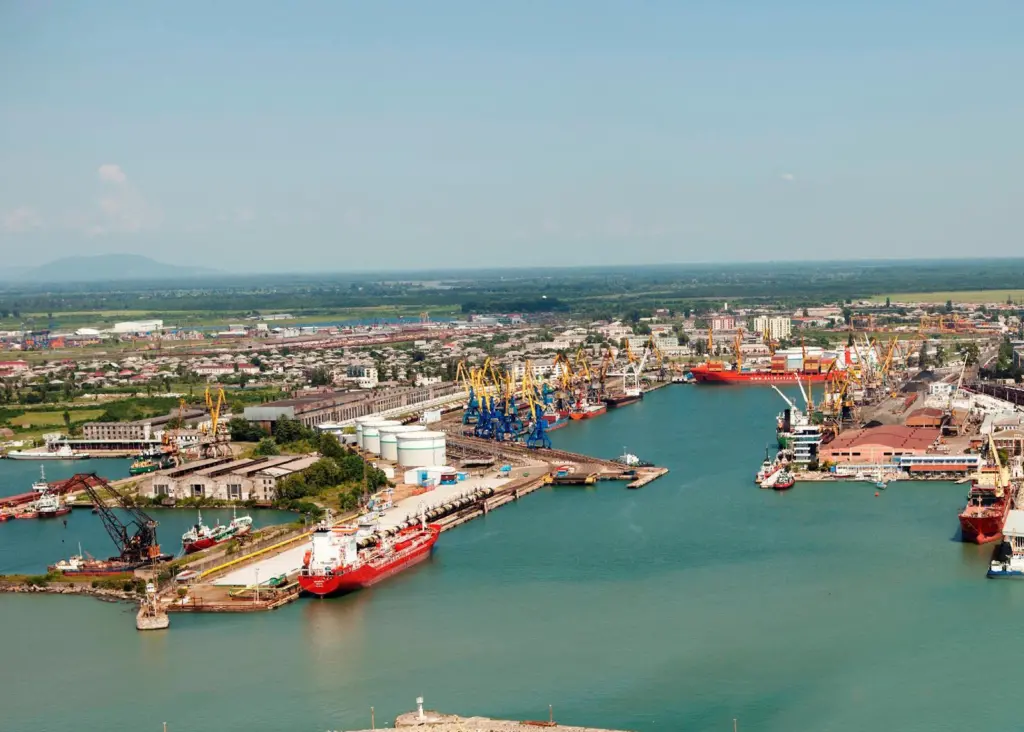
When APM Terminals’ purchased Georgia’s main gateway it was a firm, considered investment: after all Poti takes around 80% of the country’s volumes which stood at 450,000 teu in 2014. However, things have changed.
Beyond the well-publicised political developments, the fall in the oil price has also hit the region hard.conomies have been badly hurt. “How long this depressed market will continue we really don’t know”, admits APMT’s Klaus Laursen.
Despite all this he believes there’s more to the region’s overall buoyancy than is presently showing through the present gloom: “Poti is strategically well-positioned for the medium to longer term,” he says, adding he expects the region to swing back “as economies have their ups and downs”. Having said that, he points out a resurgence in oil would help as in the past this has been one of the region’s underlying drivers.
With all this in mind, what is happening to APM Terminals’ expansion plan? This involved building a new breakwater and two deep water berths just to the north of the existing terminal. These berths would be able to accommodate 9,000 teu vessels and, along with associated infrastructure on the land side, the development would give Poti an annual throughput capacity of 1m teu.
As Mr Laursen points out, at the moment the port is running at something less than half full, so while those deepwater berths are “still on the books” he adds “the need for more capacity is not there in the short term“.
Still, he explains that the land side development is already well underway. APM Terminals has already invested over $70m since taking over the port back in 2011: “We have put a lot into the back of the yard: there are full container services built to international standards in an offdock site along with around 300 reefer plots in a modern facility just waiting to go, so we will be able to give chilled goods their proper treatment. We are just not onto the quay wall itself, we don’t think that it’s needed yet.”
Potential markets
He sees Georgia as having a largely untapped foodstuffs export potential and Georgian wines could be on more menus, a move “which Poti could help support”. Further, Mr Laursen believes that Poti could eventually go beyond serving the Georgian market to take in services destined for Azerbaijan and Armenia.
A more immediate market is the north of Iran. This also has “potential” he says, as cargo could transit via Tbilisi and Azerbaijan on a fairly short overland route.
However, Mr Laursen says the country’s re-emergence onto the international market “is also a threat” to Poti’s development: “Iran may be opening up but it also has its own ports… Bandar Abbas could well attract some of the cargo we’d like to compete for.”
There is a promise of even stiffer competition closer to home. The neighbouring Anaklia port promises to woo calls away from Istanbul which has transhipped Georgian cargo up till now. The $2.5bn project will consist of 2.5 km of port waterfront with the deeper water it needs to accommodate direct calls and a 600 ha free zone, all backed up by a $100m infrastructure upgrade which includes an 18-km-long railway to connect the port to the national rail network.
But is it realistic? Although the Anaklia Development Consortium has said the port will be open for direct calls by the start of 2019, Mr Laursen points to the region’s gloomy prospects: “The market is around 350,000 or 400,000 teu maximum… it’s a typical feeder region – with no transhipment.”
By contrast, he says: “Our upgrade in Poti is a tenth of the cost and it could get going much more quickly and easily. As I see it, Anaklia needs roads and rail putting in before it could start to move cargo, leaving a huge amount of infrastructure development for the country to do. It’s difficult to see how that stacks up now, at least from a commercial point of view.”
However, politics may again be leading the agenda; it’s an election year after all.
Related Articles
 CONTAINER & CARGO HANDLING
 CONTAINER & CARGO HANDLING
 BULK HANDLING