![PortStrategy[GreenPort]](https://www.portstrategy.com/wp-content/uploads/2026/09/PortStrategyGreenPort.svg)






Maritime crane transport article
Are there too many port cranes and not enough transport options? Opinion is divided as Alex Hughes finds out

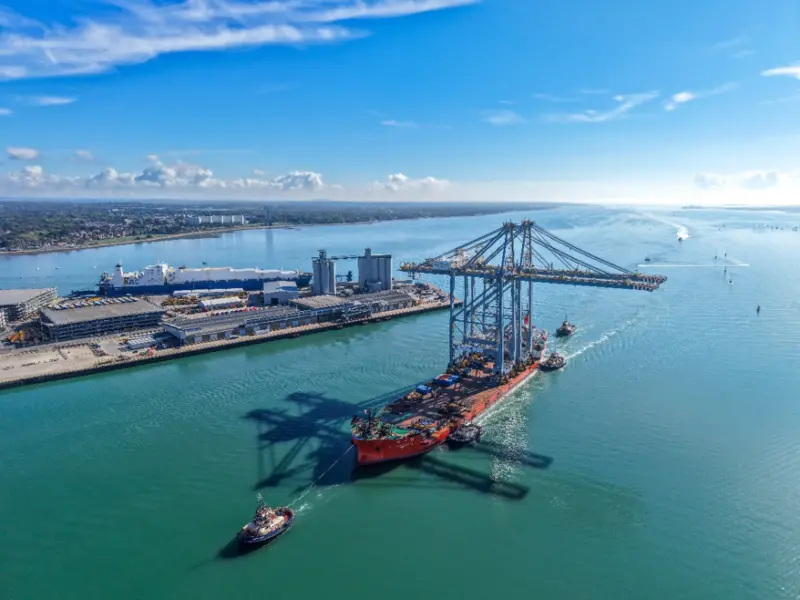
In recent years, crane manufacturers have risen to the challenge to meet an unprecedented rise in the number of maritime cranes being ordered by port terminals around the globe. But while crane manufacturers deserve their pat on the back, the maritime transport industry seems to be playing catch up with too few ships available for crane moves. Equipment specialist Portek explains that the buoyant off-shore oil and gas industry has had a major impact on resources available for the maritime transport of cranes around the globe. This is because the same project cargo vessels are used by all of these similar maritime industries. And while some crane manufacturers, such as ZPMC, have dedicated vessels to fulfil their deliveries, most do not.
“The transport cost of cranes has therefore significantly increased given the competition for the same resources, coupled with the increasing fuel price and burgeoning crane orders,” says executive director Boon Hoe Ooi. “In the last few years, freight rates have gone up by more than 100%, which in itself is a clear indication that resources for delivering cranes are insufficient.”
This is a major headache for crane refurbisher Portek, since the company does not possess any of its own vessels; it hires third party-owned ships in order to make its deliveries.
However, Maarten Guyt, marketing manager of Jumbo Shipping takes a middle view, acknowledging that capacity in the heavy lift market is currently tight, but saying with good cooperation and strict planning, shipments are being made in the desired delivery windows.
“Within Jumbo, new building programmes are a significant part of our strategy, with two new “J” class vessels to be launched within the next 8-9 months,” he says.
Meanwhile, Peter F Poulsen, sales & marketing manager of specialist transport company K/S Combi Lift, takes the high ground. He believes that just as the number of port cranes on order has shot up, so to has the amount of tonnage available to carry them.
“We have increased our own tonnage capacity. Furthermore, by building vessels like the new “combi dock” type, we have also increased the flexibility of the tonnage to suit the demands of our clients. Moreover, we are planning additional heavy lift vessels which are considered highly suitable for the transport of port cranes and equipment,” he says.
With those differing views in mind, Port Strategy asked all three industry players to predict whether, in their view, the market for maritime cranes would continue to grow.
In his response, Mr Poulsen notes that there does not appear to be any sign of a slowdown in port expansion, concluding that there will probably be a steady demand for port cranes and equipment over the next couple of years. Mr Guyt, for his part, points out that markets will always fluctuate and that it is up to companies like Jumbo Shipping to anticipate both demand and supply and react accordingly.
Given the current existence of very real impediments on the movement of cranes by sea experienced by Portek, Mr Ooi does not seem to believe this will have a direct impact on the container industry’s ability to keep on expanding. Indeed, he says that world container throughput has been increasing irrespective of much graver handicaps, such as the performance of the global economy. The only major change in periods of recession, he says, is that the overall rate of increase slows.
“The demand for new equipment will definitely be affected by other factors as well, such as increasing vessel sizes, the cascade effect as larger vessels displace smaller ones across the various segments of the container market and the resultant reinforcement of hub-and-spoke patterns. Although a possible slowdown in the world economy may dampen the rate of increase of container throughput over the next few years, it may also be an opportunity for ports to undertake expansion plans as resources are freed up due to a cyclical downturn in demand for such resources,” says Mr Ooi.
The market for refurbished equipment, in which Portek is primarily involved, could be a beneficiary of all these factors, especially the cascade effect of ship sizes coupled with increasing throughputs. The impetus for smaller feeder ports to use larger, refurbished equipment previously deployed in hub ports is also there. Competition among different feeder ports to become the “feeder port of choice” will mean that they too will need bigger cranes to service bigger “cascaded” ships now plying feeder routes.
“Larger, refurbished cranes could be made available immediately, transported and installed by niche players such as Portek much faster and at more competitive costs than ordering a new crane,” he says.
In terms of the size of consignments to be shipped, enquiries to Combi Lift usually involve moving up to three cranes at a time. Clearly, it is always more economical to transport three units instead of just one because of the spread of costs this involves. However, with the putting into service of its new Combi Dock vessels, 8-12 quayside cranes – depending on type and model – can be transported, adding considerably to the company’s flexibility.
As for Jumbo Shipping, while the company can move single cranes for customers, it points out that it is invariably more economical for both customer and supplier to ship units out in multiple where possible. Despite the awkward nature of dock cranes, neither Jumbo Shipping nor Combi Lift believes this poses particular problems during the maritime portion of the their delivery to the end user. However, not all ports are easy to access, while some very clearly have draught limitations to take into account. So how do specialist companies get around these problems?
Combi Lift says its vessels have been designed specifically so that they can call at ports either having severe draught restrictions or proving somewhat awkward to access during low tidal conditions. This makes them ideal for deployment in brand new ports, where dredging may not have been fully completed, or in habitually shallow draught environments.
Responding to the same question, Mr Guyt observes: “If a site within a port is difficult to access, our total transport concept assures safe on site offloading; this is based on many years of customised tailored solutions.”
However, finding sufficiently qualified crew in the maritime crane transport market remains challenging.
Combi Lift, for its part, recruits skilled personnel directly from the open market, and has a policy of training up its own people. “Our four “combi dock” vessels will therefore be equipped with a classroom and additional quarters to allow trainees to be accommodated on board,” says Mr Poulsen.
Mr Guyt acknowledges that manning ships these days is more difficult than it once was, agreeing that the best people are always in demand. However, Jumbo Shipping uses its solid reputation, working conditions and customer-focused way of working as a means of attracting good crew, he says.
In respect of competition, Mr Poulsen comments that there are about five or six major carriers that have the type of vessel fleet able to transport maritime cranes. Competition in the industry has always been there and will be there in future, stresses Mr Guyt. What differentiates Jumbo from the rest is the enormous amount of preparation it does before lifting and shipping heavy lift cargo, he claims.
Related Articles
 CONTAINER & CARGO HANDLING
 CONTAINER & CARGO HANDLING
 BULK HANDLING