![PortStrategy[GreenPort]](https://www.portstrategy.com/wp-content/uploads/2026/09/PortStrategyGreenPort.svg)





Moving up a gear
With many car manufacturers facing tough times, its no surprise that this filters through the supply chain, leading to significant pressure on port and stevedore rates. Felicity Landon finds out what the customers want – and how the ports are working to deliver it What must ports provide for their vehicle trade customers?
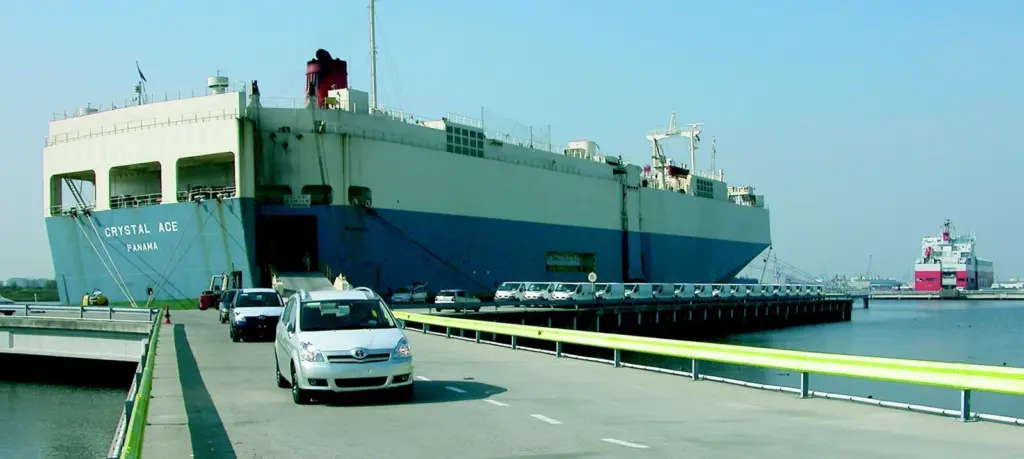
Roy Postlethwaite, the UK director of vehicle carrier and ro-ro operator Grimaldi, succinctly sums it up: “At the end of the day, we want competitive rates, we want quality and we want fast turnround, ” he says. “A lot of the car manufacturers are going through difficult times. They are looking for good economics – in other words, very competitive rates. They want rates held.
“So likewise, we [the shipping lines] are putting ports under pressure to hold their rates, because we can’t get anything more from the manufacturers. In general, it is appreciated by all concerned that this is a difficult time for the manufacturers; in that way, the ports do come to the party and work together and rates have been kept down.”
For its part, Grimaldi is building faster, newer, more economical vessels to try to keep its own costs down, he says. “Of course, we need the ports and stevedores to make the same effort. But it is difficult because it is a labour-intensive industry and with human recourses it is not quite so easy to cut back costs.”
Others report a less sympathetic response from the ports. One industry source, who doesn’t wish to be named, says: “This is a very fast-moving trade and generally what we want is stability of pricing.
But the ports don’t bring the prices down – they put prices up all the time. The car manufacturers are looking for a reduction in prices all the time and it is our port costs that give us problems. We battle with them [the ports] every year on stevedoring and other charging.”
The increasing complexity of the global car trade will take a new shift in due course with the emergence of China and India as major car manufacturing centres, and ports are keeping a close eye on changing patterns as they work to maintain their positions in the market.
Numbers breed numbers: Zeebrugge, for example, is Europe’s undisputed top port for vehicle trades, handling 1.735m units last year and already reporting a 5.5% increase in the first quarter of 2006. It is now at the centre of a huge network of deepsea and shortsea connections, and acts as an important hub which enables shippers and shipping lines to reduce their logistics costs, says Port of Zeebrugge managing director Joachim Coens. He expects continuing growth in vehicle numbers.
“We originally came from a position in the midst of production and consumption; we have developed to the position where we are a transhipment hub, with different car manufacturers worldwide importing and exporting different types of cars through the port.
“We have a network of the different operators, so they can save on their costs by bringing cars from South Africa to the United States via Zeebrugge.”
The other trump card Zeebrugge can play is space; while many European car ports are truly squeezed, the Belgian port continues to expand its car areas and has yet more land available.
Having said that, Zeebrugge is no keener than others to see its valuable land used as a long-term car park.
“We also have concerns on land use; it must be used efficiently, ” says Mr Coens. “We insist on rotation agreements in contracts. We can’t have land just stacked with cars standing there for years – we need a minimum rotation. Also, car centres [such as PDI operations] are an important issue because they create employment and generate more revenue from the land.”
Related Articles
 CONTAINER & CARGO HANDLING
 CONTAINER & CARGO HANDLING
 BULK HANDLING