![PortStrategy[GreenPort]](https://www.portstrategy.com/wp-content/uploads/2026/09/PortStrategyGreenPort.svg)





multidocker
The promise of greater efficiency and a better safety record is giving hydraulic material handling equipment for ports a boost in market share, according Fredrik Ö sterströ m, product manager of Swedish manufacturer Multidocker.
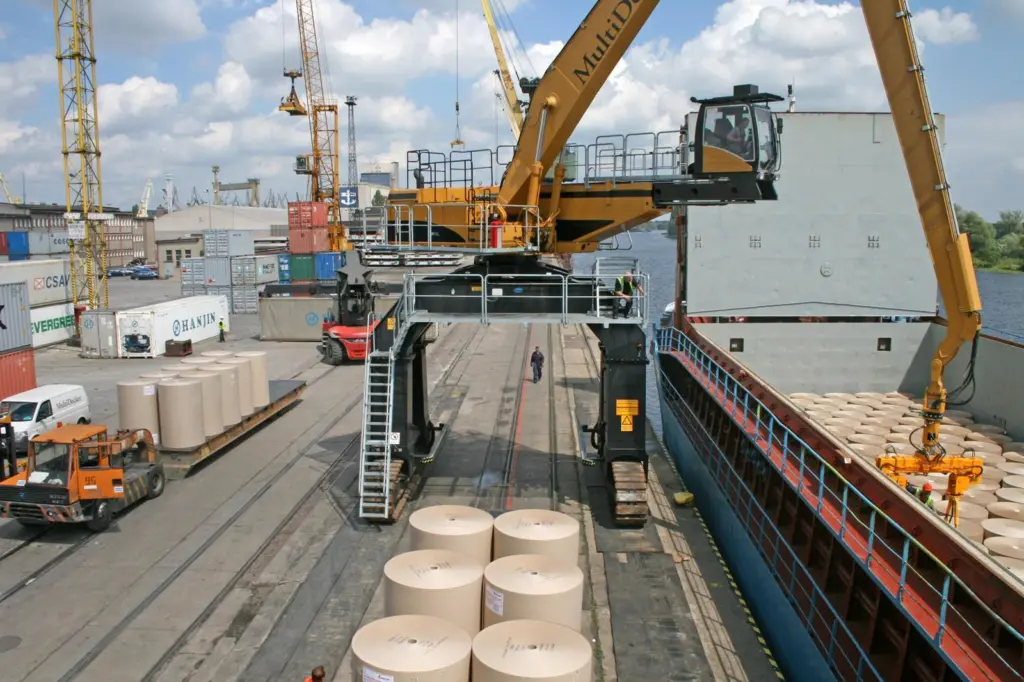
“Because there are no ropes, it is therefore easier to place cargo more precisely, so there is less damage. For every one cycle that a luffing jib crane undertakes, a hydraulic machine will achieve three, albeit with possibly less material with each cycle,” he says.
It is also easier to learn to operate a Multidocker crane than a traditional luffing jib crane, claims the manufacturer, because the operator can actually feel the load they are lifting through the levers that they manipulate, whereas a rope crane operator doesn’t immediately feel the weight of the material on the end of the rope and has to learn when to stop the swing function.
“Multidockers are most suitable for dry bulk vessels of up to 12,000 dwt-15,000 dwt; in some case 18,000 dwt vessels can be handled too. In addition to bulk and breakbulk cargo, this equipment can also handle some project cargo,” says Mr Österström, although concedes that a dedicated container terminal would probably not buy a hydraulic unit, since containers are not best suited for this type of machine.
Maintenance costs are said to be similar for hydraulic cranes and luffing cranes, although the former is claimed to be much cheaper to operate. And with a greater speed of loading, tonnage moved is higher. But the crucial saving is in manpower, says Multidocker.
“We have a client loading wood pulp in Sweden. At the moment, they have geared vessels/cranes on board their vessels. They need 10 people per loading operation: two crane operators, four people in the cargo hold and four people on the quayside. With a Multidocker, you just need the crane and an operator. This cuts personnel costs from ¢400 ($520) per hour to ¢200 ($260) simply by switching to a hydraulic unit.”
Return on investment can therefore be pegged at five to seven years, whereas to recoup the cost of a rope crane could take twice as long because of greater capital costs and less impressive performance.
“A Multidocker will remain in service for at least 10 years. However, because product development is moving very fast, investing in a crane for 25 years is not always a good idea. Look at quay cranes from the 1980s; they are antiques compared to a modern cranes and not very efficient. Buying a smaller and cheaper machine for a 10-year period can make an awful lot of sense!” says Mr Österström.
Related Articles
 CONTAINER & CARGO HANDLING
 CONTAINER & CARGO HANDLING
 BULK HANDLING